Key Points
- Accelerating de-dollarization: Global central banks are repatriating gold reserves while the Bank of Japan raises rates to 1%, signalling a historic redistribution of monetary power.
- Tech capital on the move: NVIDIA issues bonds worth 4 trillion yen while United Airlines' airborne luxury offering reshapes global private capital spending flows.
The Great Reset: Gold, Yen and Chips Rewrite the Rules of the Game
June 2026 is proving to be a month of powerful signals — almost brutal in their clarity. Those who watch the markets closely can see a coherent narrative emerging beneath seemingly disparate events: a rate hike in Tokyo, central banks repatriating gold, NVIDIA raising financing in yen. These are not isolated occurrences. They are symptoms of a global monetary system in profound transition, and understanding how they connect is precisely the kind of work no algorithm will do for you.
The Bank of Japan Breaks a Thirty-Year Taboo

Let us start with the most disruptive data point. The Bank of Japan has raised interest rates to 1%, a level the country has not seen in decades. For a nation that lived through the era of negative rates — where the cost of borrowing fell below zero — as though inside a crystal bubble, this represents an epochal break. The immediate consequences are already visible: the yen is strengthening, the carry trade (borrowing in a low-cost currency to invest elsewhere) is unwinding, and capital that spent years fleeing Japan in search of better returns is beginning to reverse course. Those who had bet on the structural weakness of the yen are now scrambling to cover their positions.
NVIDIA Bets on the Yen Itself
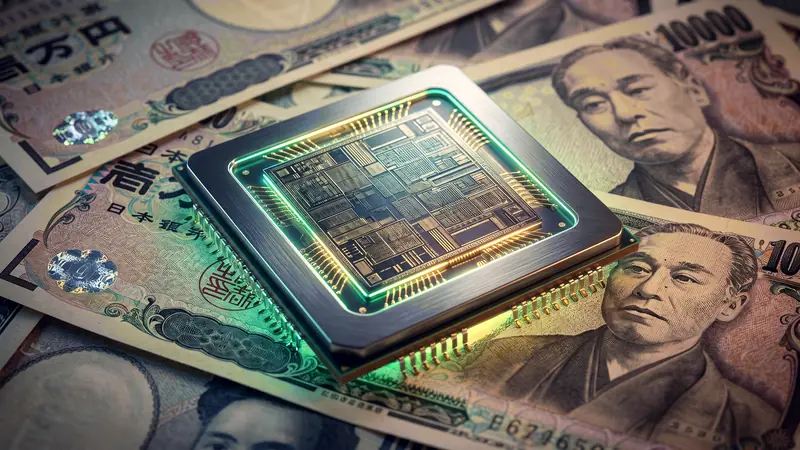
And this is where the story gets interesting. NVIDIA has chosen this precise moment to issue yen-denominated bonds — debt securities that companies sell to investors — at a record value of 4 trillion yen, equivalent to approximately 27 billion dollars at current exchange rates. The timing is no coincidence. Raising financing in yen while the currency is appreciating means NVIDIA is essentially betting on its own ability to generate returns above the cost of its debt, while also diversifying its currency exposure away from the dollar. A semiconductor giant — a maker of microchips for artificial intelligence and graphics — financing itself in Asia sends a clear message: the centre of gravity of the tech economy is shifting.
Gold as a Vote of No Confidence
The context in which NVIDIA is operating is one of de-dollarization — a reduction in dependence on the dollar within global reserves — that is no longer a conference-room theory but a documented fact. Central banks around the world are accelerating the repatriation of their gold reserves, withdrawing them from vaults in New York and London. Physical gold returning home is a political act as much as an economic one: it signals that governments trust Western custodial institutions less and want direct control over their own safe-haven asset — a store of value that holds up in times of crisis. In this scenario, the dollar does not collapse, but it is slowly losing its monopoly on global trust.
Luxury Takes to the Skies — Literally

While the great monetary balances are being redrawn, private capital continues to seek out premium experiences. United Airlines has unveiled its new luxury cabin aboard next-generation Airbus aircraft, featuring private sliding doors and dedicated snack bars. This is not merely marketing: it is an economic indicator. When airlines invest heavily in the premium segment, it means demand for high-spend travel is robust — that the global business class continues to move, to do deals, to consume. Airborne luxury is a proxy, an indirect indicator, of the health of international mobile capital.
Infrastructure and Financial Literacy: The Building Blocks of the Future
We close with two signals that look to the longer term. Hà Nội has announced an ambitious transport corridor along the Red River and National Road 1A: physical infrastructure that is transforming Vietnam into an increasingly competitive logistics hub — a node for the movement of goods and people — in South-East Asia, precisely as global supply chains are being redrawn away from China. Meanwhile, in Thailand, the MASTER PROTECT & WEALTH BOARD GAME HACKATHON 2026 is rewarding those who can teach personal finance through a board game. It may sound like a minor story. It is not: an Asia that educates new generations in money management is an Asia that is building its own investing middle class, reducing dependence on traditional bank savings.
The common thread linking Tokyo, Paris, Hanoi and Santa Clara is a single one: the old monetary order, built on dollar supremacy and zero interest rates, is giving way to something more multipolar, more fragmented — and for that very reason, richer in opportunity for those who can read the signals before everyone else.