Key Takeaways
- Private capital meets AI: KKR, Nvidia and Vistra launch a $10 billion joint venture for AI infrastructure, signalling a new phase of industrial consolidation.
- Europe accelerates: France, the EU and Germany are moving in parallel with public and private investments to avoid missing the train of technological sovereignty.
The Great Capital Rerouting: Why 2026 Is Year Zero for AI Infrastructure
There is an invisible thread connecting Wall Street to Berlin, Paris to New Delhi, running through the fabs (semiconductor factories) of Taiwan. In June 2026, that thread grew thicker, more visible, almost impossible to ignore. Global capital — the patient kind, the institutional kind, the kind that thinks in decade-long horizons — has stopped betting on artificial intelligence as an abstract idea. It has begun building, brick by brick, the physical and financial infrastructure that will sustain it. And it is doing so at a speed that has no precedent in the recent history of technology.
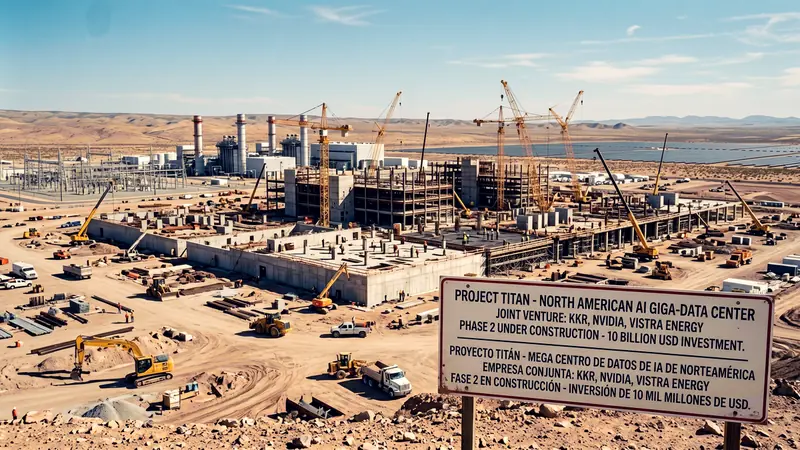
The most powerful signal comes from the United States. KKR, the private equity giant (funds that invest in unlisted companies), has announced the launch of a $10 billion AI infrastructure company in partnership with Nvidia and Vistra, one of America's leading energy operators. The trio is no coincidence: Nvidia brings the chips and computational know-how, Vistra guarantees the energy needed to run data centres (large-scale data processing facilities), and KKR provides the financial structure and the ability to aggregate institutional capital. It is, in essence, the blueprint (a replicable operational framework) of industrial AI: silicon, electricity and patient money fusing into a single entity. Ten billion dollars is not a speculative investment. It is a declaration of intent about where value will be built over the next twenty years.
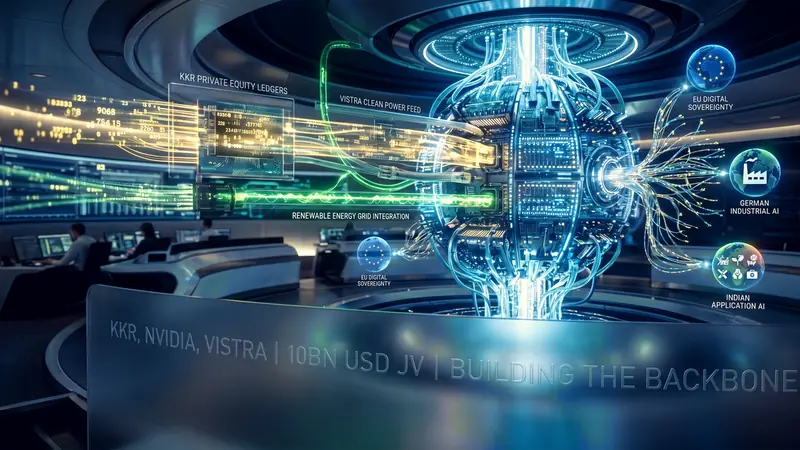
While America builds with private capital, Europe responds with the public lever. France has announced an investment of €655 million in artificial intelligence, with the stated goal of strengthening national competitiveness and developing homegrown models and technologies. It is not a huge number in absolute terms, but it is a precise political signal: Paris has no intention of allowing technological dependence on the United States and China to become structural. In parallel, the European Union is working on a dedicated investment fund for AI and semiconductors, with the aim of building a European chip supply chain that reduces the continent's geopolitical vulnerability. The watchword is digital sovereignty (European control over data and technologies), and it is no longer mere rhetoric: it has become a budget line.
In Germany, the shift can be felt even at the microeconomic level. Quoniam, an asset manager (professional portfolio manager) headquartered in Frankfurt, is redesigning its internal structure around artificial intelligence. The forecast is clear: smaller teams, decision-making processes increasingly delegated to algorithms, and a human role that shifts from operational management to strategic oversight. It is an emblematic case of how AI is rewriting not only financial products, but the very organisation of work in the sector. A German investment fund, meanwhile, has put forward a contrarian thesis set to spark debate: the real winner of AI in 2026 is not Nvidia, but TSMC (Taiwan Semiconductor Manufacturing Company, the world's leading manufacturer of advanced chips). The argument is solid — without TSMC's wafers (thin silicon discs on which chips are etched), no Nvidia GPU physically exists — and it reflects a growing analytical maturity in the way the market reads the artificial intelligence value chain.

On the Asian front, India is moving with pragmatism. Indian companies are adopting vertical AI solutions (applications specific to a single industrial sector), with a focus on productivity and the reduction of operating costs. This is not the race for foundation models (base AI trained on enormous quantities of data) that characterises the US and China, but a widespread, sector-by-sector adoption that could prove, in the medium term, equally transformative. India is playing the application card, not the invention card — and historically, in technology, that is not a losing hand.
Against the backdrop of all this, Elon Musk has crossed the symbolic threshold of one trillion dollars in personal wealth, becoming the first individual in history to reach this milestone. It is a figure that should be read not as financial gossip, but as a thermometer of an era: the concentration of value within the tech ecosystem is unprecedented, and it raises urgent questions about governance, redistribution and power. The great capital rerouting towards AI is under way. The question is no longer whether it will change the world, but who will have a say in deciding how.