Some cuisines explain themselves. And then there is Thai cuisine, which you feel — before you even taste it. It speaks through sound: the violent sizzle of boiling oil, the crackle of garlic hitting scorching iron, the hiss of steam rising like a breath. Sanh knows this well. And when she describes her dishes, she does not list ingredients — she tells emotions. Three preparations. Three acts of a domestic theater in which fire is the absolute protagonist and happiness, her word, is the only declared goal.
Key Takeaways
- Authentic Thai cooking is not Michelin-star restaurant technique: it is high heat, fresh ingredients and precise intention — shrimp, morning glory and eggs become emotional acts, not recipes to execute.
- Wok hei (literally 'breath of the wok', the smoky note from an extremely high flame) is impossible to replicate on low-power home stoves: either you push the heat to maximum or you are just stir-frying sad vegetables.
- Sanh's philosophy is an anti-performance manifesto: cook what you want, with what you have, without justifying yourself before tradition — the freedom of desire as the only gastronomic compass.
ACT I — SALT AND CHILI SHRIMP: The Sound That Heals the Soul
Everything begins with a simple conviction, almost disarming in its honesty: 'because it is incredibly delicious.' There is no other justification. No other justification is needed. Stir-fried shrimp with salt and chili are one of those dishes that have always existed, that belong not to any starred restaurant but to every family table, every night market (the famous Thai night markets open until dawn), every kitchen where someone has decided — with an almost sacred gesture — to bring the sea together with the burning earth of chili pepper. Thai cuisine, at its core, is exactly this: local herbs and vegetables that become alchemy through heat, capable of enhancing the natural sweetness of fresh shrimp without ever smothering it.
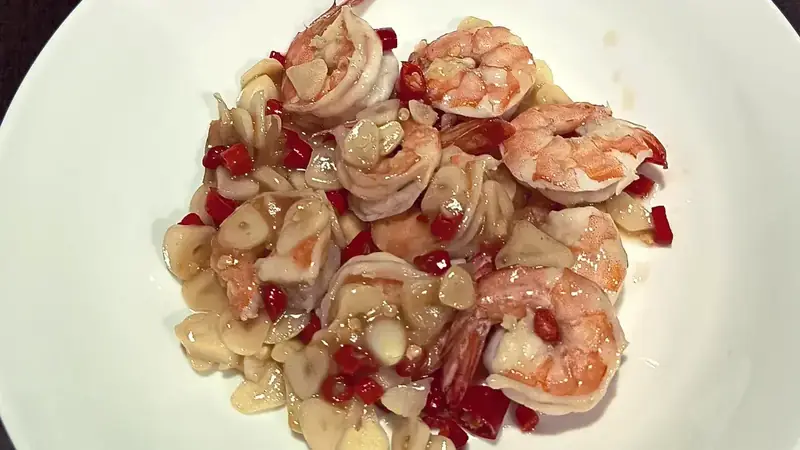
The secret lies in the garlic. Peeled with patience, thinly sliced or roughly chopped — the choice is personal, almost philosophical — and then allowed to slide into hot oil until golden. Not just any golden: that precise one, the one that smells of toasted hazelnut and earth, the one that transforms an anonymous bulb into something extraordinarily crispy and full-bodied. Every piece must brown evenly. It is an act of care, not of haste. Red and green chilies arrive cut into small pieces — not by chance, but to build a chromatic contrast that is already, visually, a promise of distributed heat, democratic, present in every bite without ever striking unpredictably. And then there is that moment. The one Sanh describes with an almost poetic precision: 'the sizzling sound in the pan that heals the soul.' It is true. Anyone who has cooked over high flame knows it. There is something deeply reassuring in that sound — something primitive, ancestral, that belongs to the human being even before it belongs to cooking. The shrimp hitting the scorching wok is not just cooking: it is an announcement, a declaration, a moment of pure presence. This dish does not want to be a gastronomic bridge toward the exotic. It wants to be, in the words of its maker, 'an emotional bridge' — something that transmits warmth, care, authenticity. Authentic flavor as a universal language of happiness. On ordinary days, especially those.
ACT II — MORNING GLORY OVER LIVE FLAME: When the Wok Catches Fire
If the first dish is a declaration of love, this is an act of faith. Water spinach — morning glory, pak bung in Thai, that aquatic vegetable with hollow stems and broad leaves that grows along the canals and rivers of Southeast Asia — demands respect and speed. Washed carefully, cut into segments of about five centimeters, dried with almost maniacal attention to prevent residual water from turning the most spectacular moment of the recipe into a disaster.

The preparation is almost meditative in its structure: everything is arranged in advance, like a mise en place (advance preparation of all ingredients) that is also a mental ritual. Crushed garlic, bird's eye chilies — red and green, roughly pounded for a wild and irregular heat — oyster sauce with its umami depth (savory and enveloping flavor, the fifth basic taste), and then the secret Sanh reveals with an almost casual simplicity: fermented soybean paste. One teaspoon. Just one teaspoon to transform the aromatic profile of the dish, to add that fermented, earthy, slightly pungent note that is the hallmark of the Thai-Chinese cuisine found in Bangkok's night markets. Sugar to balance. Light soy sauce for saltiness. A splash of water to create that light sauce that coats every stem without weighing it down. And then the fire. Fire at maximum. The wok must be scorching hot. The oil must begin to smoke. Only then — only at that precise moment of temperature at the limit — is everything poured in together, vegetables and seasonings, in a single decisive and irreversible gesture. The sizzle is violent. If the flame is high enough and the oil coats the pan well, a flare-up may occur. Wok hei — the breath of the wok — that smoky, almost charred note that cannot be replicated on any low-power home stove and that is the very essence of this cooking technique. Four, five spatula movements. Fifteen, twenty seconds at most. The leaves wilt, the stems remain green and crisp, and the dish is ready. Speed is not impatience. It is respect for the raw ingredient.
ACT III — EGG WHITE AND BROCCOLI OMELETTE: The Freedom to Cook What You Desire
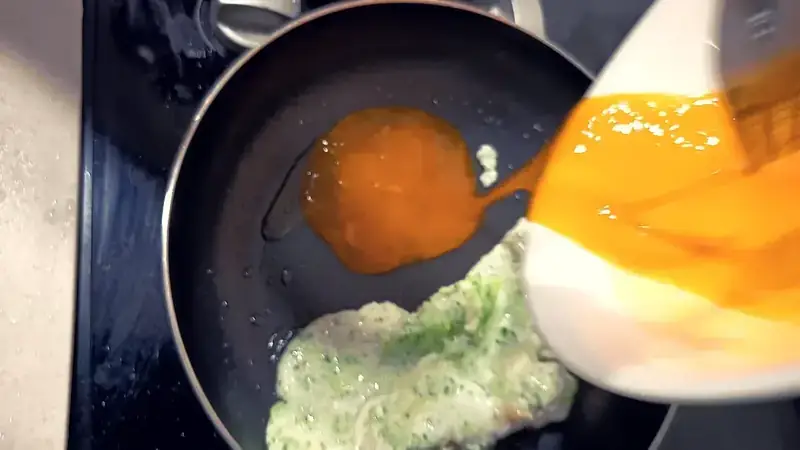
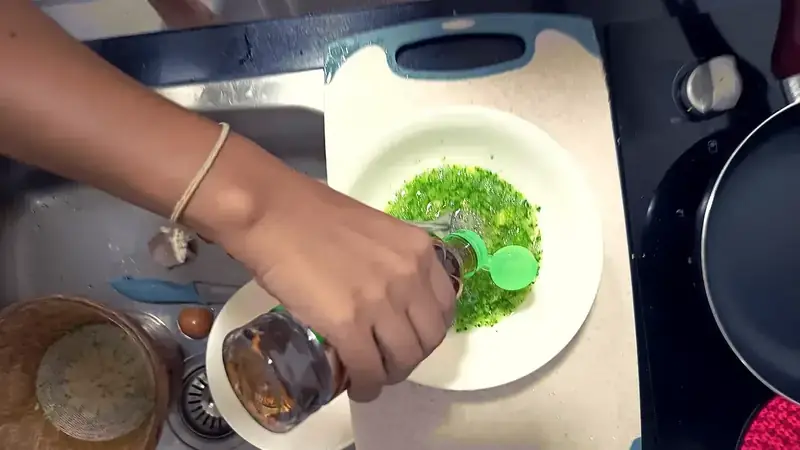
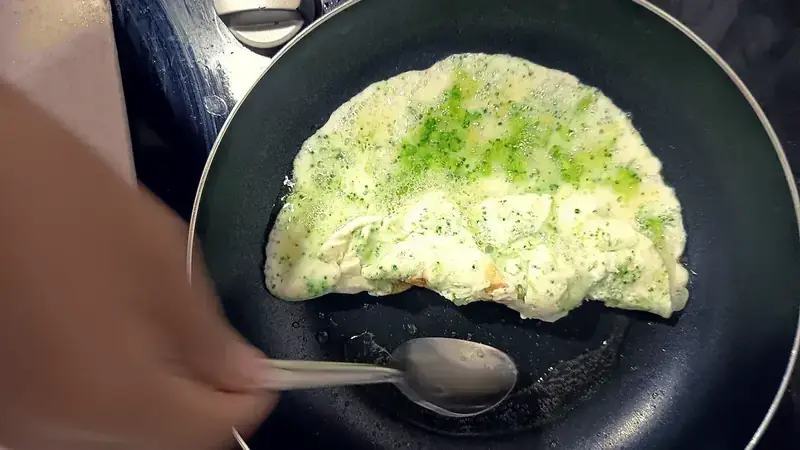
The third act is different. Quieter. Almost whispered. There is no story behind this dish. No declared inspiration, no childhood memory, no tradition to preserve. There is something more radical and, in a certain sense, more honest: 'the real purpose is simply that you can cook whatever you feel like eating.' This is a philosophy. A cooking philosophy that needs no justification before history or tradition. The freedom of desire as the only compass. The broccoli is chopped very finely — almost a green powder — blanched, then carefully dried and mixed with egg whites. Only fish sauce as seasoning: that liquid, salty and deep fermentation that is the heartbeat of Southeast Asian cuisine. The yolks are kept separate, beaten apart with another drizzle of fish sauce, and poured over the already-cooked egg whites in a hot pan. Two layers. Two textures. Two moments of cooking that meet in the final dish. It is a simple dish. Declaredly simple. But simplicity in cooking is never poverty — it is choice. It is the ability to find satisfaction in what you have, to transform a few ingredients into something nourishing and genuine, without the weight of gastronomic performance.
CODA — The Meaning of All This
Three dishes. Three ways of being in the kitchen. The first is pure passion, almost irrational in its motivational simplicity. The second is technique in service of the instant — that fraction of a second between raw and burned in which all the beauty of wok cooking (cooking over extremely high heat in a wok) hides. The third is freedom: the permission to cook without having to explain why. Sanh is not a chef in the institutional sense of the word. She is something more interesting: a person who has understood that authentic food needs no elaborate justification. It needs high heat, fresh ingredients, care in the gesture — and the intention, always, of making whoever eats happy. 'Genuinely delicious food is the best way to fill the ordinary days of anyone with happiness.' In an era when cooking risks becoming visual performance, content to be consumed rather than savored, this sentence sounds like a manifesto. Small, domestic, fragrant with golden garlic and burning chili. The kind of manifesto I prefer.