
Fridge Cooking: When Improvisation Becomes Art
There is a form of cooking that is never taught in culinary schools and never found in glossy cookbooks: it is born from instinct, from a fridge opened on a mid-afternoon whim, from eyes scanning whatever remains. A thick pork chop, a cluster of white shimeji mushrooms, a handful of cherry tomatoes waiting for their moment. No plan, no set recipe. Just hunger, a frying pan, and that quiet wisdom belonging to those who have learned to cook by watching, smelling, and tasting. It is fridge cooking, and it has a deeper soul than most people realise.
Key Takeaways
- The resting technique for meat: Letting meat rest for 2–3 minutes after cooking redistributes the internal juices.
- The value of pan drippings: The caramelised residue left in the pan concentrates flavour and enriches sautéed vegetables.
- White shimeji mushrooms: A Japanese variety with a delicate flavour, ideal for quick cooking over high heat.
Choosing the Cut: Loin or Shoulder, a Matter of Character
It all begins with the meat. A thick slice — whether loin (a lean cut from the back of the pig) or shoulder (a fattier, more marbled cut from the neck) — radically changes the final result. The loin is disciplined, precise, almost austere: it demands respect for timing and punishes distraction. The shoulder, on the other hand, is generous, indulgent, laced with fat that melts during cooking and transforms into pure flavour. First things first: pat the meat dry with kitchen paper. This seemingly trivial step is in fact essential. Surface moisture is the enemy of the Maillard reaction (the chemical process that creates the golden crust) — that amber, fragrant crust that seals the juices inside and gives the meat its visual and gustatory identity.
The Heat, the Pan, and the Moment of Truth
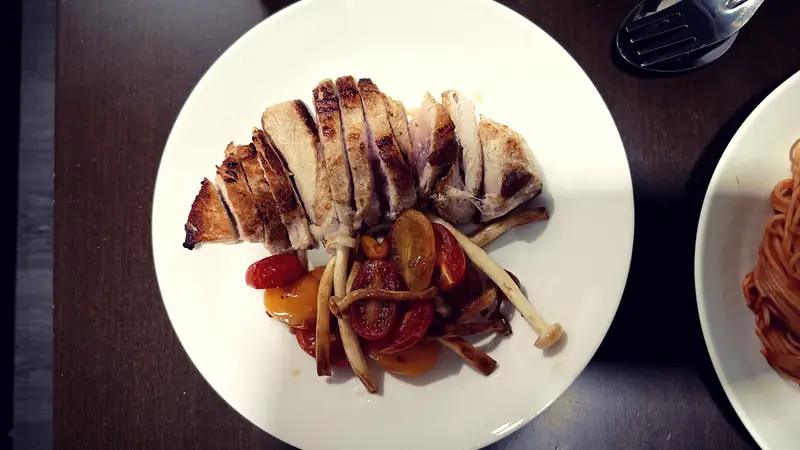
The pan must be scorching hot. Not warm, not hot: scorching hot. When the meat meets the blazing metal, the sound is immediate and decisive — a sizzle that is already a promise of good things to come. Cook for three or four minutes per side without touching it, without moving it, without giving in to the urge to check. Patience here is no abstract virtue: it is technique. The golden surface that forms is a flavour barrier, a casing that holds all the juice, all the tenderness, all the soul of the meat inside. When it is ready, remove it from the pan and leave it to rest on a chopping board. Two or three minutes of stillness. The muscle fibres (protein tissue contracted by heat) relax, the juices redistribute evenly, and when you finally slice it — with a confident knife, in thick cuts — the interior reveals a texture that is at once firm and yielding, never dry.
Shimeji Mushrooms and Cherry Tomatoes: the Side Dish That Is Not a Side Dish
The same pan, still hot, still fragrant with the pan drippings (caramelised residue rich in flavour) from the meat: this is where the second magic happens. A knob of butter — not oil, butter — melting slowly, gathering those dark remnants and transforming them into an aromatic base of extraordinary complexity. The white shimeji mushrooms go in first: small, delicate, with that clustered shape that makes them visually elegant. Over high heat they transform quickly — their moisture evaporates, the surface turns lightly golden, and the scent released is earthy, almost woodland-like, with an umami note (a savoury and deep flavour, the fifth taste) that fills the entire kitchen. The cherry tomatoes, halved, go in almost at the end: they are not meant to cook, only to warm through, to soften slightly, to release their bright acidity without losing the freshness that balances the richness of the meat and the depth of the mushrooms.
The Plate, the Tasting, the Point of It All
The dish is assembled with disarming simplicity: slices of meat fanned out, mushrooms and cherry tomatoes alongside, no elaborate sauce to cover what the cooking has already built. The first bite is revelatory. The crust of the meat yields under the teeth with minimal resistance, then the soft, juicy interior opens up into a full, rounded flavour, with that characteristic sweetness of pork that no other animal can replicate. A shimeji mushroom follows immediately: light, almost ethereal, its umami note amplifying the flavour of the meat rather than competing with it. A cherry tomato closes the mouthful with a small burst of acidity and sweetness together — the palate resets, ready for the next. This is the rhythm of the dish: richness, lightness, acidity. Repeated, varied, never the same.
The Philosophy of the Open Fridge
There is something deeply honest about this unpretentious style of cooking. No exotic ingredients ordered in specially, no restaurant-style mise en place (the advance preparation of all ingredients) from a Michelin-starred kitchen. Just the ability to look at what you have and see a meal worth eating. Great chefs have always known this: technique exists to enhance ingredients, not to disguise them. And when the ingredients are simple — a pork chop, some mushrooms, a few cherry tomatoes — the technique must be equally clean, essential, and respectful. The result is a dish that needs no elaborate introduction and no French name: it simply needs to be eaten, slowly, with the awareness that the best cooking often springs from the most sincere improvisation.