
There is a precise moment, in a Thai kitchen, when time seems to stand still. It happens when red curry paste hits the hot surface of the wok — that exact second when the oil embraces it and transforms it. The air ignites with toasted galangal (a spiced root similar to ginger), lemongrass (citrus-scented herb), and kaffir lime zest (fragrant Asian lime). It is not a scent: it is an announcement. An ancestral call that says, without words, that something essential is about to happen.
That dish is called ผัดพริกแกงหมู — Phat Phrik Kaeng Muu — and if there is a soul to Thai street food, it lives here, in this stir-fry (tossed in a pan over high heat) of pork with red curry that needs no frills to win you over.
A Dish That Asks for No Permission
Sanh, the cook who described it with the disarming simplicity of someone who cooks out of love rather than performance, calls it 'the main dish of Thailand'. Not a hyperbole: a declaration of belonging. This is a dish that does not exist outside its geographical and cultural context. It cannot be exported without losing something of itself. It is rooted in Thai soil like the jasmine rice (fragrant Thai variety) that accompanies it.
'I have no childhood memory tied to this dish,' Sanh admits with disarming honesty. 'I simply love it. I could eat it every day.' And perhaps that is precisely its greatness: it needs no nostalgia to justify itself. It stands on its own.
The Ingredients: Choosing Your Pork with Intention
The undisputed star is pork — but which cut to choose is already a statement of personal style. Loin (สันนอก) delivers firm, clean meat that absorbs the curry without losing its structure. Pork collar (สันคอ) brings a more generous marbling (fat streaks running through the meat), a tenderness that melts in your mouth with every bite. Pork belly (หมูสามชั้น), for those who embrace richness, offers that layering of fat and lean that turns each mouthful into a small sensory event.
Cut into pieces 'the right size for a single bite' — as Sanh specifies with that distinctly Asian precision that conceals years of practice — the pork becomes the perfect vehicle for carrying the complexity of the curry all the way to the palate.
The Heart of the Dish: Red Curry Paste
If pork is the body, red curry paste is the soul. One or two spoonfuls — the quantity is already a philosophical choice, an indication of your own relationship with heat and spice. Inside that compact, fragrant paste entire worlds exist: rehydrated dried chilies, pounded galangal, lemongrass reduced to fine fiber, kaffir lime zest, garlic, shallots, fermented shrimp paste. Every ingredient has surrendered its individual identity to create a collective one, greater than the sum of its parts.
The secret — and Sanh underlines it with the emphasis of someone who learned the lesson the hard way — is initial patience. Low or medium heat. Never high. The paste must be slowly worked into the hot oil, allowed to open like a flower, until the color deepens and the aroma becomes something almost physical, almost tangible. Too fierce a flame burns it, sharpens it, turns it into something bitter and aggressive. Curry does not forgive impatience.
'Excessive heat makes the curry bitter,' Sanh warns. 'And the smell gives it away immediately.'
The Dance in the Wok
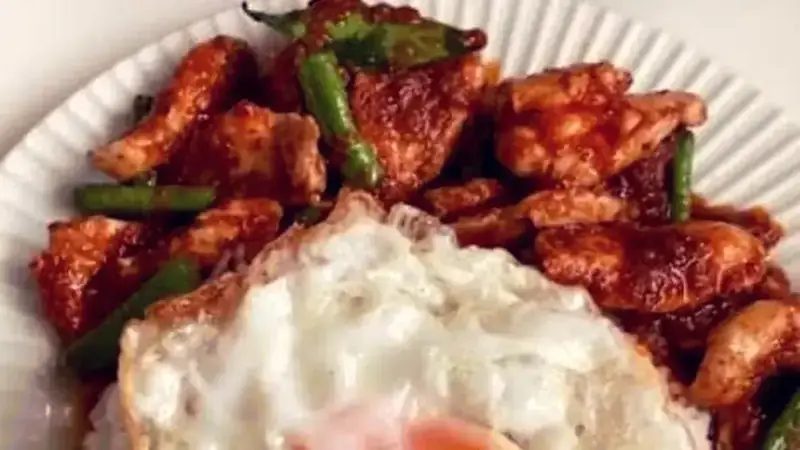
When the paste is ready — dark, fragrant, alive — the pork enters the scene. The heat rises slightly. The meat is tossed into the wok and its transformation begins: the pieces coat themselves in red curry, take on color, seal on the outside while keeping their juiciness within. It is a moment of high heat and high focus: you must move, turn, not let anything stick or burn.
Then come the long beans (ถั่วฝักยาว), cut into segments, bringing vegetable freshness and an almost percussive crunch. A splash of water or stock — the bare minimum — enters the wok to prevent the base from drying out, creating that 'kluk-klik' consistency (slightly saucy, the dish's signature texture), which is the hallmark of this recipe.
The seasoning is a balance to find with your own senses: fish sauce for deep, briny saltiness, oyster sauce for umami roundness (savory, enveloping flavor), palm sugar (น้ำตาลปี๊บ) for that amber, complex sweetness that smooths every sharp edge. The result should be salty, spicy, with a sweetness that arrives at the finish — like a gentle touch after a firm handshake.
The Aromatic Finish: Kaffir Lime Leaves
It is here, in the final thirty seconds, that the dish reaches its definitive form. Kaffir lime leaves (ใบมะกรูด), torn by hand to release their essential oils, are tossed into the wok alongside diagonal slices of fresh red chili (พริกชี้ฟ้าแดง). Two or three quick tosses of the wok — no more — and the flame goes off.
The scent that explodes in that instant is untranslatable. Citrusy, herbaceous, almost floral, with a hint of wild green. Sanh calls it simply 'the fragrance that cannot be missing'. He is right. Without kaffir lime leaves, this dish would be incomplete — technically executed but spiritually hollow. 'The curry and the kaffir lime leaves,' he says. 'These are the only truly irreplaceable ingredients.'
How to Eat It: The Ritual of Hot Rice
There is no correct version of this dish served without rice. Jasmine rice, freshly cooked, steaming, the grains still separate and fragrant. The Phat Phrik Kaeng Muu rests on top like a regal condiment, its reddish sauce slowly seeping between the white grains. And if you want to take it even further — as Sanh suggests with the naturalness of someone who does it every time — a fried egg (ไข่ดาว) placed on top, with the yolk still soft and ready to break and meld with the curry, transforms the dish into something extraordinarily satisfying.
'With hot rice and a fried egg on top,' says Sanh, 'it is already perfect.' Simplicity as the highest form of elegance.
Freedom as the Secret Ingredient
There is one thing Sanh repeats several times, almost like a mantra: 'You can adjust everything to your own taste. You love sour, spicy, sweet — follow it.' In an era when cooking is often held hostage by dogma and locked-down recipes, this invitation to personal freedom sounds almost revolutionary. Phat Phrik Kaeng Muu is not a formula to replicate with scientific precision: it is an open structure, a flexible architecture within which everyone can find their own balance. It is a dish that respects the cook enough to leave them room.
ผัดพริกแกงหมู is not just a stir-fry. It is an act of love toward your own kitchen, your own senses, toward a tradition that needs no explanation to be understood. All it takes is a wok, a good curry paste, a few kaffir lime leaves torn by hand — and that scent rising into the air that says, without a shadow of a doubt, that you are in Thailand.