
Some evenings the kitchen doesn't ask for inspiration. It asks for honesty. A salmon fillet, some leftover tomato sauce, spaghetti in the drawer. Nothing else. No plan, no recipe to follow — just the open fridge and that white light illuminating whatever possibilities remain.
Key Takeaways
- Salmon cooked dry in a pan — two minutes per side, no added fat — develops a golden crust that preserves the orange, moist interior: the resting technique after cooking is the secret that separates a mediocre dish from a memorable one.
- Fish sauce and monosodium glutamate are the two flavor modifiers that transform leftover tomato sauce into a condiment with marine depth and layered umami, completely eliminating the need for added salt.
- Empty-fridge cooking is not chaotic improvisation: it is the purest form of applied technique, where the scarcity of ingredients forces you to maximize every chemical reaction and every cooking step with no margin for error.
The Technique, No Frills
The water boils. The spaghetti goes in and eight minutes later comes out just right — tender, not mushy. Meanwhile the pan heats dry, because the salmon already carries its own fat and needs no help. Two minutes per side and the crust forms on its own: golden outside, still orange and moist inside, that texture that yields under the bite without resistance.
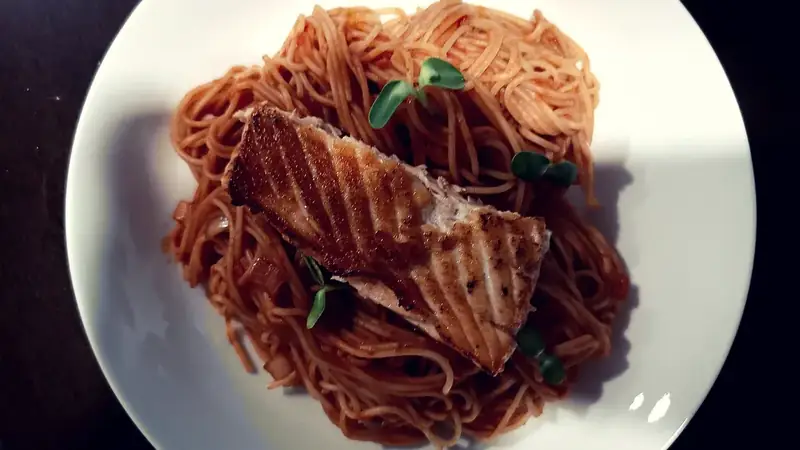
The salmon rests. Into the same pan goes the tomato sauce, and here come the two condiments that change everything: fish sauce and monosodium glutamate. No salt. Nothing else. The fish sauce brings a deep, marine salinity that the tomato alone could never achieve. The glutamate does the rest — it amplifies, rounds out, transforms a simple sauce into something that tastes like it has been cooking for hours. The spaghetti goes in. The sauce coats them, binds them, stains them a deep red.
The Moment of Plating
The pasta in the bowl, the salmon laid on top. No decoration, no pretense. The aroma arrives before the fork: cooked tomato, iodine undertones, that fatty animal warmth of fish in a hot pan. It is a smell that is domestic and wild at the same time — as if the sea had walked into the kitchen without knocking.
Then the flavor, when the pasta and the salmon meet in a single bite. That is where something hard to name happens: the acidic, umami tomato, the fatty and sweet salmon flesh, the fish sauce running underneath like a current. It is not fusion, it is not a recipe with a name. It is the taste of what was there — transformed, surprisingly whole. Sometimes the empty fridge is the best possible condition for actually cooking.