
You walk into a pharmacy in Thailand and find yourself facing shelves packed with fragrant powders, dried roots, green capsules, and glass vials covered in Thai script. This isn't a wizard's market — it's Traditional Thai Medicine (TTM), a millennia-old system that here isn't tourist folklore but real public healthcare, prescribed in hospitals and carried in purses the same way Westerners carry ibuprofen. After months traveling across Southeast Asia, I can honestly say this stuff opened my mind more than any university course ever did.
Key Takeaways
- TTM is not 'second-rate alternative medicine': it is integrated into Thai public hospitals, standardized with GMP (Good Manufacturing Practice, the international quality production standard) certifications, and prescribed by doctors exactly like a Western antibiotic.
- The diagnostic system is based on the Theory of the 4 Elements (Tat Si) — Earth, Water, Wind, and Fire — and disease is simply an imbalance between these: a holistic framework that anticipated the psychosomatic approach of modern medicine by centuries.
- From Moringa capsules to the Ya Hom powder elixir, through the anti-hangover Rang Jued and the adaptogenic Jiaogulan (a substance that helps the body resist stress), each remedy has a precise function, a scientifically identified plant, and packaging with a batch number, expiration date, and government seal.
A Crossroads of Ancient Knowledge: Where TTM Comes From
Traditional Thai Medicine was not born in isolation, as some might assume. It is a brutally effective synthesis of three traditions: ancient Indian Ayurvedic medicine (brought by Buddhist monks along trade routes), Traditional Chinese Medicine with its herbal pharmacology, and the animist and shamanic knowledge of local peoples regarding endemic plants. The result is a system that looks at the individual as a whole — body, mind, and spirit — rather than bombarding a single symptom as Western allopathic medicine (Western medicine based on drugs that counteract symptoms) so often does.
The Theory of the 4 Elements: How Diagnosis Works
The key concept for understanding everything is the Theory of the 4 Elements (Tat Si). The human body is a microcosm composed of: Earth (solid organs, bones, muscles), Water (blood, lymph, bodily fluids), Wind (breathing, circulation of vital energy), and Fire (digestion, metabolism, body temperature). Disease, within this system, is simply an imbalance between these four elements. Simple, elegant, and surprisingly useful as a diagnostic framework even for a digital nomad who finds themselves at 95°F with a wrecked stomach after one too many street food adventures.
The Pantry Pharmacy: When Food Is Medicine
In Thailand, prevention starts at the table, not at the pharmacy. Many foods are consumed daily precisely for their therapeutic value. Ginger — found dried, in bars, everywhere — is fundamental for stimulating the Fire element: it aids digestion, fights nausea, and warms the body from within. Dried or candied tamarind, packed with vitamin C, has a cooling effect and is traditionally used as a mild natural intestinal regulator. Sesame bars are an excellent source of calcium to nourish the Earth element, strengthening bones, teeth, and hair. Globalized supplements like Ginkgo Biloba (a plant extract known for supporting memory and microcirculation) also appear on shelves, proving that here East and West don't wage war on each other — they blend together.
Ya Hom: First Aid in a Bottle
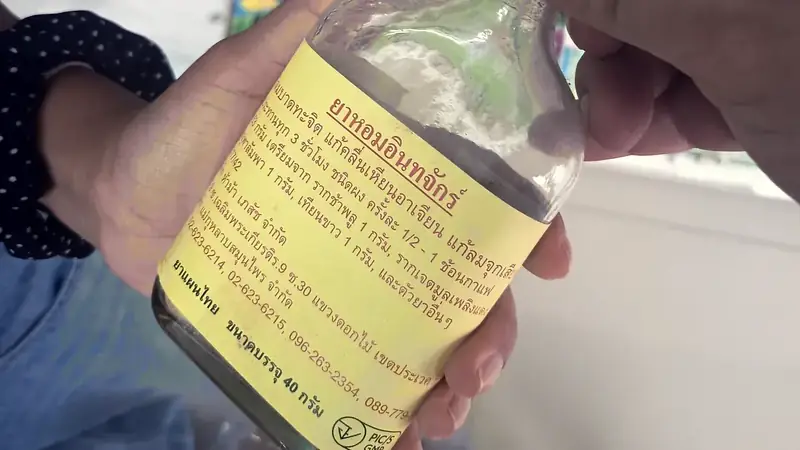
Let's talk about the remedy every Thai person carries in their bag: Ya Hom (ยาหอม), literally 'Fragrant Medicine'. It is a clear powder contained in a glass vial — the historic Inthachak recipe is one of the most famous — which is a complex blend of dozens of aromatic herbs and spices. The usage protocol is elementary: dissolve a teaspoon in hot water and drink. It acts on the Wind element and almost instantly resolves dizziness, fainting sensations, sudden weakness, palpitations, and gastric disturbances. The sharp, fresh flavor 'awakens' the senses and reactivates bodily energy. I tried it. It works. Period.

Super Herbs in Capsule Form: The Modern Pharmacopoeia
Ancient decoctions have evolved into practical, standardized capsules. Here they are, no frills:
Rang Jued: The Detox Herb (and Hangover Cure)
The plant is Thunbergia laurifolia. Historically used as an antidote against poisoning, today Rang Jued is celebrated for deeply cleansing the liver, clearing food intoxications, and — a wildly popular use among locals — as a foolproof remedy against hangovers. This is no joke: it is produced by Chao Phraya Abhaibhubejhr, the pioneering public hospital in integrating phytotherapy (the therapeutic use of medicinal plants) into Thailand's national healthcare system.
Jiaogulan: The Herb of Immortality
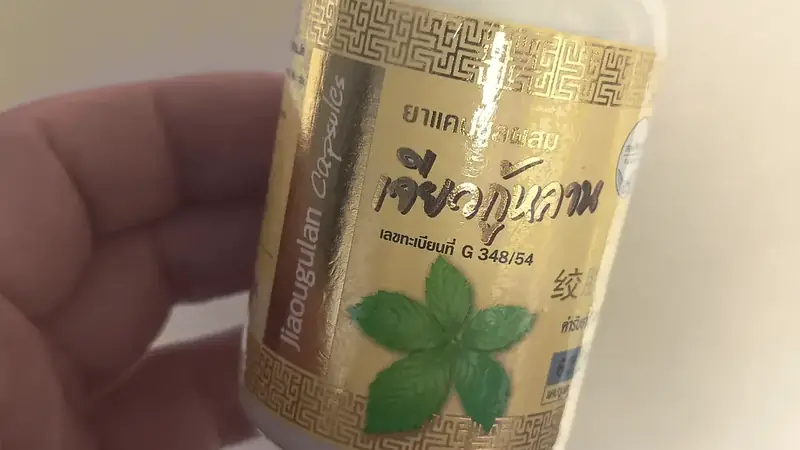
Gynostemma pentaphyllum, often called the 'Southern Ginseng', is a formidable adaptogen (a substance that helps the body resist physical and mental stress). Jiaogulan is prescribed to lower cholesterol, regulate blood pressure, and promote longevity with steady energy — without the nervous agitation that classic ginseng sometimes causes. I take it every morning. Judge away.

Moringa / Marum: The Green Miracle
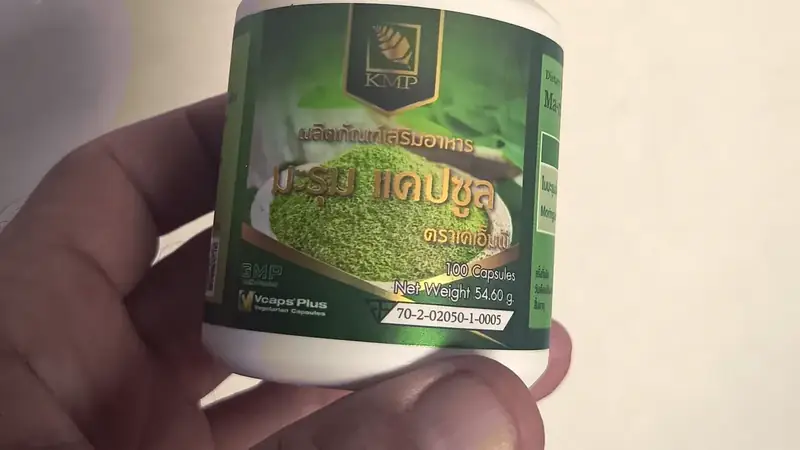
Moringa oleifera is the tree where nothing goes to waste. In capsule form it is a concentrated superfood, rich in vitamins and antioxidants, used to lower blood sugar and as a powerful anti-inflammatory. The cold-pressed seed oil, on the other hand, is a topical elixir: a deep moisturizer, anti-aging serum, healing agent, and massage anti-inflammatory. Two products, one plant, zero waste.
Butea Superba / Kwao Krua Daeng: The Male Tonic
The image on the label — a muscular torso — leaves no room for interpretation. Butea Superba, a tuberous root endemic to Southeast Asia, is the region's most famous male invigorant. It is used to combat chronic fatigue, improve vascular blood circulation, and support male vigor and performance. No embarrassment here: they sell it at the pharmacy right next to the candy.
Tradition Validated by Science: No Antagonism
In Thailand, these herbs are not considered witchcraft or second-rate medicine. Public hospitals house both Western medicine wards and traditional medicine clinics side by side, and doctors routinely prescribe products like Rang Jued or Ya Hom. As the packaging makes clear, products display batch numbers, expiration dates, government certifications, and GMP (Good Manufacturing Practice) marks: modern science has embraced ancient herbal wisdom to guarantee its efficacy and safety. This is not a compromise. It is intelligent evolution. Exactly what a serious healthcare system should do.