
Key Points
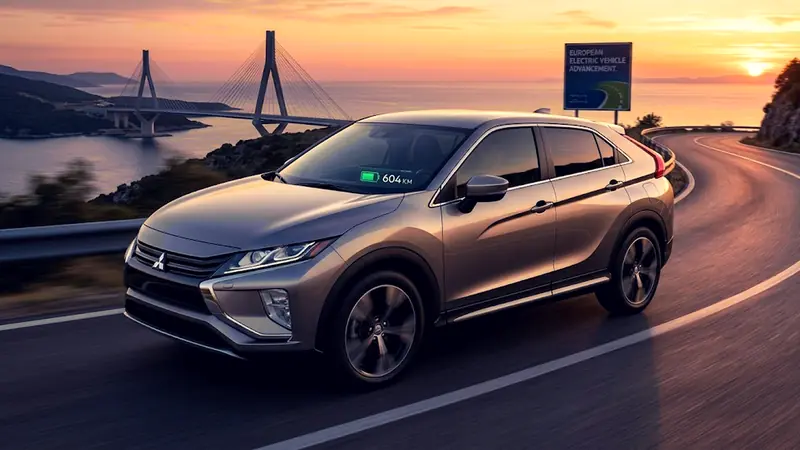
- Record range for Mitsubishi: The 2027 Eclipse Sportback achieves 604 km of range thanks to the CMF-EV platform derived from the Renault-Nissan alliance.
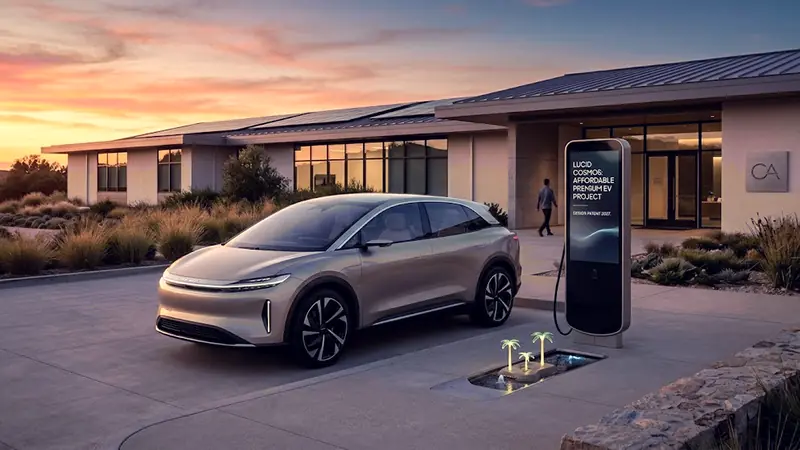
- Lucid Motors patents the Cosmos: Lucid's first affordable electric SUV takes direct aim at the Model Y and Rivian R2 in the premium volume segment.
- Leapmotor expands into Oceania: The B03X is confirmed for the Australian market, positioning itself as a direct rival to the BYD Atto 2 in the compact electric segment.
Mitsubishi strikes back: the Eclipse Sportback targets 604 km with the CMF-EV platform
In the European electric vehicle landscape, where every announcement risks getting lost in the background noise, Mitsubishi has chosen to re-emerge with a precise and hard-to-ignore figure: 604 kilometres of declared range for the new 2027 Eclipse Sportback. The model, a fastback-style crossover that ideally revives the name of one of the most beloved coupés of the 1990s, is built on the CMF-EV platform — the same architecture that has already proven its maturity beneath the bodywork of the Renault Scenic E-Tech and the Nissan Ariya. For Mitsubishi, which has progressively ceded ground in the European market over recent years, this represents a high-risk, high-potential strategic move. If confirmed under real-world WLTP testing, the declared range would place the Eclipse Sportback among the most efficient electric crossovers in the C-D segment, ahead of several direct competitors. The sportback design, with its sleek profile, is not merely aesthetic: it reduces the aerodynamic drag coefficient and directly contributes to extending the range. Full technical details — motor output, battery capacity, charging times — have not yet been officially released, but the choice of the CMF-EV platform suggests a battery pack in the region of 87 kWh net, compatible with fast charging of up to 150 kW.
Lucid patents the Cosmos: the premium electric SUV war drops in price
Across the Atlantic, Lucid Motors has filed design patents for the Cosmos, its first attempt to enter the volume market without sacrificing the technological identity that made the Air one of the most efficient electric sedans in the world. The Cosmos is explicitly designed to compete with the Tesla Model Y and the Rivian R2, two benchmarks that define the boundaries of the electric SUV segment between $40,000 and $60,000 in the United States. The move is significant because Lucid has built its reputation on vehicles priced above $100,000, and the leap toward the mass market requires a compression of production costs that technology alone cannot guarantee. The design patent reveals clean lines, a compact crossover silhouette with a high roofline and generous glazed surfaces, consistent with the Californian brand's aesthetic but clearly oriented toward family practicality. Saudi Arabia, through the PIF fund, remains Lucid's principal shareholder and has every interest in seeing the brand scale to significant production volumes by 2028. The Cosmos could be the key to that transition.
Skoda Peaq and Leapmotor B03X: electric vehicles make inroads with seven seats and emerging markets
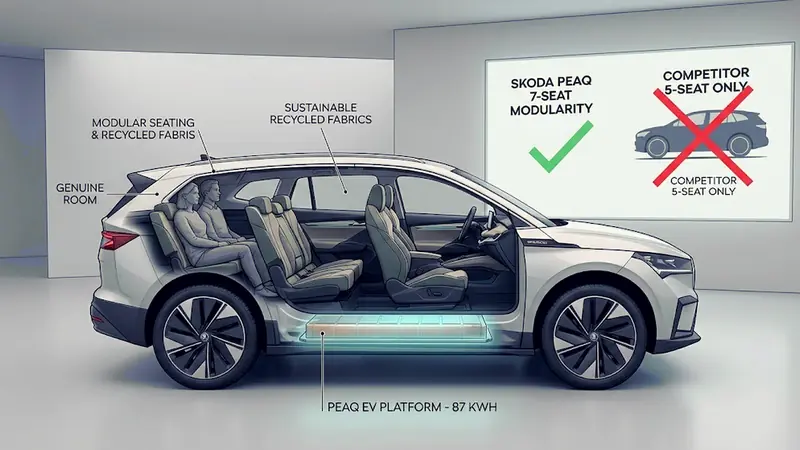
In Europe, Skoda has unveiled the interior of its eagerly anticipated Peaq, the seven-seat electric SUV that aims to redefine the concept of space in the electric family segment. The design approach is explicitly minimalist: clean surfaces, sustainable materials, and a cabin layout that prioritises modularity over technological spectacle. The third row — an element often sacrificed at the altar of the battery pack in electric SUVs — appears here to be genuinely usable for adults, at least judging by the first images released by the Mladá Boleslav manufacturer. The Peaq fits into the Volkswagen Group's lineup as a more accessible alternative to the Audi Q7 e-tron and the Volkswagen ID.7 Tourer, targeting a space-to-price ratio that is difficult to replicate in the segment.
On the opposite side of the globe, Leapmotor — the Chinese brand that entered Europe through its partnership with Stellantis — has confirmed the launch of the B03X in Australia. The vehicle, a compact electric crossover, is positioned as a direct competitor to the BYD Atto 2, a model that has already captured significant market share in Australia thanks to aggressive pricing and generous standard equipment. The B03X targets the same formula, with the added advantage of being able to rely on Stellantis's distribution network and logistical infrastructure, which maintains a well-established presence in Australia. For the Oceanian market, historically dominated by combustion-engine pickup trucks and SUVs, the arrival of two Chinese brands in direct competition represents an accelerator of the electric transition that should not be underestimated.
The hybrid showdown that matters: 2027 Kia Telluride vs. 2026 Toyota Grand Highlander
Staying in the three-row SUV segment, the comparison between the 2027 Kia Telluride and the 2026 Toyota Grand Highlander in their respective hybrid variants represents one of the most compelling matchups in the North American market. The Telluride, in its updated guise, brings a hybrid powertrain that is new to the model, while the Grand Highlander can count on Toyota's already proven PHEV system from the TNGA-K platform. Two different philosophies: Kia bets on passenger space and perceived value, Toyota on reliability certified by decades of hybrids on the road. According to the first comparative analyses available, the Grand Highlander holds an advantage in terms of declared combined-cycle fuel consumption, while the Telluride gains ground on interior space and onboard technology. Both models compete for a market segment — American families with three or more children and all-wheel-drive requirements — that in 2026 is worth over 800,000 units annually in the United States.