Key Takeaways
- Monumental reconversion: Nara's 1908 former prison — a National Cultural Property of the Meiji era (late 19th-century Japanese imperial period) — opens as Hoshinoya Nara Prison resort in June 2026, with rates starting at 147,000 yen per night.
- Project leads: David Kohn Architects, Isern Serra, Bastidas Architecture, Graphpaper, and Hoshino Resorts are the five firms behind the landmark interventions analyzed here.
- Market signal: The Mallorca luxury residence extracts 700 square meters from a former industrial printworks, marking a consolidated trend in the premium experiential real estate segment.
Brick, Memory, and Function: When Architecture Rewrites the Past
This is not nostalgia. It is something far more brutal and precise: the ability to stare a dead structure in the face and decide what it becomes next. In 2026, five architectural interventions across London, Barcelona, Mallorca, Osaka, and Nara are radically redefining how historic built fabric is reinterpreted, inhabited, and brought to market. No demolition. No blank slate. Just the cold surgical precision of those who know exactly where to cut.
London: A Ground Floor Suspended in the Sky
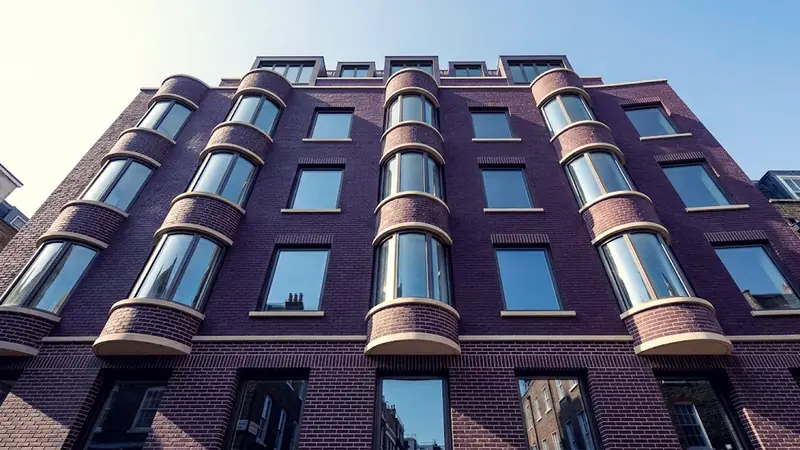
At the heart of Covent Garden, studio David Kohn Architects has completed an intervention that challenges the very grammar of building extension. House on a Hill is not a penthouse in any conventional sense. It is a ground floor suspended atop a Victorian warehouse — three levels asserting themselves above the roofline with a stepped plum-brick facade and chromatic contrast mortar. The bay windows — alternating curved and angular — punctuate the external skin with an almost musical rhythm.
Inside, the most radical move is the one you cannot see: the complete absence of doors. A continuous enfilade (a sequence of rooms aligned on a single axis) connects the living room, library, and dining room in one unbroken visual perspective. The stairwell is pierced by a colored skylight that transforms the perception of volume into something closer to inhabitable sculpture than conventional domestic space. The Victorian inheritance is present, but never decorative. It is structural, in the most literal sense of the word.
Barcelona: A Speakeasy Behind a Refrigerator
Designer Isern Serra took a radically different — and arguably more subversive — approach. In Barcelona, a cocktail bar conceals itself behind the shopfront of a traditional focacceria (a bakery specializing in flatbread). The entrance is disguised as a fake commercial refrigerator — a gesture that functions simultaneously as theatrical device and statement of intent. Once inside, the atmosphere shifts register with brutal abruptness.
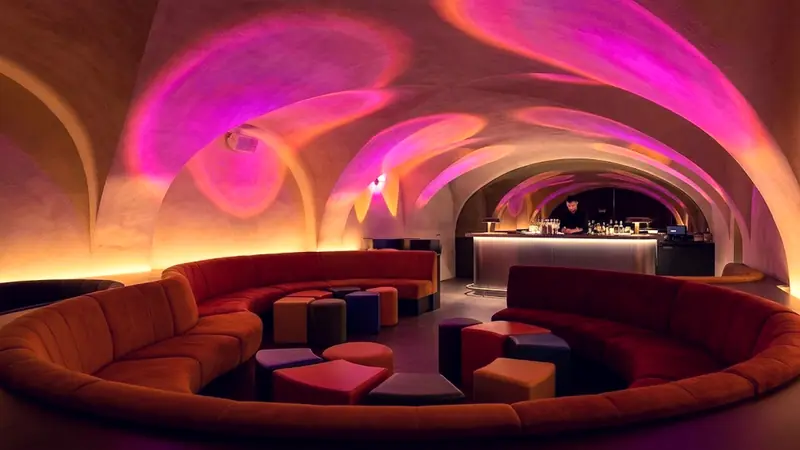
The aesthetic is Space Age filtered through 1960s psychedelia: polychromatic modular furnishings, sinuous banquettes that directly reference the installations of Verner Panton (Danish designer, pioneer of plastic furniture), vaulted ceilings that amplify every dynamic of light. This is not a lazy homage to retro-futurism. It is a sensory system built with sculptural rigor, where nostalgia becomes a tool rather than an end. Barcelona, with its deep-rooted progressive spirit, provides the ideal context for an intervention that plays with spatial identity until it becomes unrecognizable.
Mallorca: 700 Square Meters Reclaimed from Industry
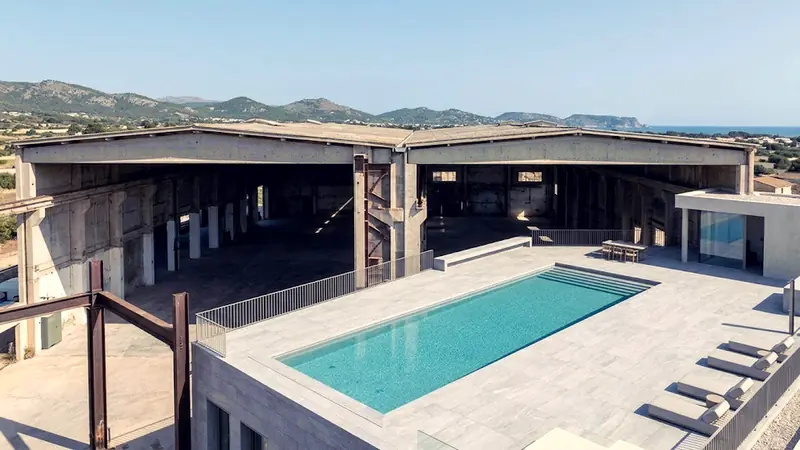
Studio Bastidas Architecture tackled one of the site's most complex challenges in Mallorca: converting a former industrial printworks into a 700-square-meter private luxury residence without betraying the original building's industrial scale. The result is a metamorphosis that does not erase but negotiates. The productive structure remains legible — in its volumes, proportions, and materiality — yet has been grafted with a swimming pool and panoramic terrace that balance the enormity of the footprint with a deliberate, calibrated domestic warmth.
The intervention confirms a now-established trend in the premium real estate segment: decommissioned industrial heritage is not a problem to be solved, but an asset to be leveraged. The sheer spatial vastness — which in a conventional residential context would be an obstacle — becomes here the primary selling point.
Osaka: A Bank Becomes a Wardrobe
In the Horie district of Osaka, fashion brand Graphpaper has opened its largest flagship store inside a historic former bank. The original architectural volumes — designed to project solidity, financial authority, and permanence — have been stripped of their original function and filled with the brand's tailored collections. The result is a minimalist, material-driven retail space in which the architecture does not compete with the product but frames it with the same precision it once used to safeguard capital.
Graphpaper's operation is emblematic of how high-end retail is abandoning purpose-built spaces in favor of historic containers capable of transferring to the product an aura of authenticity that is nearly impossible to replicate.
Nara: Sleeping in a Cell Classified as Cultural Heritage
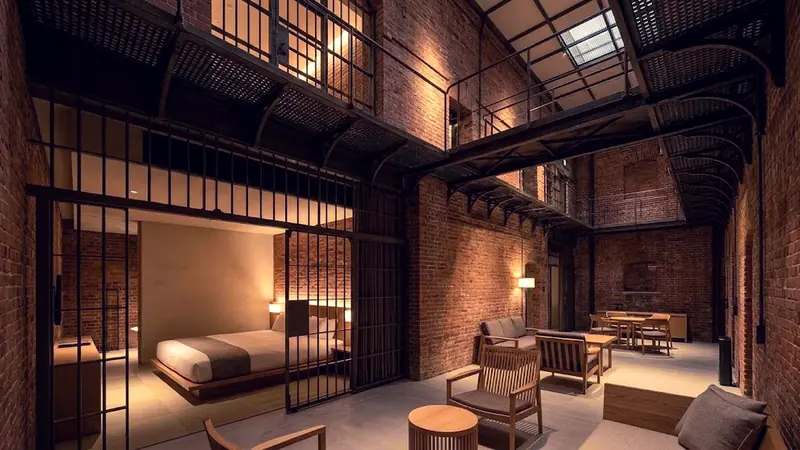
The most extreme intervention in this survey is the one that gave new life to the former Nara Prison. Built in 1908 in Western architectural style and designated a National Cultural Property of the Meiji era, the red-brick complex opened in June 2026 as Hoshinoya Nara Prison. The original cells — spaces engineered for deprivation — were merged and converted into suites with soaring ceilings. Rates start at 147,000 yen per night. An adjoining museum preserves the memory of the site.
The operation poses an uncomfortable question and refuses to answer it: what does it mean to inhabit a place built to deny freedom? Hoshino Resorts offers no resolution — only an immersive experience designed to make that question impossible to ignore. In a hospitality market increasingly saturated with decorative luxury and devoid of substance, Nara proposes something far more unsettling: luxury as a confrontation with history.
The Common Thread
Five interventions, five geographies, one underlying logic. Advanced-level design does not merely alter geometries or update finishes. It rewrites the vocation of buildings, projecting them toward new functions without dispersing their genetic heritage. Warehouse, printworks, bank, bakery, prison: none of these buildings exists in its original form any longer. But none has been erased. They have simply been reread — with cold precision and zero sentimentality.