
Key Points
- Expanding global fashion market: Five major geographic macro-areas — the United States, Germany, Italy, Thailand and Japan — are driving the industry's main stylistic and production trends in 2026.
- Sustainability and technology as strategic pillars: Brands such as Uniqlo, Issey Miyake and Yohji Yamamoto, alongside Italy's major luxury groups (Gucci, Prada), are integrating recycled materials and high-tech processes into their supply chains.
- Market impact: The convergence of sustainable fashion and technological innovation now represents the primary driver of growth and competitive differentiation in the global fashion industry.
An industry at five speeds: mapping the global style power
In 2026, talking about fashion means talking about geopolitics. The clothing and style industry can no longer be traced back to a single creative epicentre; instead, it is articulated across at least five major poles that express profoundly different worldviews, often in open competition with one another. The United States, Germany, Italy, Thailand and Japan are not simply nations that produce fabrics and collections: they are country-systems that project identities, economic values and cultural ambitions through what their fashion industries choose to build, sell and communicate. Ignoring this complexity means failing to understand where the market is truly headed.
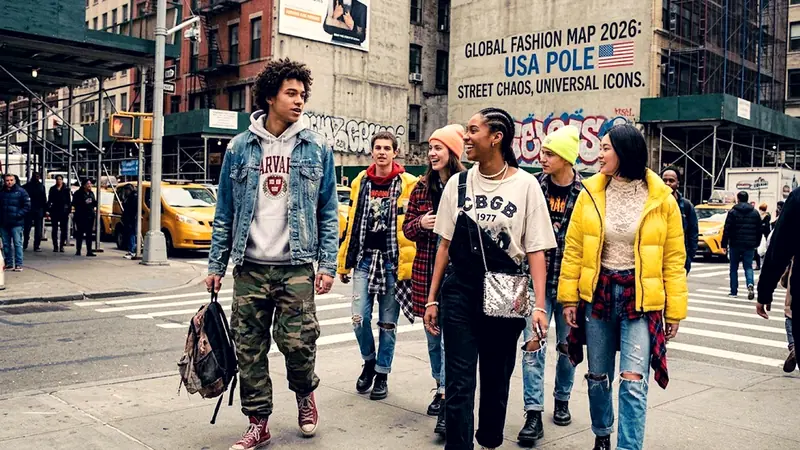
America and the democracy of style: power without discipline
The American fashion model is, at its core, a model of radical democratisation. From Levi's jeans — a universal symbol of an aesthetic born from working-class necessity and transformed into a global icon — to the evening wear of New York's great fashion houses, the United States has always favoured scale over refinement, volume over rarity. This approach has generated an extraordinarily capacious market, capable of absorbing opposing trends simultaneously, but it has also produced an industry that often lacks a coherent aesthetic direction. America's strength is its diversity; its weakness is the very same thing. The global trends emerging from the USA in 2026 reflect this contradiction: an authentic and chaotic creativity, difficult to export as a system yet irresistible as individual cultural products.
Germany: when engineering meets the wardrobe

Germany occupies a peculiar position on the map of global fashion. Its industrial reputation — built on brands such as Mercedes-Benz and BMW, which embody the philosophy of technical detail taken to the extreme — has inevitably shaped the way the country interprets clothing and style as well. It is no coincidence that Karl Lagerfeld, the most influential German designer of the twentieth century, built his career on formal discipline, constructive precision and a vision of elegance that admits no approximations. Contemporary German fashion inherits this DNA: sophisticated, functional, measured. It is an aesthetic that struggles to generate the kind of irrational desire that fuels pure luxury, yet it holds a solid position in the premium market segment — the one where consumers seek verifiable quality rather than romantic storytelling.
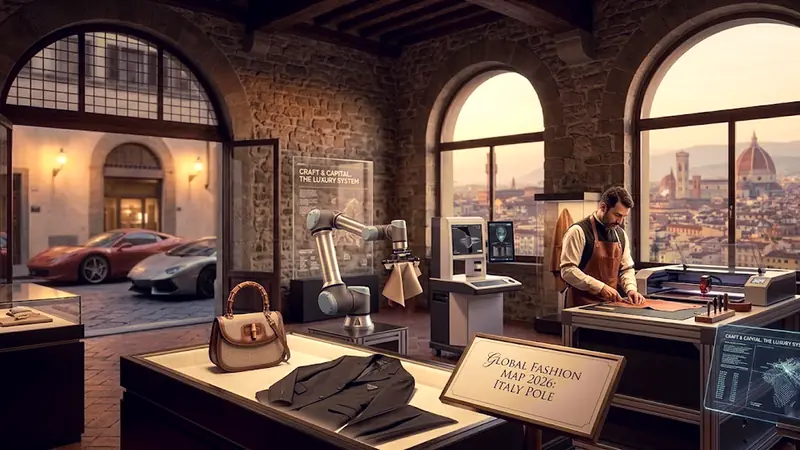
Italy: luxury as an industrial system
If there is one country where fashion has become a national economic infrastructure, it is Italy. Gucci, Prada, Ferrari, Lamborghini: names that belong to different product sectors yet share a common production philosophy — that of artisanal excellence brought to industrial scale. Italy does not simply sell clothes or cars: it sells a system of aesthetic values that the world has chosen to regard as a benchmark. This primacy, however, is under pressure. In 2026, Italy's major luxury groups — many of them controlled by French holding companies such as LVMH and Kering — are managing an increasingly acute tension between the need to grow in volume across Asian markets and the imperative to preserve the perception of exclusivity upon which the entire business model rests. The challenge is not stylistic: it is strategic, and the coming years will reveal whether the Italian fashion system is robust enough to sustain this balance.
Japan: the avant-garde as a method
Japan is the only country in the world where innovation in fashion is treated with the same methodological rigour applied to aerospace engineering. Designers such as Issey Miyake and Yohji Yamamoto did not simply create collections: they redefined the conceptual parameters of what a garment can be, exploring the relationships between body, space, material and movement with an almost scientific approach. On the commercial side, Uniqlo has demonstrated that it is possible to build a global fast-fashion giant without sacrificing measurable technical quality — the HeatTech and AIRism technologies have become reference standards for the entire industry. In 2026, Japan continues to occupy that rare position of a country capable of operating simultaneously at the conceptual avant-garde and at mass scale, without the two levels contradicting each other.

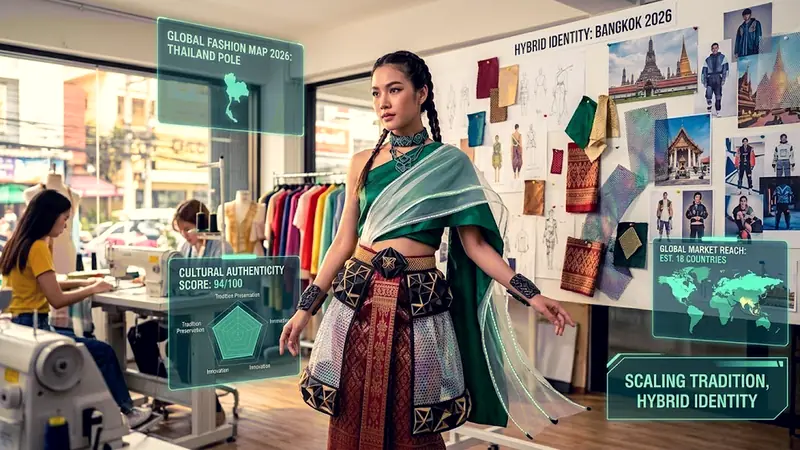
Thailand and the value of tradition as a competitive asset
Thailand perhaps represents the most compelling case of a country seeking to transform its cultural heritage into a competitive advantage in the global fashion market. Traditional textiles such as the sabai and the pha sin — garments laden with ritual and identity significance — are today being reinterpreted by a new generation of Thai designers who blend them with contemporary languages, creating products capable of speaking to both the domestic and international markets. It is a strategy that other Southeast Asian countries are watching closely, aware that in an era of global aesthetic saturation, cultural authenticity has become one of the few truly scarce resources. The challenge for Thailand is to scale this proposition without hollowing it of meaning.
Sustainability and technology: the two axes reshaping the industry
Beyond geographic specificities, two cross-cutting forces are reshaping the entire fashion industry at a global level: environmental sustainability and technological integration. On the sustainability front, the shift from declarations to concrete action is still partial, but the direction is unequivocal. Brands that have genuinely invested in recycled material supply chains and low-impact production processes are recording measurable competitive advantages, particularly among under-35 consumers in Western markets and East Asia. On the technology front, the convergence of fashion and digital innovation — from smart materials to AI-driven personalisation platforms — is compressing product development cycles and opening margin opportunities that the traditional seasonal model was unable to generate. According to industry projections, by 2028 more than 40% of new collections from the world's leading fashion groups will incorporate at least one advanced technological component in their supply chain or finished product.
The market won't wait: those who don't position themselves get positioned
The picture that emerges from this analysis is that of an industry in the midst of a full-scale redefinition of its power dynamics. The countries and brands growing most rapidly are those that have managed to build a coherent narrative around verifiable values — technical quality, cultural authenticity, reduced environmental impact — rather than relying solely on the historical weight of their name. Traditional luxury is not in crisis, but it is under pressure from every direction: from below, as a result of the growing sophistication of technological fast-fashion; from above, as a result of demand for increasingly personalised and hard-to-replicate experiences and products. Market data for 2026 indicate that the premium-accessible segment — the space between mass-market and pure luxury — is the terrain on which the most intense competition will be fought over the next twenty-four months, with Japan and Italy better positioned than the rest to hold their ground.