Key Points
- The Price of Ritual: A hand-stitched leather cover at Tokyo's stationery boutiques can exceed 300 euros, with personalized inks registered by name in proprietary databases.
- Oshi-Katsu and Kakimori: Japanese aesthetic idolatry culture and the paper tailoring of Kuramae are the two cultural and commercial engines that have redefined the global premium stationery market.
- Anti-AI Reaction: In 2026, artisanal agenda personalization has become the primary analog status symbol for Asia's executive class fleeing digital fatigue.
The diary is no longer purchased. It is commissioned.
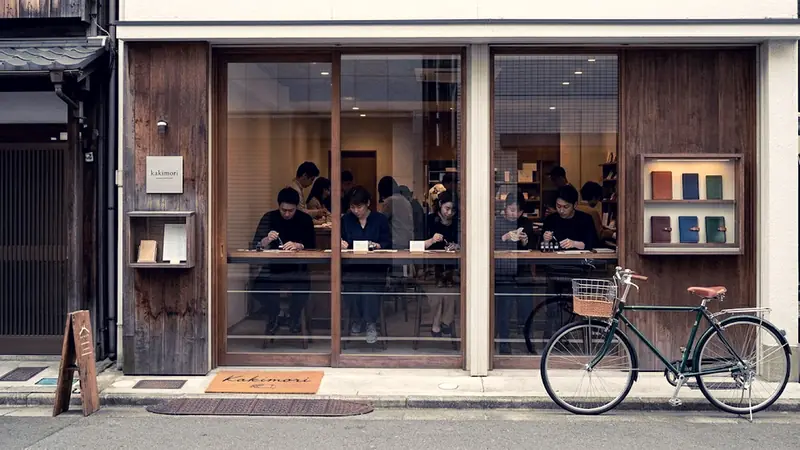
There is a neighborhood in Tokyo, Kuramae, that until a few years ago was known only to independent design enthusiasts. Today it has become a pilgrimage destination. The destination is called Kakimori, and it is not a stationery shop in the sense that anyone outside Japan would understand. It is closer to a bespoke tailoring house, or perhaps an alchemical laboratory, where you sit down with an artisan and build your own diary from the inside out: you choose the leather of the cover, you deliberate on the type of spiral — copper, brass, or silver — you select the pages one by one, alternating watercolor paper with dotted or lined pages. Everything is bound before your eyes. But the detail that has driven the trade press and international social media wild is another: the Ink Stand, where the customer mixes drop by drop their own personal ink color, which is then registered under their name in a database. A chromatic profile. A liquid identity preserved in the archive.
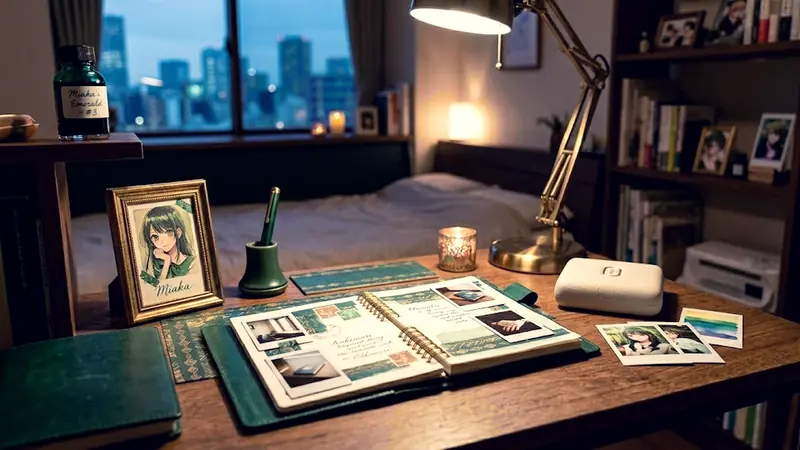
This is not nostalgic craftsmanship. It is the industrially sophisticated response to a cultural phenomenon that in Japan has a precise name: Oshi-Katsu. Literally, "support with devotion." It is the practice — widespread among Japanese under-35s — of building the entire aesthetic of one's daily life around an idol, a character, a brand, or a specific passion. If the object of devotion has emerald green as its identifying color, then the diary will have an emerald green cover, matching rings, and ink custom-blended in that same shade. The agenda ceases to be an organizational tool and becomes a portable sanctuary, a manifesto-object of its owner's emotional identity.
Paper Tailoring and Modular Luxury
Kakimori is the most visible epicenter, but it is not the only player in this expanding market. On the masculine and professional luxury front, the brand Plotter has intercepted a different segment: designers, architects, business executives who are not seeking artisanal romanticism but modular perfection. The Plotter system operates on a principle of subtraction: you purchase only a sheet of fine leather and a brass spine. The contents — card pockets, metal rulers, paper types — are chosen and assembled by the user autonomously, with a logic that recalls the configuration of a high-end computer more than the purchase of an agenda. The result is an object that resembles no other object on the market, because technically it does not exist until someone has wanted it.
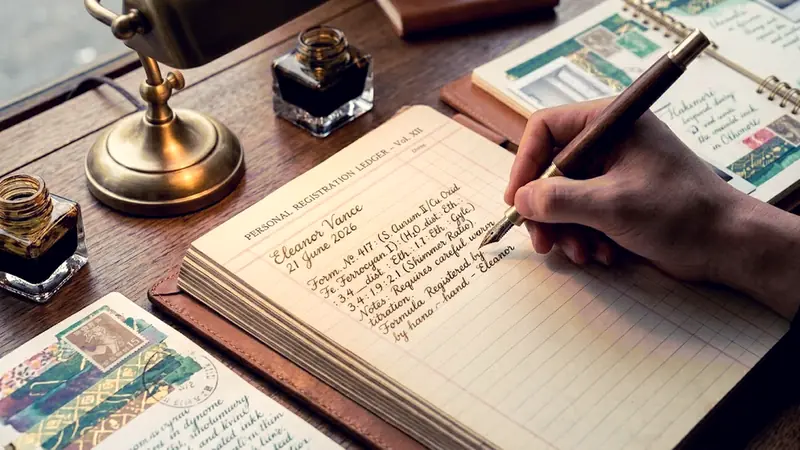
Distribution itself has changed structurally. Traditional stationery shops are out of this game. The new point of contact with the consumer is the stationery boutique, a hybrid between showroom and atelier where purchase time is measured in hours, not minutes, and where the artisan's consultation is an integral part of the product. A business model that, not by chance, recalls the Swiss watchmaking sector more than the stationery trade.
The Social Paradox: The Intimate That Wants to Be Seen
There is, however, an apparent contradiction at the center of all this. The diary was historically born as a secret object, guarded, hidden from view. Yet its contemporary renaissance is fueled by the opposite: by the need to be shown. On Instagram and TikTok, hashtags like #TechoTime and #Journaling have generated fierce global aesthetic competition. The pages — called "spreads" in community jargon — are decorated with stratifications of author washi tape, vintage stamps, and micro-photographs produced by portable mini-printers like Canon Ivy or Fujifilm Instax, capable of printing directly from smartphones onto adhesive paper. The final objective is a single photograph taken from above, perfectly composed, ready for sharing. The secret has become the content.
The Agenda as Status Symbol in the Age of AI
In 2026, however, the phenomenon has acquired an additional and more radical layer of meaning. In a context where artificial intelligence writes, plans, synthesizes, and organizes on behalf of millions of professionals, Asia's executive class — and beyond — is experiencing structural digital fatigue. The cognitive saturation produced by increasingly autonomous tools has generated a luxury reaction: the deliberate, costly, and ostentatious return to the analog. Spending three hundred euros for a hand-stitched leather cover, and dedicating twenty evening minutes to gluing tickets and writing with custom-blended ink, has become the most powerful signal of a privilege that money alone can no longer guarantee: time. In a hyper-accelerated attention economy, the slow gesture is the only luxury that remains truly exclusive.
The global premium stationery market, according to the most recent industry estimates, continues to grow at double-digit percentages year on year, driven precisely by the artisanal personalization segment. Tokyo remains the laboratory, but Kakimori replicants are already opening in Seoul, London, and Milan.