Key Points
- Seasonal overview: Milan Men's Fashion Week spring-summer 2027 has consecrated seven macro menswear trends redefining the contemporary male wardrobe, featuring wide silhouettes, lightweight fabrics and a reinterpretation of workwear.
- Change of guard: Moschino entrusts its creative direction to Loris Messina and Simone Rizzo, founders of the Milanese brand Sunnei, with an official debut scheduled for September at Milan Fashion Week.
- Market impact: The coexistence between major maisons such as Prada and emerging independent realities signals a season of creative pluralism that could reshape the commercial balance of luxury menswear.
Milan reclaims menswear
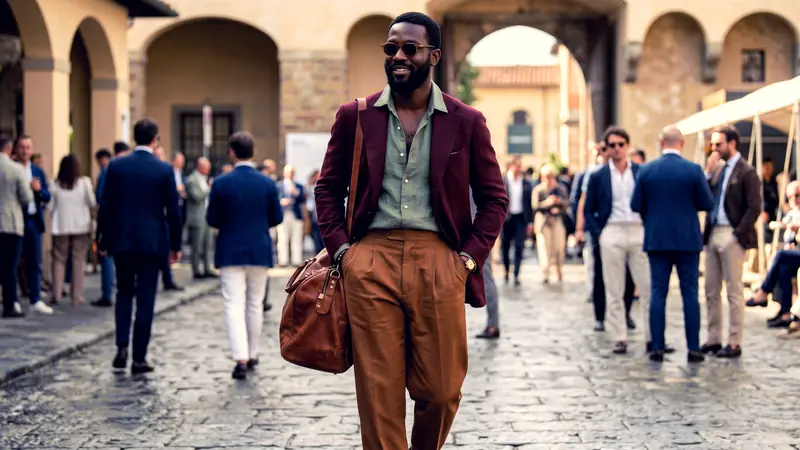
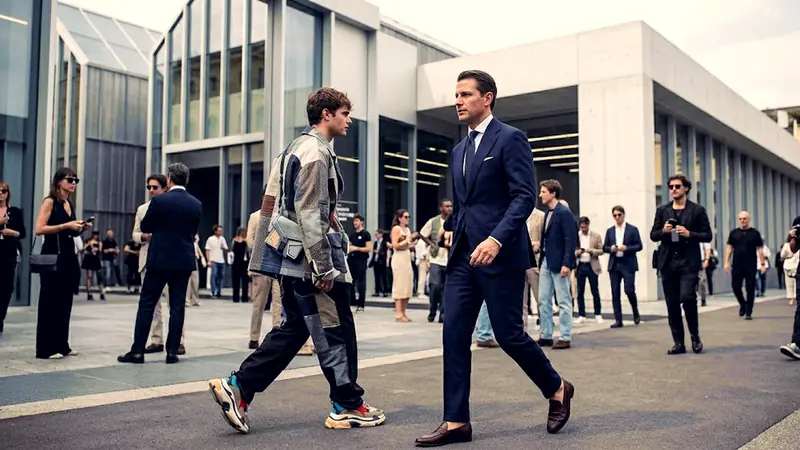
There is a precise moment when a fashion week stops being a sequence of shows and becomes a talking point. Milan Men's Fashion Week, in its edition dedicated to spring-summer 2027, reached that threshold. Not because of a single dramatic twist, but through the sum of signals that, read together, paint a picture of an industry that has stopped navel-gazing and started asking questions about the outside world again. Expanded silhouettes, fabrics that breathe, a nostalgia for manual craftsmanship filtered through contemporary aesthetics: luxury menswear arrived in Milan with a precise agenda and, for once, a coherent one.
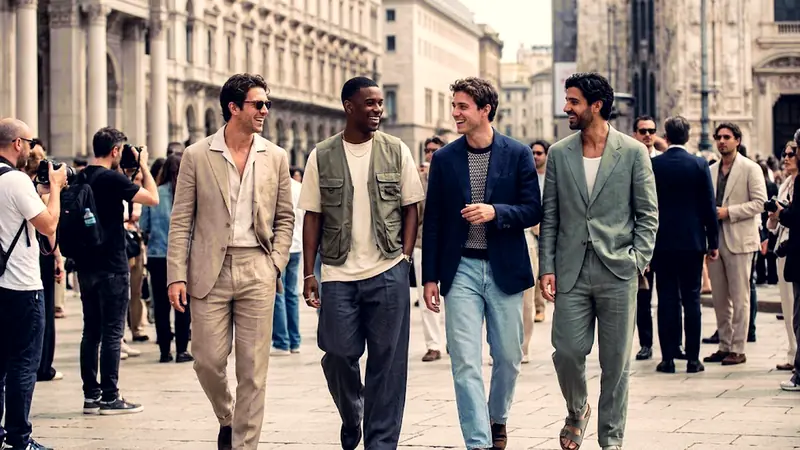
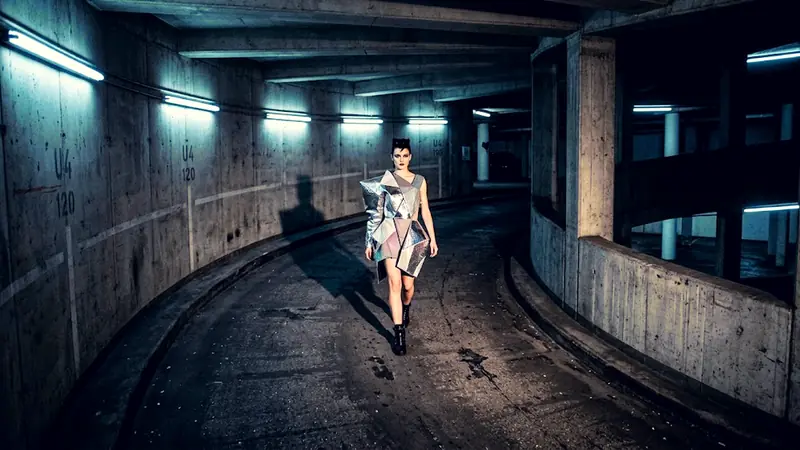
The seven trends identified by industry observers are not abstract categories. They are the stylistic translation of a cultural unease that has been running through the male wardrobe for at least three seasons: the search for an elegance that does not suffocate, a formality that does not exclude movement, a colour that is not decoration but declaration. Workwear reinterpreted through a sartorial lens, lightweight fabrics worn with the gravitas of structured suits, details elevated to the role of primary narrative element: these are all answers to the same question, that of a man who wants to dress well without playing a part.
Thom Browne and the Pixar lesson
In this context, Thom Browne chose the riskiest path: that of total theatre. The American designer staged his Milanese show by transforming the space into a vegetal ecosystem built from four hundred plants crafted in seersucker, the puckered striped fabric that has always been one of his material signatures. The declared inspiration was A Bug's Life, Pixar's 1998 masterpiece: a film about perspective, about seeing the world from below, about the grandeur of the ordinary. This is neither a casual reference nor a publicity stunt. It is a reading key entirely consistent with Browne's overall poetics, which for years has built collections as closed systems, universes with their own internal grammar.
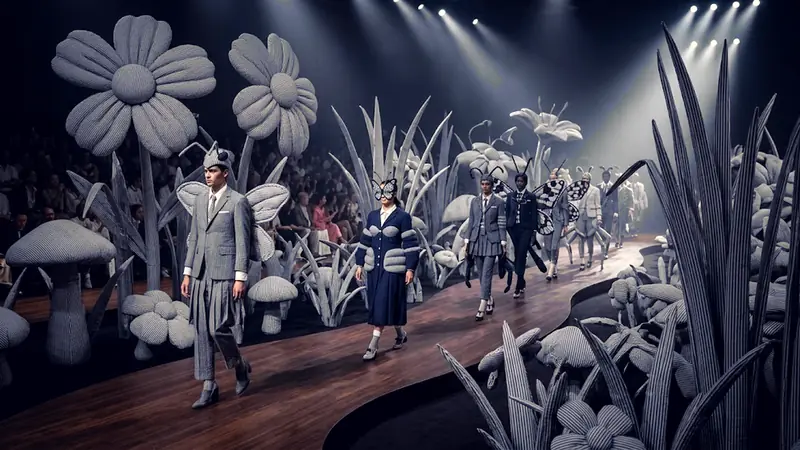
The scenic result was, by unanimous acknowledgement of the international press, unprecedented in the season. But beyond the spectacle, the collection confirmed Browne's ability to use a pop reference without sliding into easy quotation: every garment bore the marks of that miniaturisation of the world, of that tension between human proportion and natural scale, which the Pixar film had explored through animation. Translating it into fabric is an act of intellectual craftsmanship that few designers are capable of.
Moschino sheds its skin: Messina and Rizzo arrive
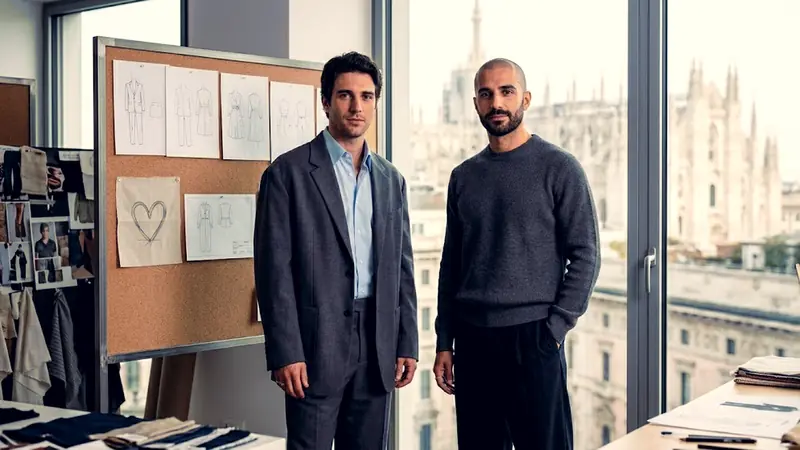
The most disruptive news of the week, however, did not come from the runway but from a press release. Moschino announced the appointment of Loris Messina and Simone Rizzo, founders of the independent brand Sunnei, as the maison's new creative directors. Their debut is set for September, at the next edition of Milan Fashion Week.
The choice is significant on multiple levels. Messina and Rizzo built Sunnei as a laboratory of formal experimentation, with a recognisable visual identity and a loyal community of followers, far removed from the mechanisms of mass fashion. Bringing that sensibility into a brand historically founded on irony and provocation — the irony of Franco Moschino, which was social critique dressed up as fashion — is a high-risk, high-potential gamble. The risk is the loss of identity for both parties. The potential is the birth of something genuinely new in a segment, that of accessible and conceptual luxury, which is desperately seeking a credible voice.
Moschino's creative direction had remained in a grey area following the departure of Jeremy Scott in 2023 and the interim tenure of Adrian Appiolaza. The maison needed a sharp break, not a caretaker. With Messina and Rizzo, Aeffe — the group that controls the brand — has chosen to bet on a vision rather than an established name. It is a logic opposite to the one currently dominating luxury, and for that very reason it deserves attention.
The verdict on a season that matters
Reading together the threads of this Milanese edition — from Prada to emerging realities, from Browne to Moschino — a fashion system emerges that has stopped playing defence and started making proposals again. The major maisons hold their ground with technically impeccable collections; independent brands push at the margins, test new languages, force the boundaries of the male wardrobe towards still uncharted territories. The tension between these two poles is precisely what makes Milan relevant in 2026, in an international landscape where Paris consolidates and London experiments without always finding commercial scale. According to industry projections, luxury menswear is expected to achieve global growth of 6.8% by the end of 2027, with Milan positioned as the primary creative hub for the sartorial segment.