OSCA MT6: The Return of the Cursed Marque Nobody Saw Coming
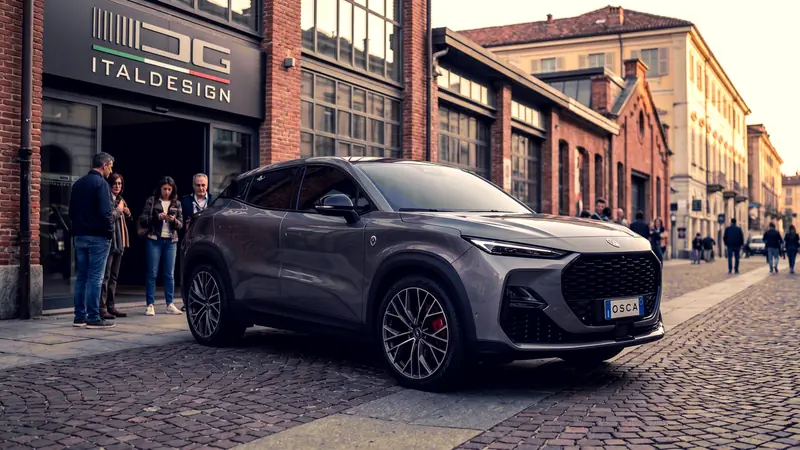
There's something deeply Italian about resurrecting a legendary brand using a Chinese platform, a 1.5 turbo engine, and the Maserati brothers' name as moral armour. Welcome to 2026, where nostalgia is a marketing strategy and DR Automobiles has just pulled one of the most romantic names in Italian motoring history out of the drawer: OSCA, Officine Specializzate Costruzione Automobili, founded in 1947 by the Maserati brothers after their departure from the house of the Trident. Massimo Di Risio, the patron of the DR Group, has bet everything on this revival. The question is: has he won or lost?
Key Takeaways
- Official relaunch in 2026: DR Automobiles brings the OSCA brand back to life with the MT6, a compact coupé SUV priced at €49,000 fully inclusive.
- Changan Uni-T platform: The mechanical underpinnings are Chinese, but the chassis has been revised by engineer Roberto Fedeli, the father of the Alfa Romeo Giulia Quadrifoglio.
- Certified Italian supply chain: Design by Italdesign, carbon fibre by Carbotec, infotainment software by ART, engine electronics by VL, and biofuels by BeonD with emissions reductions of up to 65%.
The DR Formula: China as the Foundation, Italy as the Finish
Let's be honest, without the usual armchair punditry: the OSCA MT6 is built on the Changan Uni-T (a compact SUV from Chinese giant Changan) platform. That's not a scandal — it's a deliberate industrial choice. DR Automobiles has built its entire empire on this model: importing established Chinese architectures, Italianising them with design, engineering, and domestic suppliers, then selling them at competitive prices on the European market. With the MT6, however, the group raises the bar considerably. This isn't badge engineering (simply swapping the badge on an existing car) in its most cynical form: this is a deep transformation project involving some serious names from Italian industry.
Roberto Fedeli and the Chassis You Didn't Expect
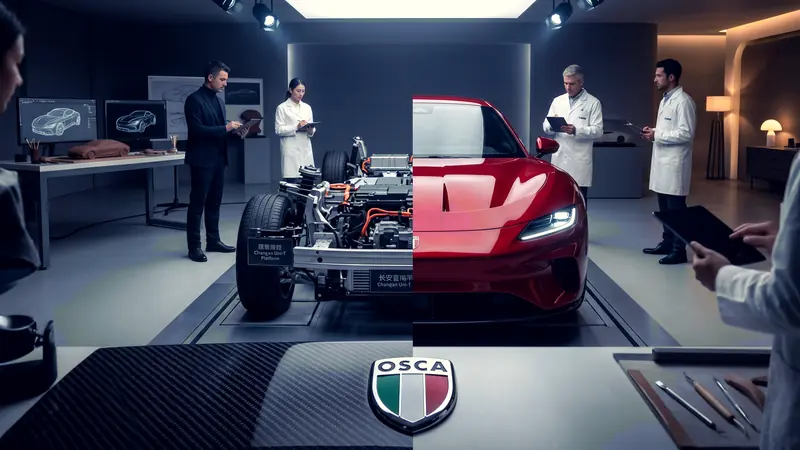
The name that changes everything is Roberto Fedeli. The engineer who signed off on the dynamics of the Alfa Romeo Giulia Quadrifoglio (Italian sports saloon, benchmark of its class) has worked on the original chassis intended for the Chinese market, redesigning its suspension geometry and on-road behaviour. This is no press-release footnote: it's the difference between a car you drive and a car you feel. Pairing Fedeli's work with 21-inch MAK wheels shod with Pirelli P Zero tyres (high-performance rubber, the sporting benchmark) suggests the MT6 genuinely wants to bite the tarmac, not just look like it does. The price of €49,000, all-in, places the car in a fiercely competitive segment — but one where a vehicle with this engineering pedigree and design signed by Italdesign (the historic Turin-based studio, formerly Giugiaro) can carve out a genuine space.
The Cabin: When Italy Decides to Mean Business
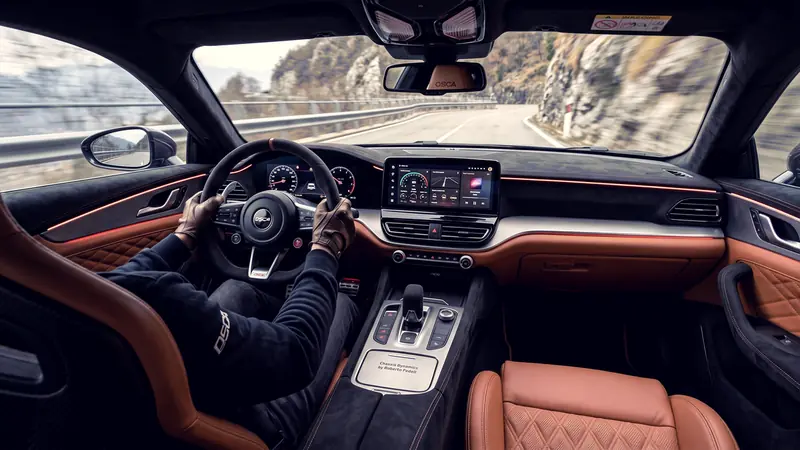
The interior tells the same story in a premium key. Leather, Alcantara (ultra-suede synthetic material, an Italian luxury staple), seats by Recaro (German brand, an icon of the sports seat world), and an infotainment system (on-board multimedia system) based on a dual 12-inch screen setup with software redesigned from scratch by Italian firm ART. The carbon fibre detailing on the exterior is genuine, produced by Carbotec, not printed onto shiny plastic. It's a cabin that wants to communicate artisanal seriousness, and on paper it succeeds. The real unknown remains long-term reliability: the history of DR's brands shows that perceived quality at the point of purchase doesn't always hold up against the miles.
The Engine: The Weak Spot Everyone Can See
A Chinese-built 1.5 turbo producing 180 hp under the bonnet of a car bearing the Maserati brothers' name is a choice that will raise plenty of purists' eyebrows. The powertrain electronics have been optimised by Italian firm VL, bringing output to 180 hp with a stated short-term target of 200 hp. Compatibility with biofuels (fuels derived from renewable biological sources) developed by BeonD, capable of cutting emissions by up to 65%, is a smart argument in a Europe that keeps redrawing its emissions rulebook. But the real narrative — the one that could transform OSCA from an experiment into a phenomenon — comes from the future of the range.
MT8 and the V6 Coupé: Now We're Talking
The industrial plan includes a second SUV, the MT8, and above all a rear-wheel-drive sports coupé powered by a supercharged V6 derived from the Lotus Emira (British sports car, Toyota/AMG engine). Should this rumour be confirmed, OSCA would cease to be a neatly packaged nostalgia story and become a genuinely compelling proposition for anyone seeking driving thrills without supercar-level expenditure. The circle would close in an almost poetic fashion: a marque born from the sporting soul of the Maserati brothers, brought back to life with Chinese technology and Italian ingenuity, setting its sights on a British engine to once again make its presence felt through the corners. Welcome to global motorsport capitalism. It's chaotic, it's contradictory, and it's tremendously fascinating.