
Key Takeaways
- Design as lasting economic value: From Nikon to Ferrari, iconic design proves itself a strategic asset capable of generating value over time, regardless of industry.
- Tradition and innovation as market drivers: Different cultures — from Vietnam to the United States — converge on a shared principle: the past is a competitive resource, not a limitation.
Timeless Design: Why the Past Outperforms the Future
There is an invisible thread connecting a 1950s film camera, a Marvel superhero, an Italian supercar, and a Vietnamese design award. It is not nostalgia. It is economics. In 2026, while the technology industry chases generative artificial intelligence and aggressive miniaturisation, design — real design, the kind that survives decades — is proving to be one of the most undervalued and yet most profitable assets (long-term value resources) in the global market. Joining the dots is not difficult: you simply need to look at where the money is going, and above all, where people's eyes are turning.

Nikon S3: When Form Is Already the Product
Let us start with an apparently niche case. The Nikon S3 Rangefinder (a manual optical rangefinder camera) is a camera originally designed in 1958. And yet, in 2026, the debate over its possible revival is more alive than ever. The reason is straightforward: its design has aged so gracefully that it feels contemporary. Compact body, clean lines, intuitive ergonomics. Nikon, which in recent years has struggled to differentiate itself in the mirrorless (cameras without an internal reflex mirror) market, could find in a reissue (commercial re-release of a historic product) of the S3 an extraordinarily powerful marketing lever. This would not be a mere vintage product, but a statement of brand identity in a saturated market. Design as strategic positioning: that is the lesson.
Ferrari: Space Is the New Engine

Let us move to Italy. In 2026, Ferrari is not only revolutionising its powertrain — the shift to hybrid and electric is now an established fact — but is redefining the very concept of the cabin (the interior space of the car). The Prancing Horse's new vision places space and design as primary differentiating elements, as if to say that the engine, however extraordinary, is no longer sufficient to justify a price that easily exceeds €300,000. This is an enormous paradigm shift (a reference model that guides an entire industry). Ferrari is conceptually moving closer to the world of experiential luxury, where what matters is not only performance, but the environment in which it is experienced. This is a language the premium automotive sector knows well, but one that Maranello is now deploying with unprecedented radicalism. The result? A brand that no longer sells merely speed, but a lifestyle encoded in metal and carbon fibre.
Marvel and Design as a Global Cultural Language
In the United States, Marvel has unveiled a new design for Iron Man that breaks with the established aesthetic of the past twenty years of the MCU (Marvel Cinematic Universe, a shared narrative universe). The move is not purely creative: it is simultaneously commercial and cultural. At a time when cinematic franchises (narrative brands with commercial licences) are struggling to renew their audiences, a radical redesign of the most iconic character in the Marvel universe sends a precise signal. Investment in design is used to recapture attention, to generate organic conversation, and to sell merchandise (products derived from intellectual properties). Design, once again, as a primary economic lever. Not an accessory. Central.
Vietnam: Tradition as Creative Infrastructure
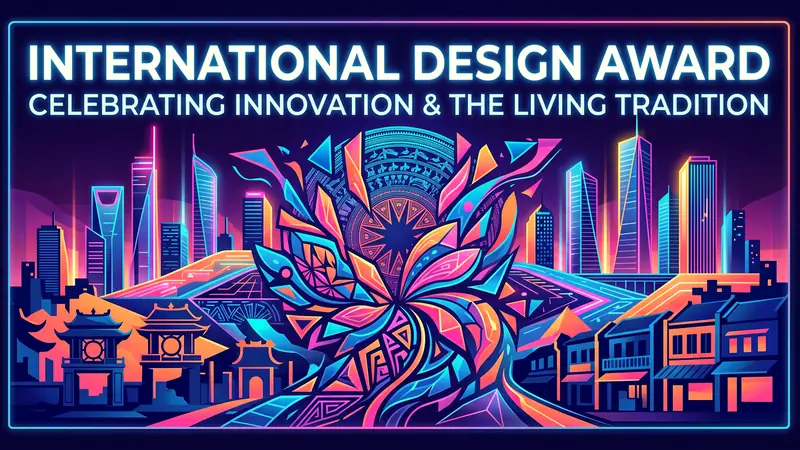
Perhaps the most interesting, and least obvious, case comes from Vietnam. The director of the Trân Bảo Việt Nam International Design Award articulated a position that deserves global attention: tradition is not a museum, but a living organism that must breathe with the times. Applied to graphic design, this principle produces something powerful — an aesthetic that does not imitate the past, but metabolises it (assimilates it, transforming it into new creative energy). In an economy like Vietnam's — growing strongly and increasingly integrated into global value chains — this philosophy is not merely cultural: it is a strategy of competitive differentiation. Design rooted in local tradition becomes a comparative advantage (relative superiority in a specific market) in a homogenised global marketplace.
The Common Thread: Design Is Macro
What connects Nikon, Ferrari, Marvel, and Vietnam? The awareness — increasingly widespread among companies, institutions, and creatives — that design is not decoration. It is strategy. It is identity. It is, ultimately, measurable economic value. In an era in which AI can generate functionality in a matter of seconds, what cannot be replicated algorithmically is the authenticity of a form that has traversed time and emerged stronger for it. The market knows this. Investors are learning it. And in 2026, we are simply witnessing the formalisation of a truth that great designers have always known: beauty endures. And when it endures, it is worth something.