AI Doesn't Need Your CV: Why the Job Market Is Looking in All the Wrong Places
There is something deeply paradoxical about the way companies talk about artificial intelligence in 2026. The word "innovation" echoes everywhere — in press releases, LinkedIn posts, investor presentations — yet the moment you open any job board, you are instantly transported back twenty years. Five years of coding experience. Seven years in software editing. A master's degree. On-site presence. As though the future were still measured in years of seniority and hours spent at a desk.
The problem is not artificial intelligence. The problem is who is trying to adopt it without truly understanding what they are looking for.
The Paradox of the "Innovative" Recruiter
Recruitment agencies, large corporations, startups that brand themselves as disruptive: all of them publish AI-driven workflows, all of them claim to be pioneers of digital transformation. Then they post a job listing and ask for references, certified prior experience, and a willingness to clock in at the office. It is like trying to build a rocket using instructions written for a horse-drawn cart.
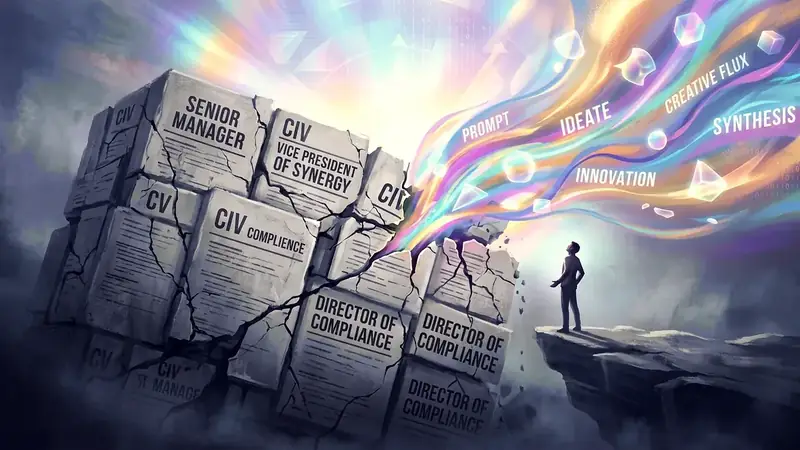
An honest translation of many job adverts today reads something like this: "Show us how much you are willing to put up with a working model that grows more obsolete by the day." How many hours can you sit at a desk? How many pointless meetings can you endure? Do you have a piece of paper certifying that someone, years ago, taught you something a language model can now do in thirty seconds?
The Tools Belong to Everyone. The Ideas Do Not.
Here is the point that most people miss: in the age of AI, the tools are democratic. Anyone with an internet connection and genuine curiosity can access technologies that, until recently, were the exclusive preserve of entire engineering teams. Learning is available to all, regardless of academic background or professional history.
What cannot be replicated with a prompt is lateral thinking, an uncontaminated perspective, the ability to ask questions that those already inside the system have long since stopped asking. And who tends to possess these qualities in abundance? Not necessarily someone who has spent the last decade inside a corporate structure.

Some of the most surprising and productive collaborations in recent months? With a pizza chef and with someone who cleaned holiday apartments for a living. Brilliant ideas, unexpected approaches, solutions no MBA-holding consultant would ever have surfaced. The specifics remain confidential — professional discretion — but the message is clear: the title before your name does not determine the quality of your thinking.
LinkedIn: A Platform of the Past Dressed Up as the Future
LinkedIn has every ingredient needed to be the platform for a new global world of work: people connected from every corner of the planet, cross-functional skills, remote collaboration. In theory, a professional could work from French Polynesia with a company based in Madagascar and nobody would bat an eyelid.
In practice, it has become the stronghold of the old system wrapped in a modern filter. Recruiters sending lists of candidates as though they were supermarket leaflets — every profile photographed, labelled, and put up for sale — with no genuine understanding of what an organisation that truly wants to evolve actually needs today.

- The search is for the perfect candidate on paper, not the most suitable thinker for the problem at hand.
- Physical presence is prioritised in an era where asynchronous and distributed working is already an established reality.
- Past career paths are evaluated instead of the capacity to adapt to scenarios that did not exist until yesterday.
- Credentials are confused with intelligence, job titles with value, experience with vision.
The Future Belongs to Those Who Are Not Afraid to Have No CV
The traditional world of work is not simply in crisis: it is on life support, kept alive artificially by those with too much to lose in admitting that the rules of the game have changed. But systems that resist change do not survive — they grow rigid, they break, and they make way for those who had already stopped asking for permission.
The companies that will succeed in the coming years will not be those with the most rigorous selection processes or the longest lists of requirements. They will be those capable of recognising the value of a raw idea, a fresh pair of eyes, a mind not yet formatted by the system. Those who can look at a butcher, a barista, or a supermarket checkout assistant and ask themselves: what does this person see that I can no longer see?
Because in the age of artificial intelligence, the scarcest resource is not technical expertise. It is the courage to think differently. And that is something no job advert has yet figured out how to look for.