
Bangkok, between a food cart and a conversation worth more than a thousand travel guides
I was wandering without any particular destination through one of those Bangkok alleyways where the air smells of lemongrass, frying oil and something indefinable that hits your nostrils in the best possible way. That's where I ran into him: a middle-aged man, stained apron, wide smile, sitting on the edge of his cart as if he had been waiting for exactly me. He didn't speak perfect English, I don't speak Thai, and yet in twenty minutes he explained his city to me better than any travel app ever could. This is the kind of journalism I care about doing.
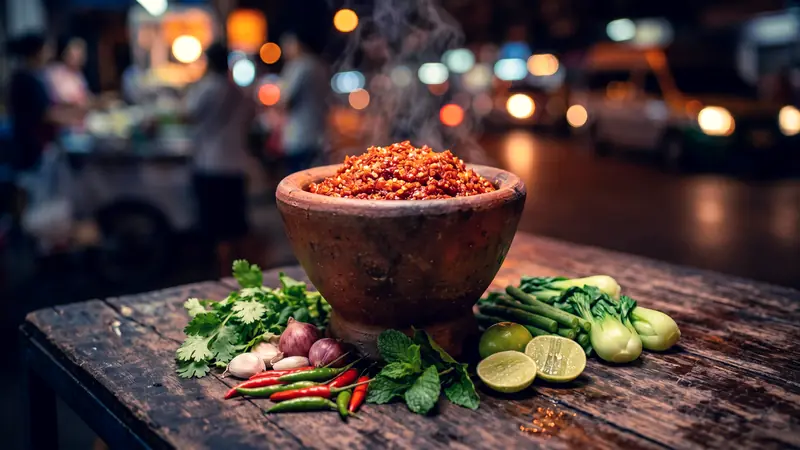
The first thing he told me, almost with childlike pride, was about his favourite dish: everything that revolves around nam phrik (a traditional sauce made from pounded chillies). Not the watered-down version for tourists — the real one: thick, sharp, served with boiled vegetables that seem almost like an act of humility beside the power of the sauce. He offered me a spoonful. I broke into a sweat. I asked for seconds. That is the difference between eating and understanding a culture.
The problem no Michelin guide ever tells you
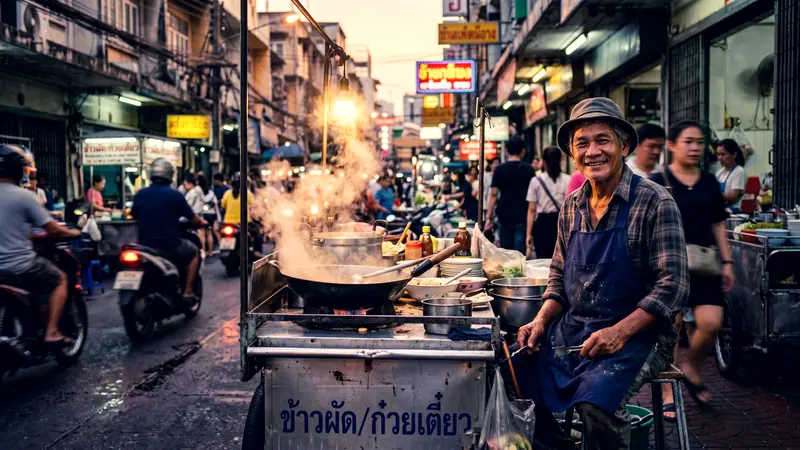
Then the conversation turned more serious. I pulled out my notebook. The biggest challenge for those who make a living from street food in Bangkok today, in 2026, is neither competition from restaurants nor the economic crisis. It is space. The city is growing vertically and horizontally; large urban regeneration projects are "eating up" the pavements, the alleyways and the grey zones where food carts have found their natural home for decades. Spaces are being reduced, regulated or simply wiped out by a municipal decree.
"The important thing," he told me, gesturing towards his cart in a way that seemed to embrace the entire street, "is to maintain accessibility." Not just physical, but economic. Thai street food has historically been the food of the people, not the elite. If you move it inside a standardised food court in a shopping mall, everything changes: the price, the atmosphere, the very meaning of the experience. Hygiene is a legitimate concern — nobody denies that — but the solution cannot be the sterilisation of the experience itself.
Innovation yes, but with roots firmly planted
On this point, my interlocutor surprised me. He is not a pure nostalgist. He talks about innovation with respect, not fear. He calls it "growth for the future", and the one condition he sets is this: preserving the "foundation of the main flavours". The harmonious balance between sour, salty, sweet and spicy is the genetic code of Thai cuisine. Within that framework, everything else is negotiable:
- new preservation techniques
- more refined plating
- presentations that speak to new generations and to foreigners
But if you lose that balance, you are not innovating — you are simply cooking something else and calling it Thai.
The most common misconception: Pad Thai and Tom Yum Goong
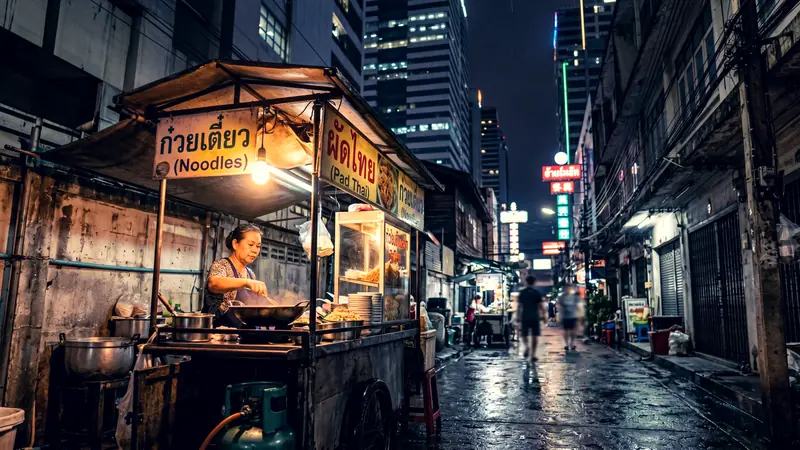
This is where we get to the most common misconception, the one that makes him raise his voice slightly. Pad Thai and Tom Yum Goong — the two most famous Thai dishes in the world — are also the most misunderstood. Foreigners expect a sweet Pad Thai and a Tom Yum Goong like volcanic lava. Both expectations are wrong. The true essence, he explains with the patience of someone who has said this a thousand times, is "harmony and the three flavours": depth of taste, contrast, no single element overpowering the others. It is almost a philosophy before it is a technique.
Tourism: an imperfect but necessary ally
On tourism, he holds a pragmatic view, far removed from both uncritical enthusiasm and snobbish rejection. The flow of travellers, he tells me, helps mainly to "promote": it pushes local communities to rediscover and preserve ancient recipes as a point of identity, not as museum folklore. The tourist seeking an authentic flavour becomes, paradoxically, a guardian of tradition.
Of course, some restaurants dial down the spiciness so as not to frighten Western palates. He understands it. He calls it "understandable commercial adaptation", not betrayal. The red line lies elsewhere: when you yourself no longer know how the original dish is supposed to taste, then you have lost something irreversible.
We said our goodbyes as his cart began drawing the first customers of the evening. Bangkok was lighting up all around us. I walked away with the certainty that the best conversations are not something you seek out — they wait for you in an alleyway, perched on the edge of a food cart, with a spoonful of nam phrik extended towards you like an invitation.