Key Points
- DTV Visa for digital nomads: Thailand offers the DTV (Digital Nomad Visa) with a duration of five years, the primary reason for the author's relocation from the Camargue, France, to Bangkok.
- Bangkok demographics: The actual population of Bangkok exceeds 11 million inhabitants within city boundaries, expanding to over 14 million in the metropolitan area, compared to only 5.5 million officially registered residents.
- Enterprise technology ecosystem: Bangkok hosts advanced infrastructure such as True Digital Park (sandbox for IoT, 5G networks and automation) and Fortune Town IT Mall, establishing itself as a relevant operational base for Artificial Intelligence specialists and automated agents.
From digital nomad to Bangkok: AI development, street food and extreme contrasts
I am a digital nomad of South American origin and I work on the development of automated agents in the Artificial Intelligence sector. I have been living without a permanent residence for years now: a few months or at most a year in one place, and then onward, to discover what lies elsewhere. This time, however, I am making a major move. In a month I will leave the Camargue, in France, to relocate to Thailand. The reason? I have never been there and, above all, the country offers the possibility of obtaining the DTV, a visa for digital nomads with a duration of five years. A few hours after making the decision, I terminated my rental contract in the Camargue and purchased the ticket: Paris-Doha, Doha-Bangkok with Qatar Airways. I spent the last few weeks in France increasingly frequenting typical local establishments, savoring with greater attention the atmosphere that I would soon leave behind. Then, the moment of departure arrived. I took the TGV from Avignon toward Paris airport.
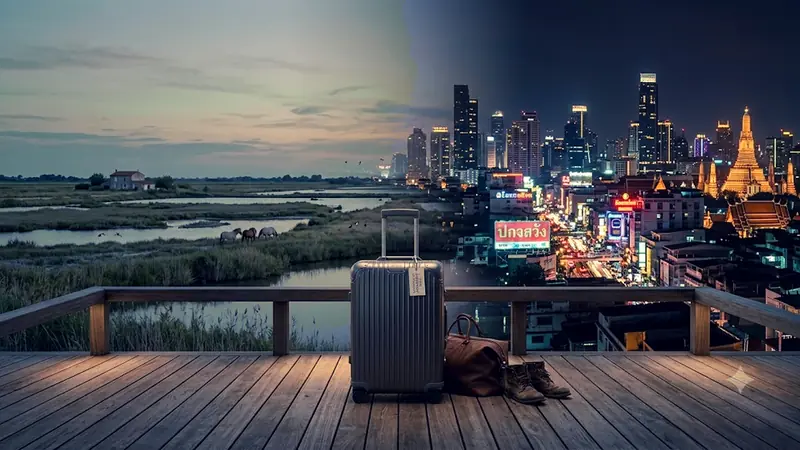
Paris Charles de Gaulle Airport: Brutalist architecture and Art Deco design
The Parisian terminal of Charles de Gaulle welcomes me with its retro-futuristic design, an icon of Brutalism from the 1960s and 1970s dominated by exposed concrete and clean geometries. The central core, affectionately nicknamed "le camembert" by Parisians, is a massive cylinder of ten floors surrounded by seven satellite buildings for boarding. The original architectural idea of Paul Andreu was to create an octopus-shaped structure, physically separating ground operations from aircraft parking areas to optimize logistical flows. The true visual heart of the building is the empty central atrium, open to the sky, where the various levels are connected by a network of escalators suspended inside transparent plexiglass tubes. These tunnels cross dramatically in the void, offering acoustic and thermal insulation but, above all, a profoundly science-fiction aesthetic, so much so that it has been used in numerous films. Before boarding, I traverse the new and vast international hall, born from the union of three satellites. Designers Maxime Liautard and Hugo Toro transformed it by moving away from brutalist concrete to embrace an Art Deco aesthetic, featuring warm lighting, curved geometries, brass and dark marble inserts, all flooded with natural light from the large windows that finally open the view onto the runways.
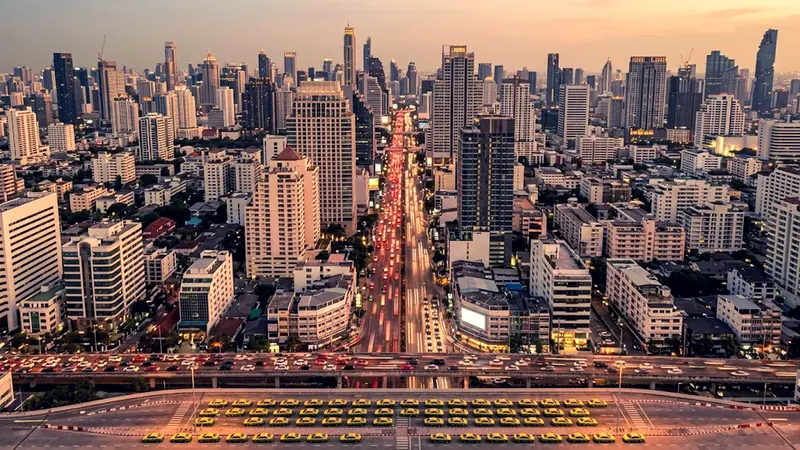
Arrival in Bangkok: Suvarnabhumi Airport and Lumpini Park
The two flights proceed smoothly, facilitated by a convenient three-hour stopover in Doha. Landing in Bangkok immediately clarifies the dimensional scale of the city. Immigration at Suvarnabhumi is an enormous space, with extremely high ceilings, managed with surgical efficiency that never gives you the sensation of being confined, despite the oceanic crowds. After retrieving my luggage, I take a taxi toward my hotel in the Lumpini Park area. Already during the journey I understand that I have entered a crazy, imposing and chaotic ecosystem, in which extreme contrasts coexist and where one can live an excellent quality of life at a fraction of Western costs, residing in hyper-modern condominiums with infinity pools, co-working spaces and 24-hour security.
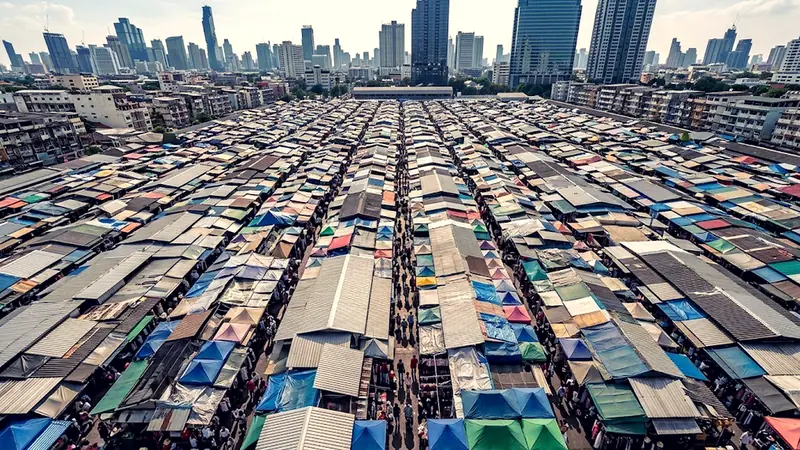
Bangkok demographics: 14 million inhabitants in the metropolitan area
Bangkok is a metropolis whose demographics are complex and stratified. While official records count approximately 5.5 million residents, the actual population living and working within city boundaries exceeds 11 million, expanding to over 14 million when considering the entire metropolitan area. This immense pressure has generated an urban physiognomy of extremely high density, operating continuously 24 hours a day, where enormous glass skyscrapers and dense networks of alleyways brush against each other just meters apart.
Bangkok urban mobility: river, BTS Skytrain, motorcycle taxis and railway market
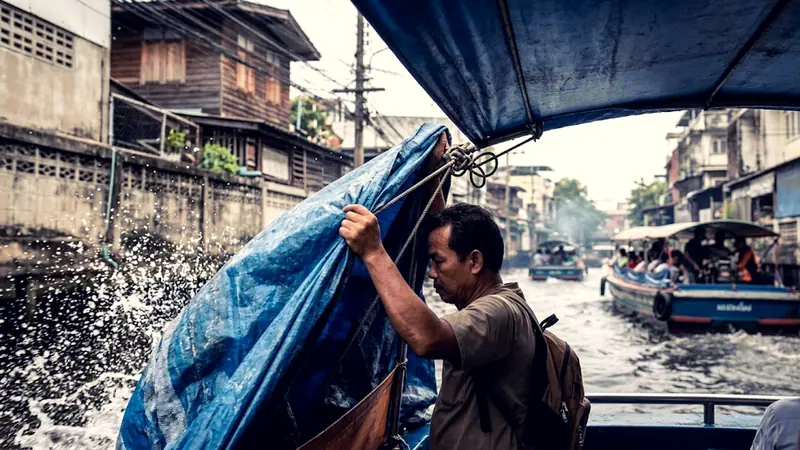
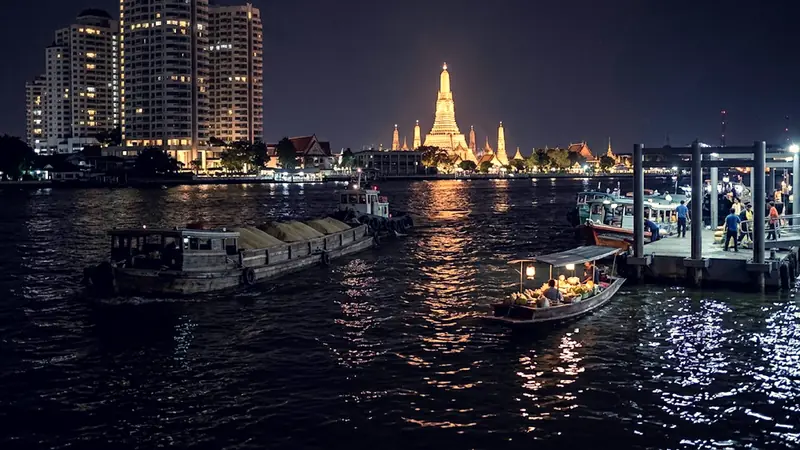
To circumvent ground congestion, the mobility system expands physically across three dimensions. On water, the Chao Phraya river and internal canals function as massive arteries of movement. Aboard the fast boats of the Khlong Saen Saep, passengers operate a rope system to lift heavy side tarps, protecting themselves from splashes of dark water while navigating close to house walls. In the air, the BTS Skytrain wedges itself between skyscrapers, running on reinforced concrete viaducts at the height of intermediate floors and stopping on tracks connected directly to shopping centers. At street level, one relies on the ballistic precision of motorcycle taxis, identifiable by their numbered orange vests, which squeeze millimeter by millimeter through blocked traffic, alongside the famous tuk-tuks heavily modified by their owners with fluorescent LED lights and personalized stereo systems. Markets also merge with infrastructure, as happens at the Maeklong railway market: the entire produce market is built literally over functioning tracks. At the sound of a siren, vendors operate pulleys to retract awnings and move merchandise just centimeters, allowing the train to pass flush with the baskets, then restore the market in a matter of seconds.
Bangkok extreme gastronomy: from Jay Fai (Michelin Star) to Boat Noodles
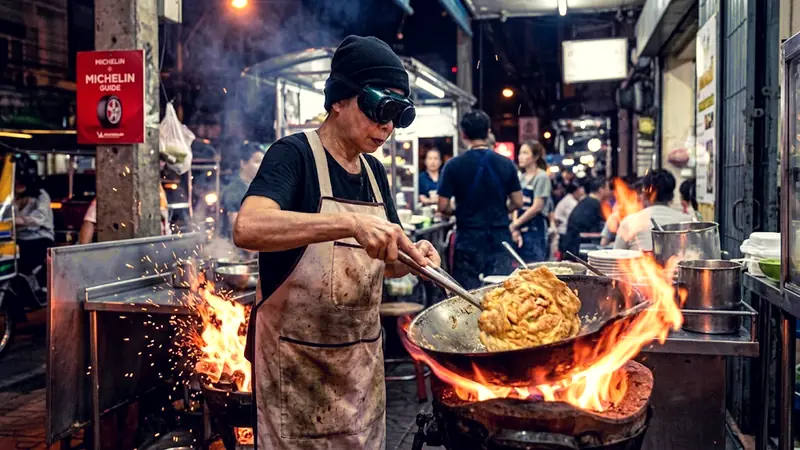
The culinary infrastructure of the metropolis is equally extreme and merges street cooking with haute cuisine, in a cycle of uninterrupted preparation on sidewalks. On one hand there is pure entomophagy in the markets, where silkworms, scorpions and grasshoppers are fried in enormous pans and consumed as a regular protein source; on the other hand one encounters excellences such as Jay Fai, a street stall awarded a Michelin Star, where the cook prepares celebrated crab omelets over extremely hot charcoal braziers, wearing large welding goggles to protect herself from the flames. Historical traditions remain intact: Boat Noodles are served in tiny portions, a legacy from when vendors prepared them on moving boats to avoid spilling boiling broth, which is still thickened by pouring raw animal blood during boiling. The dynamics of service often border on mechanical performance. At Ka-Tron, roasted chickens are launched from a metal catapult and caught in mid-air by a waiter on a unicycle, who impales them on a spiked helmet. Night then activates inflexible logistical rituals, such as the rule of Jeh O Chula, which triggers physical encampments of hundreds of people on the asphalt to consume its celebrated sour soup served strictly only from 23:00 onward, or the thermodynamic stasis of Wattana Panich, a restaurant where a gigantic cauldron of stew boils without pause and whose base broth has not been disposed of for over fifty years, forming thick solidified rings along the brass edges.
Bangkok markets and shopping centers: IconSiam, Terminal 21, Chatuchak and beyond
Commerce also operates on unique scales and conceptual isolations. Large malls are true hyper-climatized microcosms: IconSiam hosts navigable internal rivers on which wooden vessels operate; Terminal 21 is a perfect airport simulation where each floor reproduces the architecture of a different global city; MBK Center is a massive labyrinth of 2,000 stalls that brings the rough logic of street market negotiation indoors. Outdoors, spaces assume titanic or extremely niche connotations. There are the 35 acres of Chatuchak Weekend Market, down to the silent Amulet Market, a covered labyrinth where monks and collectors analyze bone and clay fragments with watchmaker's magnifying glasses. There even exist temporal anomalies, such as Nightingale-Olympic, a large department store without air conditioning crystallized in the 1960s where elderly staff sell rusty gym equipment, or Papaya Design Furniture, a chaotic archive where hills of cathode ray tubes and surgical equipment pile up to the ceiling. Some commercial networks exist only for a few hours, such as the Pratunam Dawn Market, which occupies entire street lanes from 4:00 to 8:00 in the morning and where exchanges occur in darkness with enormous black bags, then disintegrate without a trace before daytime traffic.
Bangkok nightlife: rooftop bars, Nana Plaza, Havana Social and flower market
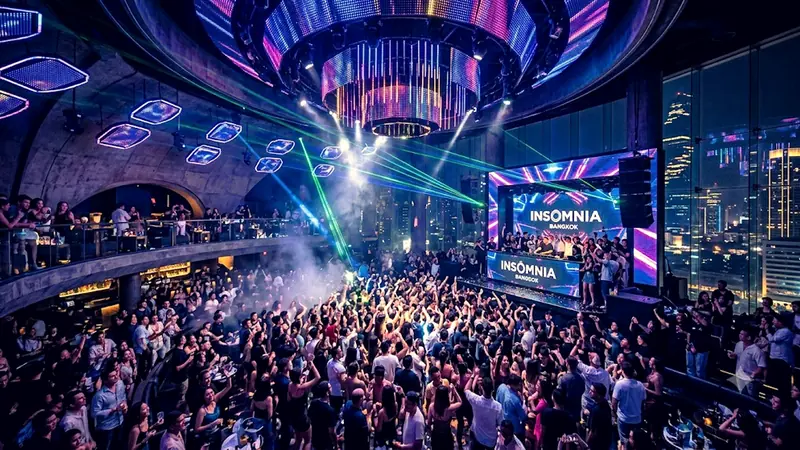
Nightlife further amplifies these physical contrasts, moving from extreme heights to hyper-saturated pedestrian districts with overlapping neon. Rooftop bars, such as Mahanakhon, challenge altitude between the 60th and 80th floors with terraces devoid of upper visual barriers and cantilevered glass floors. In districts like Nana Plaza or Soi Cowboy, adult entertainment operates in the open, coexisting on the same sidewalk with fruit carts. The city hides inaccessible venues except through specific physical logic, such as Havana Social, masked behind a telephone booth that unlocks only by entering a code, or the Srinagarindra Train Market, an area dominated by industrial recovery aesthetics, with bars inserted in ex-freight cars and decommissioned helicopters mechanically hoisted onto roofs. As clubs close, the Pak Khlong Talat flower market reaches its operational peak between two and four in the morning, with thousands of workers seated on the ground braiding tons of votive garlands for the first light of dawn.
Bangkok urban anomalies: Varanus salvator, Sathorn Unique and inhabited Boeing 747s
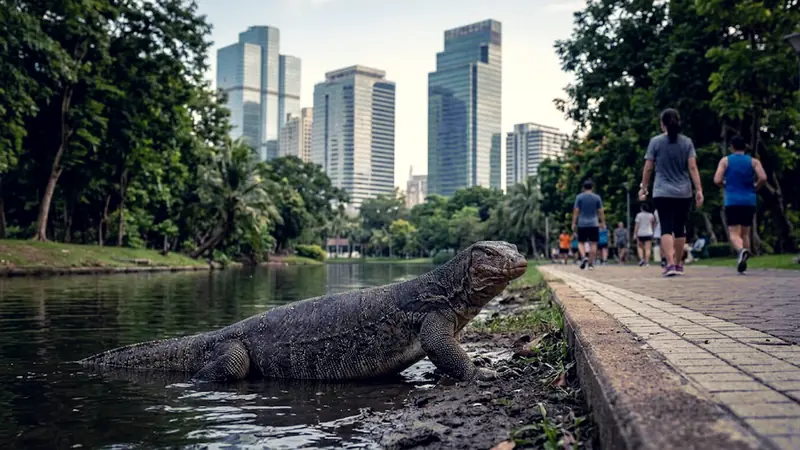
Living and working in this city, one cannot help but explore the anomalies and invisible infrastructure that make it breathe. Beyond the better-known mystical rituals, the urban landscape imposes direct contact with biology, religion and urban logistics. In Lumpini Park, my residential area, coexistence with Varanus salvator is absolute: enormous prehistoric carnivorous reptiles live freely in the canals, emerging to hunt or bask in the sun, walking undisturbed on paved paths among pedestrians. It is a city of imposing ruins and physical paradoxes, from the spectral bulk of Sathorn Unique, the skyscraper abandoned in '97 that dominates the river like a monolith, to the mangrove maze of Bang Krachao, a green lung without railings to cross by bicycle, to the Ramkhamhaeng aircraft cemetery, where local families inhabit the holds of dismantled Boeing 747s. Religion itself manifests through tangible architectures and contracts: the Wat Samphran temple is physically enveloped by the coils of a giant dragon traversable from within; the Erawan Shrine transforms prayers into cash transactions paid to musicians and dancers in the middle of traffic; the Wat Pariwat temple embeds statues of Batman and David Beckham at the base of its sacred altars; and city spirits are daily quenched with the votive offering of bottles of red Fanta, left strictly uncapped to simulate the blood of ancient sacrifices. Not to mention the mass kinetic paralysis imposed at 08:00 and 18:00, when the broadcast of the national anthem literally freezes the entire human flow of the metropolis on the sidewalks.
Bangkok's most extreme hotels: from Bangkok Tree House to Sook Station
Hotel accommodation also does not escape this conceptual drive. Hotels like Mustang Nero transform commercial buildings into dark chambers of wonders populated by taxidermized animals. The Bangkok Tree House eliminates walls and roofs to leave guests sleeping physically outdoors in the swampy jungle. Those seeking the resonance of the river find refuge at Loy La Long, a teak stilt house whose floor gaps allow perception of the uninterrupted water current. And those seeking extreme ergonomics can isolate themselves at Sook Station, a faithful reproduction of a reinforced concrete prison complete with bars, uniforms, mugshots at the entrance and automated curfew.
Bangkok as a technology hub for Artificial Intelligence: True Digital Park and Fortune Town IT Mall
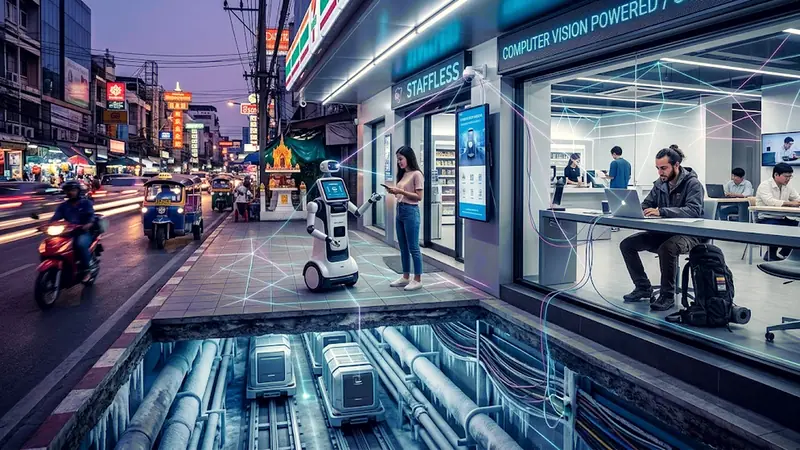
As a specialist in artificial intelligence and automated agents, the aspect that closes the circle of this new operational base of mine is the enterprise technology ecosystem. Bangkok is not just street food and spirituality. Spaces like True Digital Park function as gigantic urban sandboxes for testing IoT, 5G networks and automation. Heavy hardware and extremely low-level data recovery find their vertical expression at Fortune Town IT Mall, where micro-soldering and complex logical repairs occur daily far from mass consumption circuits. Meanwhile, the integration of physical agents on the territory is already a silent and capillary reality, evident in restaurants served by fleets of robots for spatial navigation or in unmanned convenience stores governed by computer vision neural networks. Everything is connected, often through enormous hyper-climatized underground pedestrian tunnels in reinforced concrete that, defying swampy terrain, function as protected arteries to bypass monsoons and the extreme heat of the surface.
The entire city is a complex architecture of hardware, biology, faith and code, and as of today it is my new laboratory.