
Garlic, Chilli and Survival: Why Southeast Asia Eats the Way It Does
You arrive in Vietnam, Laos, Indonesia. You order something from the menu without understanding a word. The dish arrives and the first bite sets your mouth on fire. You ask for a "non-spicy" version and they look at you as if you'd ordered a pizza without dough. After a few weeks of digital nomadism between Bangkok, Hanoi and Yangon, I stopped fighting it and started understanding it. I asked locals, dug into the scientific literature, spoke with street food vendors and a few elderly people who remembered the time before refrigerators. What I found is not a story about taste: it's a story about survival, chemistry, colonialism and neuroscience. Garlic and chilli are not condiments. They are technology.
Key Takeaways
- Scientific origin of spice use: A 1998 study by Paul Sherman and Jennifer Billing at Cornell University demonstrated that the use of spices is directly proportional to average temperatures across the globe.
- Physiological mechanism of spiciness: Capsaicin (the active compound in chilli) binds to TRPV1 receptors (heat sensors in the mouth), triggering sweating that lowers body temperature.
- The Philippines as inverse proof: The Philippines, colonised by Spain for over 300 years, uses massive quantities of garlic but almost zero chilli, demonstrating that colonial history completely reshapes dietary habits.
Darwinian Gastronomy: When Food Was a Matter of Life and Death
Before talking about flavours, we need to talk about corpses. In a tropical climate with temperatures nudging 35°C and humidity at 90%, a piece of meat or fish left out in the open air rots within a matter of hours. Before the cold chain (a system of preservation at controlled temperature), every meal was a bacterial game of roulette. Allicin (the antibacterial sulphurous compound in garlic) and capsaicin (the irritant alkaloid in chilli) were not spices: they were medicines. They killed pathogens in food, masked the flavours of early spoilage and, above all, protected those who ate from intestinal infections that in that era were death sentences. Sherman and Billing proved this with irrefutable data: the closer you get to the equator, the more traditional recipes contain antimicrobial spices. This is not culture. It is natural selection applied to cooking. Those who didn't use garlic and chilli fell ill. Those who fell ill died. Those who died did not pass their recipes on to their children.

The Thermoregulation Paradox: Eating Fire to Stay Cool
It sounds like madness, and it sounds even more so when you're perched on a plastic stool in Chiang Mai in 38-degree heat and the street food vendor hands you a bowl of curry emitting visible steam. And yet biology is on its side. Capsaicin binds to TRPV1 receptors (thermal sensors in the oral mucosa), tricking the brain into believing the body is burning. The automatic response of the nervous system is gustatory sweating (the production of sweat induced by spicy food). The sweat evaporates on the skin and lowers body temperature by several degrees within minutes. It is a biological air conditioner — free, portable and recharged with every meal. In the absence of electricity, fans or any cooling infrastructure whatsoever, this was the only technology available. And it worked.
The Dictatorship of Rice and the Economy of the Poor Man's Spice
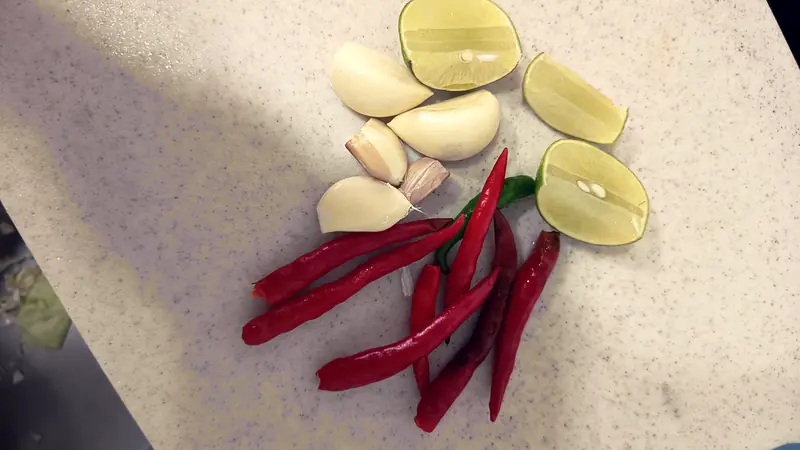
There is a brutally economic reason behind all of this, and nobody talks about it enough. White rice is the staple food of a billion people in this region: high in calories, filling, but completely flavourless. Black pepper, for centuries, was so precious it was used as a medium of exchange. Garlic and chilli, by contrast, grew like weeds in tropical climates, without irrigation, without tending, at zero cost. A handful of crushed garlic with a few bird's eye chillies (a small and lethal chilli variety) transformed a kilo of white rice into an appetising meal for an entire farming family. This is not gastronomy: it is the engineering of economic survival. And when one generation grows up eating this way, the next generation cannot imagine food any other way. Necessity becomes identity.
The Neurochemistry of Addiction: How Pain Becomes Pleasure
The burn of chilli is, neurologically speaking, pure pain. The body does not distinguish between a flame and a massive dose of capsaicin: it registers both as tissue damage (injury to bodily tissue). The response is automatic: the brain releases endorphins (endogenous painkillers) and dopamine (the neurotransmitter of pleasure and reward). The result is a mild euphoria, a sense of post-meal wellbeing that has nothing mystical about it and everything chemical. Eating spicy food every day, two or three times a day, for an entire lifetime, creates a genuine neurobiological dependency. Asian palates are not "more resistant" to spice for mysterious genetic reasons: they are simply desensitised through repetition and, at the same time, dependent on the endorphin rush that only ever-increasing doses can produce. It follows the same logic as caffeine tolerance, but applied to food.
Country by Country: How History Rewrites Chemistry
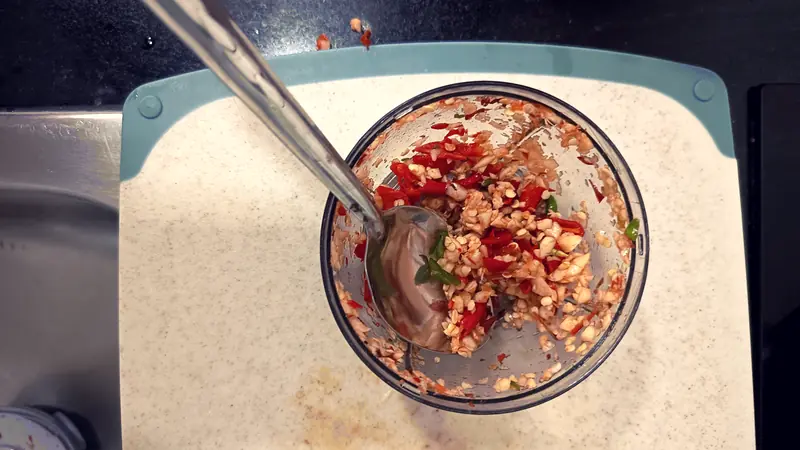
Thailand adopted chilli with such speed after its Portuguese introduction at Ayutthaya in 1600 that it renamed black pepper Prik Thai, meaning "Thai pepper", as if to erase the memory of what had existed before. Thai cuisine does not seek heat as an end in itself, but rather a mathematical harmony of five simultaneous flavours: sour, sweet, salty, bitter and spicy. Garlic and chilli are pounded raw in a granite mortar to release the essential oils (volatile aromatic compounds) before heat can destroy them. In Indonesia and Malaysia — nations that were literally the Spice Islands — the historical irony is razor-sharp: they cultivated cloves and nutmeg to enrich European merchants, yet for their own daily food they adopted chilli because it was the only spice they could afford. The result is Sambal (a paste of chilli, garlic, shallots and fermented shrimp paste), a condiment so deeply embedded in the culture that serving a meal without it is considered socially unacceptable.
Vietnam introduces the most sophisticated medical dimension in the entire region. Vietnamese cuisine is governed by the principle of Âm Dương (the local equivalent of the Chinese Yin and Yang): fish, pork and the abundance of fresh herbs consumed daily are classified as "cold foods" that slow digestion and create energetic blockages. They must be obligatorily balanced by garlic and chilli, classified as "hot foods". This is not superstition: it is an empirical medical system (based on practical observation) refined over centuries of clinical observation. Laos, often overlooked by travel bloggers, is arguably the country with the spiciest food in all of Asia — not Thailand. In a landlocked nation where protein arrives from the Mekong River and is often consumed raw or fermented in preparations such as Padaek (long-fermented fish paste), massive doses of raw chilli and garlic charred over embers were not a gastronomic affectation: they were the only available antiparasitic prophylaxis (prevention against parasites).
The Anomalies That Explain Everything: The Philippines, Cambodia and Singapore
Exceptions are always more instructive than the rule. The Philippines are the perfect inverse proof of the entire thesis: colonised by Spain for over three centuries, they inherited the Iberian culture of sofrito (a cooking base of garlic, onion and tomato) and are arguably Asia's greatest consumers of garlic. Yet they dislike spicy food. The national breakfast dish, Sinangag (fried rice with mountains of crispy garlic), does not contain a single gram of chilli. To preserve meat without chilli, Filipinos developed Adobo (meat braised in vinegar, soy sauce and whole garlic): the acidic environment created by the vinegar is so antibacterial that it keeps meat edible for days without refrigeration. Same function, different ingredient. Colonial history simply replaced one antibacterial agent with another. Cambodia, meanwhile, offers the definitive historical proof that chilli is a relatively recent newcomer: the Khmer Empire of Angkor Wat built one of Asia's greatest gastronomic civilisations without ever knowing chilli, relying instead on its own Kampot Pepper (a prized local variety of black pepper), still considered among the finest in the world by leading chefs. When the Portuguese arrived with chilli, the Cambodians never fully replaced their pepper with it. Singapore, finally, demonstrates that when the necessity of preservation disappears thanks to wealth and ubiquitous refrigeration, garlic and chilli survive as cultural glue and as a neurochemical vehicle. Hainanese Chicken Rice (a boiled chicken dish of Chinese origin and Singapore's national dish) is an extraordinarily delicate plate that would make no sense in Southeast Asia without its sauce of fresh chilli, garlic and ginger pounded raw: that sauce preserves nothing and cools nobody. It simply delivers the endorphin rush that modern palates have come to expect as an integral part of the dining experience.
East Timor: Ground Zero and the Closing of the Circle
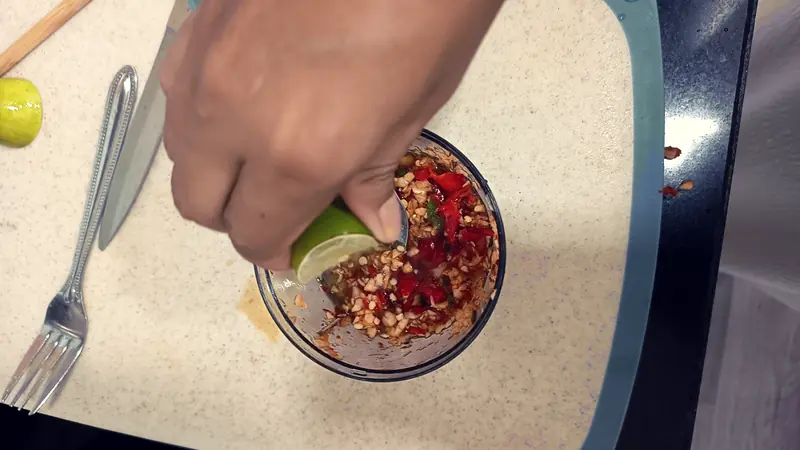
Timor-Leste closes this story in an almost poetic fashion. A continuous Portuguese colony until 1975, it was literally the landing point of South American chilli into the Southeast Asian archipelago, brought by Iberian missionaries and colonisers directly from the Americas. The national condiment, Ai-manas (a paste of local chilli, garlic, onion and lime juice), in a nation marked by decades of poverty and conflict with a purely subsistence-based agriculture, returns to the original Darwinian function in its purest form: mixed with tubers, maize or rice, it provides intestinal disinfection, prevents scurvy thanks to the vitamin C in lime and raw chilli, and tricks the enteric nervous system (the "second brain" in the gut) into producing a false sense of satiety. From Portugal to the Americas, from the Americas to Timor, from Timor to the rest of Southeast Asia: chilli travelled half the world to become indispensable. Not because it tasted good. Because it worked.
Conclusion: The Spice as a Mirror of History
What appears to be a simple excess of flavour in a dish at a restaurant in Vientiane or a night market in Penang is in reality the sediment of centuries of biological adaptation, economic survival strategies, empirical medical systems and colonial trauma. Myanmar invented Sì-byan (a technique of sealing with flavoured oil) to isolate meat from oxygen. Brunei replaced cooking wine, forbidden under Islamic law, with Sambal to achieve the same depth of flavour. Every country found its own local solution to universal problems: heat, bacteria, poverty, hunger. The next time a dish burns your mouth in some corner of Southeast Asia, remember that you are not simply eating: you are ingesting the history of how that civilisation learned to survive. And if you're there eating it, it's probably because it worked.