
Key Takeaways
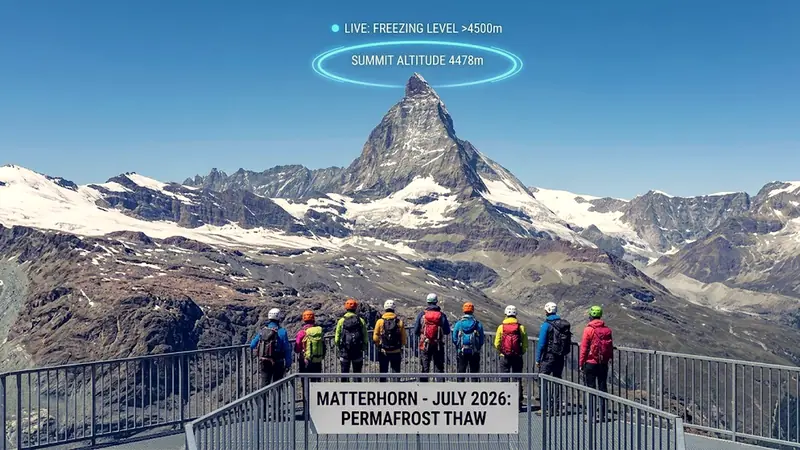
- Freezing level out of bounds: In late June 2026, the freezing level (the altitude where air temperature drops to 0°C) surpassed 4,500 meters, physically exceeding the Matterhorn's summit (4,478 m), triggering massive permafrost melt.
- Documented anomaly: An abnormal waterfall on the Matterhorn's north face was reported by specialized glaciological outlets including Desnivel, with torrents plunging hundreds of meters down the rock wall.
- Systemic impact: Direct threat to Europe's strategic water reserves, hydroelectric output, and summer agricultural water supply.
The Matterhorn Is Falling Apart
A colossal waterfall has appeared on the north face of the Matterhorn. This is not a spectacle. It is a symptom. In late June 2026, the freezing level broke through 4,500 meters, physically surpassing the summit of the most iconic peak in the Alps. The result is visible and undeniable: high-altitude permafrost (permanently frozen ground beneath the surface) is thawing at a rate that standard climate models struggle to track, generating water flows that cascade hundreds of meters down walls that, until recently, were solid ice and stable rock.
Rockfalls, Closed Routes, an Unreliable Mountain

The immediate consequences are brutal and concrete. Accelerated permafrost thaw destabilizes rock structure at depth, multiplying rockfall risk on routes frequented by climbers from around the world. The classic lines on the Matterhorn are becoming unpredictable death traps. This is not alarmism: it is applied physics acting on a mountain that is literally failing from within.
The Real Problem Is Below the Mountain
The heaviest impact, however, is measured downstream, on a continental scale. The progressive collapse of Alpine glaciers is not an aesthetic or tourism issue: it is a direct threat to Europe's strategic water reserves. Summer water supply for major agricultural basins, the hydroelectric (water-powered electricity generation) production chain, and the entire water management architecture all depend on those ice masses. The Matterhorn in 2026 is no longer just a summit. It is a system indicator. And the system is sending signals that cannot be ignored.