
AI: Five Lies the Market Is Selling You as Truth
There's a narrative war going on, and you're the battlefield. On one side, the doomsday prophets who see Skynet lurking behind every chatbot. On the other, the dream merchants promising you that a twenty-dollar-a-month subscription will turn your business into a lean, mean competitive machine. The reality, as always, is more complicated, more interesting, and far less cinematic. It's time to clear the air: five myths about Artificial Intelligence that have been doing the rounds on LinkedIn feeds across the globe, debunked without mercy.

Key Takeaways
- LLMs don't "understand": They are statistical engines that calculate probabilities over tokens, not cognitive entities.
- AI copyright is widely misunderstood: The legal debate concerns the training phase, not some alleged copy-paste in the output.
- Automation targets tasks, not roles: People who know how to use AI will replace those who don't — AI isn't replacing humans.
The Machine That "Thinks": The Biggest Misconception of the Decade
Let's start with the founding myth, the one holding up the entire narrative cathedral. The idea that an AI reasons and understands is, technically speaking, a fantasy. Large Language Models (large-scale language processing models) have absolutely no idea what an apple or a metaphor is. What they do, with brutal engineering precision, is calculate the statistical probability that one token (the smallest unit of text, often a single word) will follow another, based on billions of parameters extracted from an equally vast number of texts. It's autocomplete evolved to an absurd degree. No cognition, no awareness. Just mathematics applied at a mind-bending scale. Understanding this distinction isn't an academic footnote — it's the difference between using a tool and believing you have an ally.

The Great Theft That Doesn't Exist (Or Barely Does)
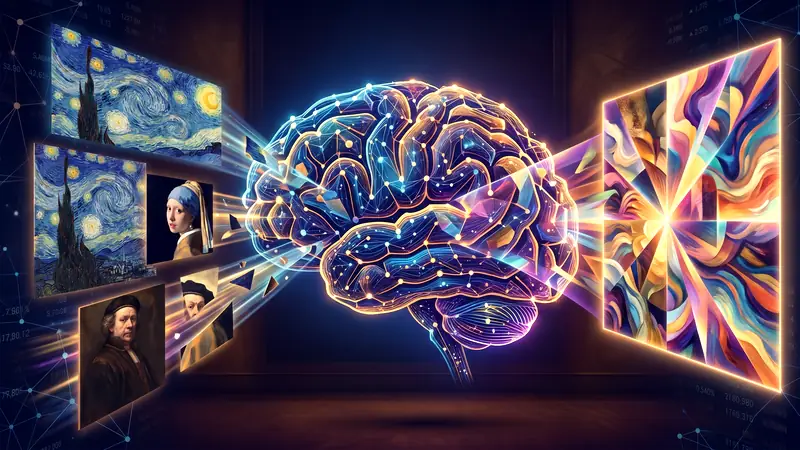
Second myth, the one driving lawyers and creatives up the wall: AI as a serial content thief. The technical reality is far more nuanced. When a model is trained, it doesn't store the original files in some secret database. It absorbs the data to update its own weights (the model's internal numerical values) and neural connections, then forgets the source. When it generates text or an image, it builds it from scratch, mathematically. It's like a painter who has studied a million paintings: they know the technique, but they don't have the paintings stashed in their basement. The real legal battleground — the one where OpenAI, Getty Images, and half the global creative industry are currently clashing — concerns the training phase (the model's learning process), not the output. A distinction that newspaper headlines have a persistent habit of ignoring.
The Jobs Apocalypse: Why You're Looking at the Problem Backwards
The third myth is the one that sells the most column inches and generates the most collective performance anxiety. AI doesn't eliminate jobs, it eliminates tasks (specific, repeatable activities). It automates drafting an email, generating boilerplate code (standard, repetitive code), analysing a spreadsheet. It doesn't automate strategy, legal accountability, client relationships, or contextual judgement. The right framework isn't "AI versus humans" — it's something far more Darwinian: a person who masters these tools will become structurally more productive than one who ignores them. This isn't occupational extinction; it's a disruption (a radical market reorganisation) that rewards those who adapt and punishes those who wait for the storm to pass.
Objective, Neutral, Infallible: The Algorithm's False Trinity
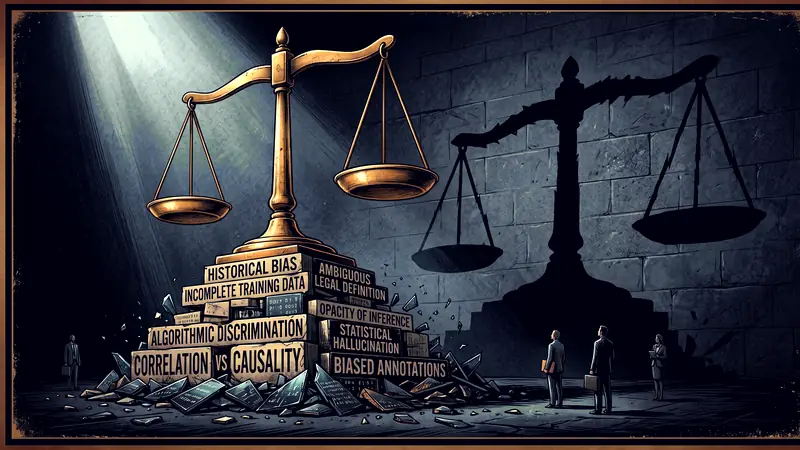
Fourth myth, and arguably the most dangerous of all, because it disguises itself as rationality. The idea that software, having no emotions, produces absolute truth is a logical short circuit. An AI is precisely as distorted as the data it was trained on. If the internet — its primary training corpus — is saturated with bias (systematic prejudices embedded in data) around gender, race, and politics, the model absorbs them, compresses them, and feeds them back amplified. Add to this the phenomenon of hallucinations (the generation of false facts delivered with confidence): when the model doesn't know an answer, rather than leaving the statistical pattern incomplete, it invents citations, dates, people's names, and non-existent scientific studies with disarming self-assurance. Human fact-checking (independent verification of sources) isn't a quaint relic — it's the only real safeguard.

Plug-and-Play: The Lie That Is Bankrupting Businesses
Fifth and final myth, the one burning through corporate budgets worldwide. The interface is simple, sure. But getting an AI system to produce enterprise-grade (professional, business-scale) results requires an architecture that is anything but straightforward. Behind a professional workflow sit APIs (connection interfaces between systems), advanced prompt engineering (the craft of writing effective instructions for AI), RAG (Retrieval-Augmented Generation, real-time retrieval of external data) systems to inject relevant context, automation pipelines, and a human being acting as project director. Without this infrastructure, AI produces generic, predictable, interchangeable content that won't move the competitive needle by a single millimetre. Paying for the subscription and expecting magic is the 2025 equivalent of buying a hammer and expecting it to build the house on its own.
The point isn't to demonise AI or to put it on a pedestal. The point is to stop thinking in slogans and start thinking in systems. Those who truly understand what's under the bonnet — the statistics, the limitations, the necessary architecture — hold a genuine competitive advantage. Everyone else is simply paying for the feeling of being modern.