Key Points
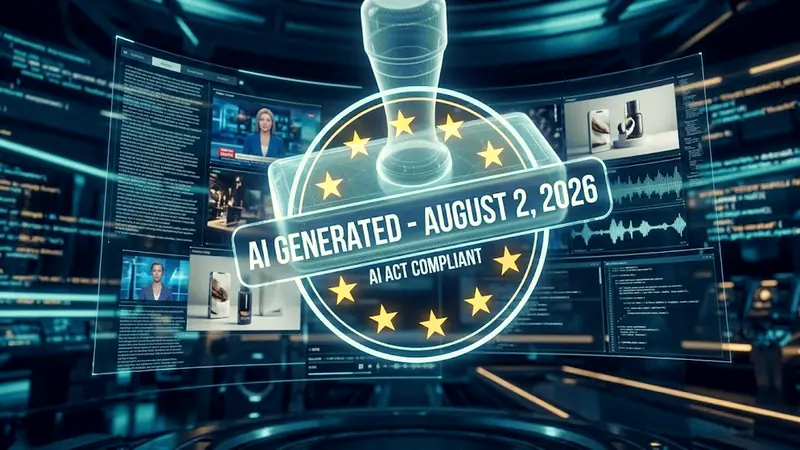
- Imminent regulatory deadline: From August 2, 2026, the transparency obligations of the European AI Act for AI-generated content come into force.
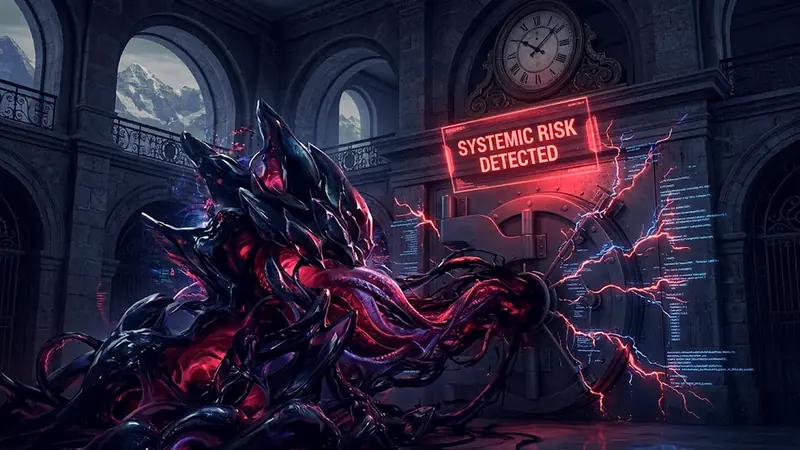
- Model under scrutiny: Mythos, the new system developed by Anthropic, is already in the crosshairs of the Swiss banking sector as a vector of systemic risk.
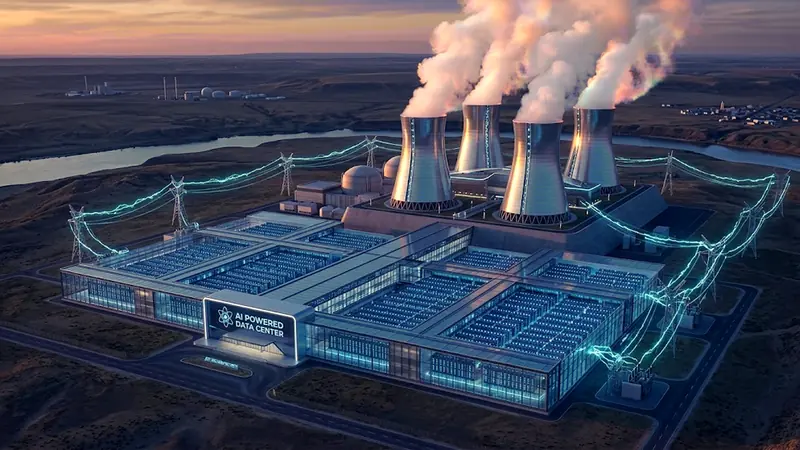
- Structural pressure: Global energy demand driven by AI and data centers is reviving investment in nuclear power, with the VanEck Uranium & Nuclear Technologies ETF fund serving as an indicator of institutional sentiment.
The summer of reckoning: the AI Act stops being theory
For years, the AI Act remained in the background of the European technology debate — a regulatory document cited at conferences and ignored in production processes. From August 2, 2026, that phase is officially over. Transparency obligations for AI-generated content come into force: texts, images, videos, and audio produced by automated systems will have to be identifiable as such, with obligations falling on both model providers and the platforms that distribute them. The European Commission has launched a technical guidance phase to help operators achieve compliance, but the timeline is tight and the audience affected is vast — from major publishers to communications agencies, from social platforms to individual professional creators. Those who fail to comply face penalties that the AI Act calibrates as a percentage of global turnover, a mechanism designed to target larger entities while closing loopholes for European subsidiaries of non-EU giants.
Mythos and the banking system: a risk Switzerland is taking seriously
While Brussels works on the transparency front, a signal from Anthropic has put the financial sector on alert. Mythos, the California-based company's latest-generation model, is considered powerful enough to pose a concrete threat to the operational stability of banks. The alarm originated in Switzerland — historically one of the most robust and conservative banking systems in the world — and that is no minor detail. These are not generic fears about automation: the hypothesis is that a model with advanced reasoning capabilities and access to structured data could be deployed for sophisticated attacks on decision-making systems, risk management, or the generation of fraudulent documentation at a level of quality that is difficult to distinguish from the genuine article. Swiss financial institutions, according to circulating reports, are not yet equipped to detect and contain scenarios of this kind.
Energy: AI doesn't run on air, it runs on watts
There is a physical cost to artificial intelligence that often disappears from the narrative. Every query, every generated image, every large-scale training session consumes electricity in industrial quantities. The exponential growth of data centers dedicated to AI is rewriting projections for global energy demand, and the market is responding unequivocally: the VanEck Uranium & Nuclear Technologies ETF has become one of the most closely watched instruments among institutional investors as a proxy for the nuclear race. Governments and major technology operators are signing long-term agreements with nuclear energy producers, considered the only source capable of guaranteeing continuity, energy density, and a low carbon footprint at the required scale. The paradox is clear: the most talked-about technology of the decade is bringing back an energy source that many had written off as obsolete.
Communications, universities, pizzerias: AI enters everywhere, with uneven results
Beyond the major regulatory and financial scenarios, artificial intelligence continues to penetrate the most capillary layers of society with contradictory effects. In the world of professional communications, AI is shifting the focus from high-volume content production to strategic quality: those who know how to use models to refine relevant and credible messages are gaining ground, while those who use them to flood the market with generic text are exposing themselves to rapid irrelevance. In universities, the pressure runs even deeper: the debate over curriculum reform is intertwined with the growth of technical trades, which are attracting students seeking concrete prospects in a labour market increasingly polarised between highly specialised skills and automatable tasks. Even the 2026 school-leaving exams bore the mark of the times, with prompts that asked students to reflect on artificial intelligence alongside Einstein and Quintilian. And then there is the case of pizza makers: a survey conducted among the twenty-two professionals present at the Coca-Cola Pizza Village in Pozzuoli returned a clear picture. AI is perceived as a useful tool for optimising dough, suggesting pairings, and personalising menus, but far removed from the artisanal soul of the craft. A culturally understandable resistance — but one that has historically never stopped automation in sectors where it delivers economies of scale.
The picture as of August 2
The date of August 2, 2026 acts as an accelerator of awareness. Businesses, institutions, and professionals who until recently treated AI governance as a future problem now find themselves confronting concrete obligations, measurable operational risks, and an energy demand that is reshaping global infrastructure. Industry analysts estimate that over the next eighteen months, the AI compliance market in Europe will generate a downstream economic impact exceeding three billion euros, spanning watermarking software, system audits, and specialist training.