
AI Takes Over: From Italian Bureaucracy to Killer Drones, the World Will Never Be the Same
We have officially entered the era where artificial intelligence is no longer a topic for tech conferences with canapés and sparkling wine. It is law, it is war, it is foreign policy, it is the wheat field behind your house. In just a few weeks, AI has broken into four sectors that seemed immune to disruption (radical disruption of existing models): Italian public administration, the American political debate, Ukrainian battlefields, and farming operations. Connecting these dots is not an academic exercise — it is about understanding where power is heading in the 21st century.
Key Takeaways
- The Italian Council of Ministers approved in 2025 the first comprehensive legislative decrees on AI, getting ahead of the EU AI Act (European Union regulation on artificial intelligence) scheduled to come into full force in 2026, with direct application to schools and public administration.
- For the first time in documented military history, fully autonomous AI-guided drones eliminated Russian soldiers on the battlefield, marking a point of no return in the ethics of warfare and international humanitarian law.
- In the US, AI has become a primary macroeconomic variable: the sector already consumes over 2% of national electricity, and the debate on automation and structural unemployment has officially entered the political agenda ahead of the 2026 elections.
Italy Regulates AI: Bureaucracy 2.0 or Silent Revolution?
The Council of Ministers has approved two legislative decrees bringing artificial intelligence into school classrooms and public administration offices. On paper, the goal is to improve efficiency and transparency — two words that in Italy sound almost like science fiction. But the real point is something else entirely: Italy is equipping itself with the first comprehensive national regulatory framework on AI, ahead of the full implementation of the EU AI Act. This is not a bureaucratic footnote. It is a geopolitical positioning move. Those who write the rules today control the market tomorrow. The concrete risk? That the decrees become yet another regulatory architecture (system of rules and laws) without real enforcement (control mechanisms and sanctions), turning innovation into compliance theatre (superficial conformity without substance).
Washington and AI: When Technology Becomes a Campaign Issue
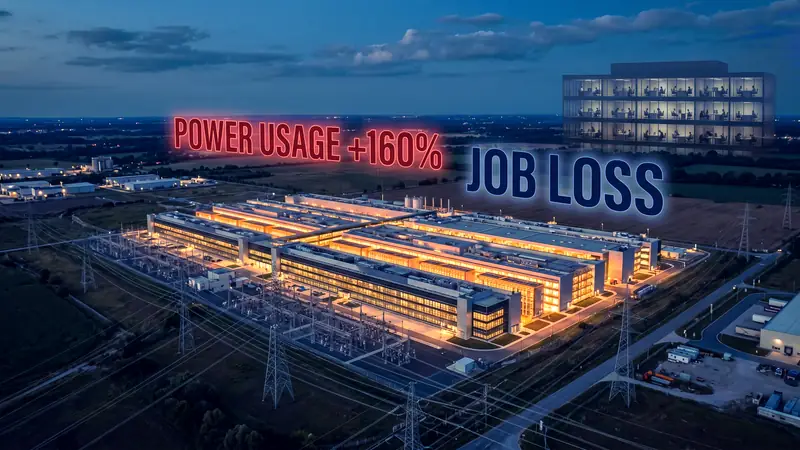
In the United States, artificial intelligence has stopped being a Silicon Valley talking point and has become electoral fodder. Concerns are focused on two fronts: jobs and energy costs. This is not paranoia — it is arithmetic. The data centres (physical infrastructures for data processing) powering LLM models (Large Language Models, advanced generative AI) consume amounts of energy comparable to those of entire nations. Goldman Sachs estimates that by 2030, AI energy consumption could increase by 160% compared to current levels. Meanwhile, occupational disruption (large-scale job losses) in white-collar (skilled office-based work) sectors is already measurable. When these numbers enter the American political debate, the conversation is no longer about the future — it is about votes.
Autonomous Killer Drones: The Rubicon Has Been Crossed
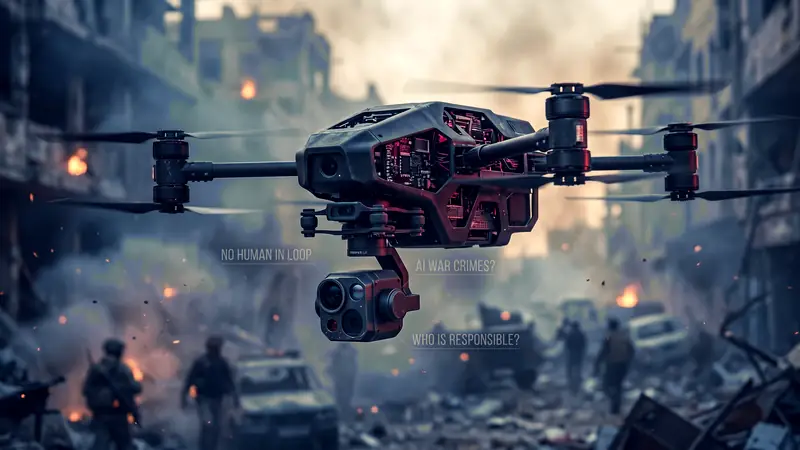
This is the story that should be keeping you up at night. For the first time in documented military history, fully autonomous drones — with no human operator in the decision loop (decision-making process without human oversight) — have identified, tracked, and killed Russian soldiers on the battlefield. The line between weapon and algorithm has officially dissolved. The implications are enormous: international humanitarian law (international laws of war) is not equipped to handle a weapons system that makes lethal decisions autonomously. Who is responsible for a war crime committed by an AI? The chip manufacturer? The general who pressed "deploy"? We have entered completely uncharted ethical and legal territory, and governments are still debating how to regulate chatbots.
AI in the Fields: Efficiency Yes, But the Land Still Needs Human Hands

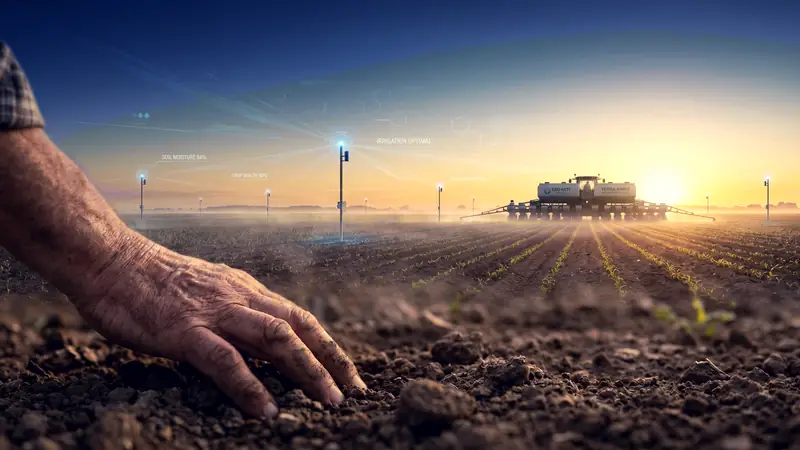
AI-driven precision agriculture (use of technology to optimise crop cultivation) promises to revolutionise global food production: IoT sensors (internet-connected devices), predictive analytics (forecasts based on historical data) for crops, irrigation optimisation. The numbers are real — some estimates point to productivity increases of up to 20% on farms that adopt these systems. But there is a structural limitation that no algorithm can overcome: the land still requires physical labour, local knowledge, and a relationship with the territory. AI can optimise, but it cannot replace the farmer who knows the microclimate (specific climate of a small area) of their valley. The real risk is that these advanced tools remain the exclusive domain of large agricultural corporations (multinational food industry companies), further widening the gap with small-scale producers.
The Macro Picture: A World Rewriting Itself in Real Time
Put all these pieces together and you see the pattern: AI is not a technology, it is a force for the reorganisation of power. Those who regulate win (Italy, the EU). Those who fail to regulate risk falling behind (the US, lagging on policy). Those who deploy it in warfare redefine international law. Those who bring it to the fields can either feed the world or concentrate wealth even further. The question is not "will AI change the world?" — it already is, right now, as you read this article. The question is: who will be writing the rules of the game when the dust finally settles?