
Key Points
- Global job hemorrhage: 425,000 workers already laid off due to AI worldwide, with 150,000 affected in Germany alone in 2026.
- US government restrictions: Anthropic's Fable 5 and Mythos 5 models blocked for all foreign nationals, including those residing in the United States, by federal export control directive.
- Institutional response: The European Commission and the OECD launch a joint framework for AI literacy in schools, a signal that the education system is already structurally behind.
The machine is eating jobs: 425,000 positions already gone
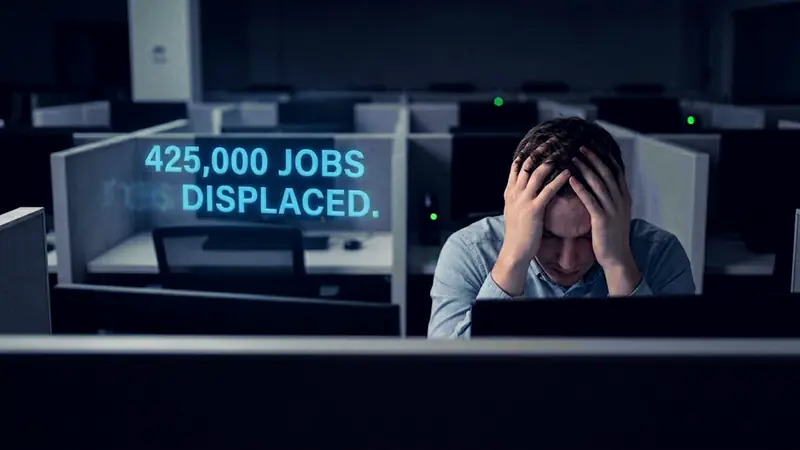
This is no longer an apocalyptic prediction from a tech conference. It is a number written in black and white, and it stings: 425,000 workers have already lost their jobs because of artificial intelligence. Not "at risk of losing them," not "could be replaced in the coming years." They have already lost them. Translators wiped out by automated translation systems that cost a fraction of a cent per hour. Call center operators replaced by chatbots that never take bathroom breaks, never ask for raises, never call in sick. Graphic designers, junior analysts, content writers: entire categories that three years ago felt secure and today find themselves rewriting their résumés from scratch.
The phenomenon is not uniform, but it is everywhere. In Germany, a study by the Ifo Institute has captured an already critical situation: over the course of 2026, approximately 150,000 workers were directly affected by automated substitution, with the heaviest impact in retail and services. Sectors that historically absorbed mid-level labor — neither top executives nor highly specialized technicians. The most exposed group? Young people between the ages of 17 and 29, with nearly half of them reporting they are "very worried" about their professional future. This is not generational paranoia: it is clarity.
Silicon Valley and the religion of AI agents: productivity yes, but at what cost
While workers count their losses, Silicon Valley has already found its new mantra: delegate everything to AI agents. The emerging trend spreading through major American tech companies is to measure productivity no longer in hours worked or human deliverables, but in output generated by autonomous systems. The human being becomes a supervisor, when things go well. When they do not, they become redundant.
The problem is that this relentless race toward automation generates costs that no one wants to put in the official balance sheet. The data centers powering these models consume industrial quantities of energy and water. The environmental impact of generative AI at a global scale is already comparable to that of entire industrialized nations, yet it remains conveniently absent from the press releases of companies that declare themselves "carbon neutral." Productivity rises, and so do emissions. The bill, as always, will be paid by someone else.

Anthropic closes its borders: Fable 5 and Mythos 5 banned from the world
On the geopolitical front, the news that received far less attention than it deserved: Anthropic, one of the world's leading artificial intelligence laboratories, received a directive from the American federal government imposing a total access block on its most advanced models, Fable 5 and Mythos 5, for all foreign nationals. Not only those living abroad: non-Americans residing in the United States, including the company's own employees, are also excluded. This is a precedent of enormous magnitude, one that transforms artificial intelligence into an explicit instrument of foreign policy — a strategic national asset to be protected in exactly the same way weapons systems are protected. The technological cold war is not on its way: it is already underway.

Schools and training: Europe scrambles to respond, but is it too late?
While the labor market burns, institutions are trying to put out the fire with a bucket of guidelines. The European Commission, in tandem with the OECD, has presented a reference framework for AI literacy aimed at students. The goal is to build a generation capable of using these tools critically, without being overwhelmed by them. Noble. Overdue. Students sitting their 2026 final exams are already using AI to prepare, already integrating it into their study routines alongside TikTok and social media. They are not waiting for European guidelines: they are adapting in real time, with or without institutional guidance.
The ethical knot remains unresolved: how do you teach critical thinking in an era when a tool can generate a plausible answer to any question in under three seconds? Mathematicians, at least for now, have demonstrated that AI models collapse when faced with genuinely novel problems — those for which no pattern exists to copy from training data. But the labor market is not made up solely of mathematicians. It is made up of ordinary people, with average skill sets, who until yesterday were indispensable and are today discovering that they no longer are.
According to projections by the World Economic Forum, by 2030 AI-driven automation could reshape more than 40% of global job functions. The 425,000 already laid off are only the prologue.