
Nearly a trillion dollars. That is the figure hovering over Anthropic's IPO (initial public offering, i.e., stock market listing), the financial move that is rewriting the rules of the global artificial intelligence game. When a company founded in 2021 by former OpenAI defectors files confidentially with the SEC (the U.S. financial markets regulatory authority) at a potential valuation of $965 billion, you are not watching a simple stock market listing. You are watching the most expensive declaration of war in the history of technology.
The timing is surgical. Anthropic filed its confidential documentation before OpenAI could do the same, stealing media oxygen and, more importantly, investor confidence at a moment when financial markets are starving for something concrete to bet on in AI. Because this is the point mainstream commentators keep missing: it is not about who has the best model, it is about who can secure the computational fuel for the next five years. Chips cost money. Data centers cost money. The energy to run them costs money. And whoever reaches public capital markets first wins the race before the competition has even formally begun.
Google, Berkshire, and the $80 Billion That Changes Everything
Alphabet knows this all too well. Google's parent company is raising $80 billion through equity offerings, with Berkshire Hathaway as a partner. Eighty billion dollars. That is not an investment, it is a geopolitical statement. It means the major players no longer believe AI is a technology of the future: they believe the future is being purchased right now, at this precise historical moment, and that anyone who hesitates is already out of the game. The fact that Warren Buffett, historically allergic to speculative tech, is involved in this operation says everything there is to know about the perceived maturity of the sector.

Chips, China, and the Gray Market That Sanctions Cannot Stop
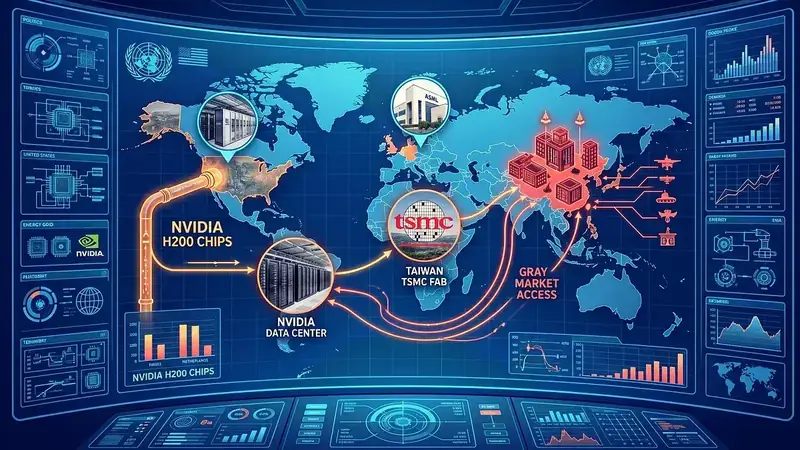
Yet while Wall Street celebrates, on the other side of the Pacific an equally brutal and far less transparent game is being played. At least seven Chinese universities with documented military ties are attempting to acquire Nvidia H200 chips (top-tier AI processors), the most advanced AI processors that U.S. regulations still permit to be exported to China. Seven universities. With military ties. Buying AI hardware. If anyone thought export restrictions on technology were working as a deterrent, this data point should be a cold shower. Sanctions create gray markets (unofficial, uncontrolled exchanges), not voids. And in a context where AI supremacy equals military and economic supremacy, expecting China to stop at a few American bureaucratic regulations is simply naive.
This geopolitical tension has a direct impact on the real economy that is frequently ignored. Control of chips has become the new control of oil. Who manufactures the most advanced semiconductors (high-density microchips), who distributes them, and who manages to access them despite restrictions will determine the global power balances of the next several decades. TSMC, Nvidia, ASML: these are not tech companies, they are critical infrastructure of civilization.
Walmart Cannot Scale, Europe Regulates: The Signals Nobody Wants to See
Meanwhile, on the ground, the contradictions of the AI boom are beginning to surface in increasingly visible ways. Walmart is rationing access to its own internal AI tools because internal demand exceeds available capacity. One of the largest companies in the world, with virtually unlimited resources, cannot scale its AI infrastructure fast enough to serve its own employees. It is a subtle but powerful signal: we are in a phase where demand for applied AI is structurally outpacing the supply of computational capacity, and that gap will not close in six months.
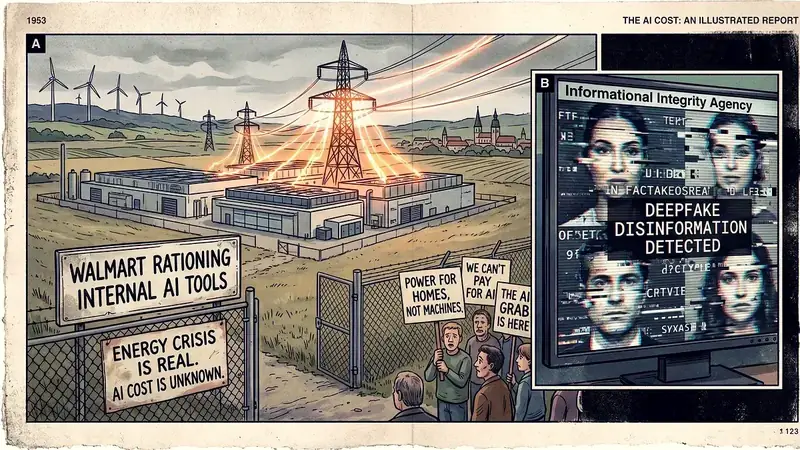
The environmental impact of all this is finally moving out of the corner of sustainability reports and into the streets. Protests in the United States and Germany against the energy consumption of AI data centers. Analyses showing consumption comparable to that of entire nations. This is not armchair environmentalism: it is a real macroeconomic problem. Energy has a cost, and that cost transfers onto utility bills, national energy policies, and industrial location decisions. Europe, already struggling with energy costs, finds itself having to compete in a technological race that demands enormous quantities of the resource in which it is structurally weakest.
Europe Debates, the World Buys
This is where the critique from Aidan Gomez, CEO of Cohere, deserves to be taken seriously without diplomatic discounts: Europe has talent, it has capital, it has companies. What it lacks is the cultural will to compete. It is not a shortage of resources, it is a shortage of systemic ambition. While Anthropic is worth nearly a trillion dollars and Google raises $80 billion in a single move, Europe debates regulation. The AI Act (the European Union's artificial intelligence law) matters, protecting rights is legitimate, but if in the meantime you lose all your best engineers to San Francisco and your capital to Wall Street, you are building the rules for a game you no longer participate in.
Intellectual Property, Deepfakes, and the Bill Nobody Has Paid Yet
The New York Times accusing AI companies of brazen intellectual property theft is the other side of the same coin. The tension between content creators and large language models (AI systems that generate text) cannot be resolved with a few licensing agreements: it is a structural fracture in the way value is created, extracted, and distributed in the digital economy. Who owns the data on which models are trained? Who is compensated when an AI generates economic value from that body of work? These questions do not yet have definitive legal answers, but they are already redrawing the balance of power between media companies, creatives, platforms, and AI developers.
The warning from Brandenburg's constitutional protection agency regarding digital manipulation through AI closes the loop. Deepfakes (false content generated by AI), synthetic text, AI-generated video: the threat to informational integrity is not future, it is present. And in a context where Western democracies are already under pressure, adding low-cost, high-quality industrial disinformation tools is a destabilizing variable that no economic model has yet priced correctly.
Those Who Wait Have Already Lost
The picture that emerges is of a sector burning through milestones at a speed that exceeds the collective capacity to manage its consequences. Capital flows in, valuations explode, geopolitics ignites, the environment pays the bill, and the rules of the game are being rewritten while the match is already underway. Those who navigate this chaos with clarity win. Those who wait for it to stabilize have already lost.