Key Points
- Hidden Infrastructure: Glean aims to build the data orchestration layer underlying enterprise AI interfaces, while Microsoft, Google, OpenAI, and Anthropic compete for the application market.
- Strategic Partnership: Anthropic has signed an agreement with Tata Consultancy Services (TCS) to scale Claude deployments across multiple business units and platforms in enterprise operations.
- Modular Nuclear Energy: Small Modular Reactors (SMRs), with capacity below 300 MWe each, position themselves as a decentralized energy solution to power the next generation of AI data centers.
The Invisible War Beneath the Interface
There is a battle that goes unseen, but it will determine who truly controls artificial intelligence in global enterprises. It is not fought with chatbots or stage demonstrations at conferences. It is fought in infrastructure layers, in data pipelines, in the silent connectors that unite dozens of heterogeneous corporate systems. And this is precisely where Glean has chosen to position itself, with a strategic clarity that major players seem struggling to replicate.
While Microsoft integrates Copilot into the Office ecosystem and Google pushes Gemini within Workspace, the dominant narrative speaks of virtual assistants, prompt boxes, and increased productivity. But this narrative is, in large part, a commercial simplification. The real problem of enterprise AI is not the interface: it is data fragmentation. A mid-sized company manages dozens of tools — CRM, ERP, document repositories, communication platforms — that rarely communicate coherently. Without a layer of semantic and contextual connection, any AI assistant remains a brilliant but blind tool.

Glean has built its value proposition precisely on this gap. It does not compete directly with Copilot or Gemini on the conversational interface plane: it aspires to become the search engine and data understanding engine for corporate data that powers any AI surface, regardless of provider. A position of potential strategic neutrality that, in the medium term, could prove more defensible than any exclusive agreement.
Anthropic Chooses TCS's Industrial Scale
On the opposite end of the spectrum — that of massive adoption and enterprise go-to-market — Anthropic moves with a decision that merits analytical attention. The partnership announced with Tata Consultancy Services is not an ordinary distribution agreement. TCS is one of the world's largest system integrators, with a capillary presence in regulated sectors such as banking, insurance, healthcare, and advanced manufacturing. Choosing TCS means choosing a network of institutional relationships that no technology startup, however well-funded, could build autonomously in reasonable timeframes.
Anthropic's move responds to precise competitive pressure. OpenAI has consolidated its enterprise presence through the Microsoft Azure ecosystem, benefiting from enormous commercial force and distributive reach. Anthropic, with Claude as its primary asset, must find alternative channels to reach business units of large corporations without passing through intermediaries that could, over time, erode its margins and control over the relationship with the end customer. TCS offers exactly this: direct access, institutional credibility, and industrial-scale deployment capability.

The agreement provides for extending collaboration across multiple platforms and operational divisions, suggesting deep integration rather than merely superficial engagement. This is not about reselling API licenses: it is about building vertical solutions in which Claude becomes a structural component of TCS clients' business processes.
The Problem No One Wants to Address: Energy
All this rush toward enterprise AI — the partnerships, the infrastructure layers, the large-scale deployments — collides with a physical constraint that the technology sector has long treated as an operational detail: energy consumption. Next-generation data centers, optimized for inference workloads and training on increasingly large models, require power density that traditional electrical grids struggle to guarantee with continuity and with the decarbonization commitments that major tech operators have pledged to respect.
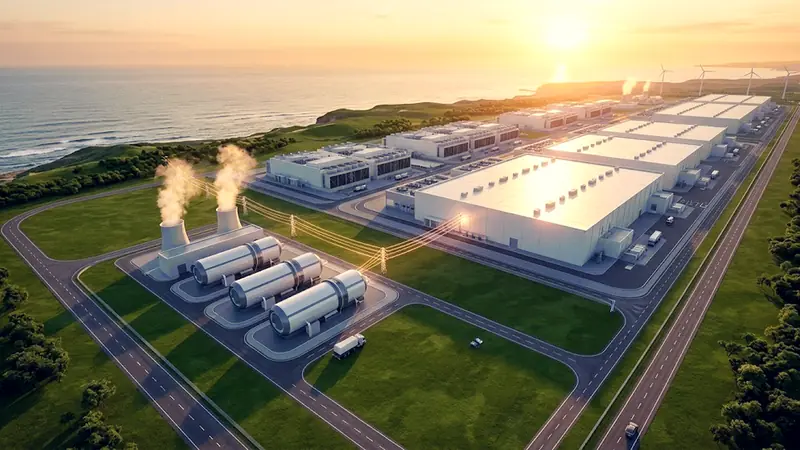
In this context, Small Modular Reactors, or SMRs, emerge with growing concreteness. With generative capacity below 300 MWe per unit, these next-generation micro nuclear reactors represent a radically different response compared to traditional renewable solutions. They do not depend on solar or wind intermittency, can be installed near consumption sites — reducing transmission losses — and offer energy density that no other currently available clean technology can match.
Their adoption in AI infrastructure is no longer an academic hypothesis. Several hyperscale data center operators are exploring energy supply agreements based on SMRs, with deployment timeframes between 2028 and 2032. The market for SMRs dedicated to digital infrastructure is estimated to grow significantly over the next decade, with major developers — including NuScale, Rolls-Royce SMR, and TerraPower — in advanced regulatory certification phases in Europe and North America.
An Ecosystem Stratifying Rapidly
What emerges from the joint analysis of these three vectors — Glean's infrastructure war, Anthropic's distributive scaling through TCS, and the energy question of SMRs — is an enterprise AI ecosystem stratifying at a speed exceeding the general market's comprehension capacity. Each layer has its own dominant players, its own competitive logics, and its own bottlenecks. Whoever controls a single layer, however effectively, remains exposed to dependence on the others. Whoever manages to control two or more builds a structural advantage that is difficult to attack. At the moment, no single player controls the entire chain. But 2026 is the year in which positions are crystallizing.