Key Points
- AI and World Cup predictions: American and Chinese artificial intelligence models are competing to forecast the results of the 2026 World Cup, with Mexico among the favourites according to some simulations.
- Technology and surveillance: The Lenovo-FIFA partnership brings advanced tools to the pitch, but the biggest tournament in history is already raising alarms over costs and data control.
World Cup 2026: when football becomes a geopolitical and technological laboratory
It is 17 June 2026 and the World Cup is already underway. Forty-eight teams, three host nations — the United States, Canada and Mexico — and an expected number of spectators that is unprecedented in the tournament's history. But behind the goals and the flags, a parallel match is being played out, far quieter and perhaps far more consequential: one involving artificial intelligence, economic power and national identity. Joining the dots of this edition means realising that the ball is merely the pretext.
AI takes to the pitch: from Silicon Valley to Beijing, everyone wants the perfect prediction
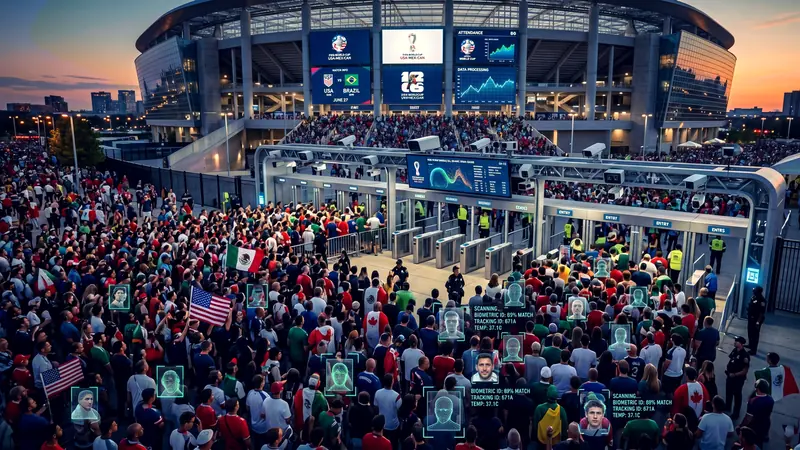
In the United States, several machine learning models (systems that learn from data) have already produced complete simulations of the tournament, identifying Mexico as one of the most likely surprise packages. This is no mere entertainment: these algorithms analyse historical data, players' physical condition, styles of play and even meteorological variables to generate statistical probabilities with a level of precision never seen before. Meanwhile, on the other side of the world, Chinese models — developed by companies such as Baidu and emerging startups — are openly competing to claim the title of "oracle of the World Cup". It is a race within a race, with implications that extend well beyond football: whoever builds the most accurate predictive model demonstrates superior computational capability (processing power and data analysis), and this counts enormously in the global AI race.
Lenovo, FIFA and the digital transformation of the pitch
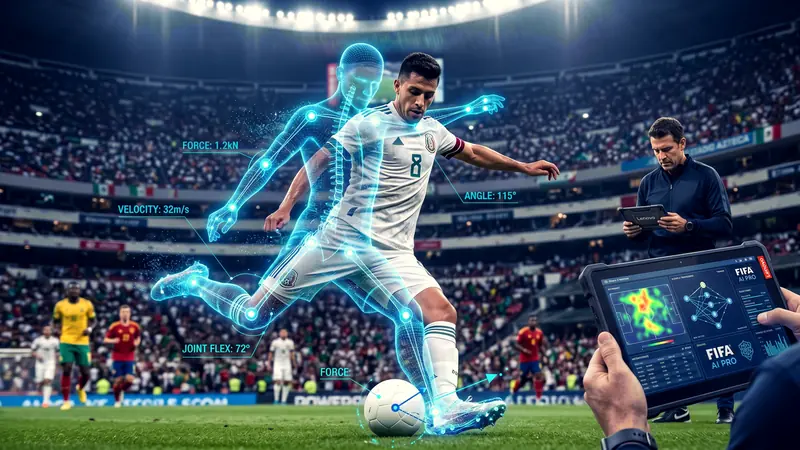
The official partnership between Lenovo and FIFA represents perhaps the most visible technological leap of this edition. The FIFA AI Pro programme uses neural networks (mathematical models inspired by the human brain) to analyse team strategies in real time, providing coaches with tactical suggestions during matches. Three-dimensional player avatars, generated by sensors distributed across the pitch, allow every movement to be reconstructed with millimetre-perfect accuracy. It is the first time a sporting competition of this scale has integrated predictive analysis tools directly into the decision-making process of technical staff. Football — a sport defined by its unpredictability — now finds itself confronting its own quantification.
The price of gigantism: surveillance and stadium inflation
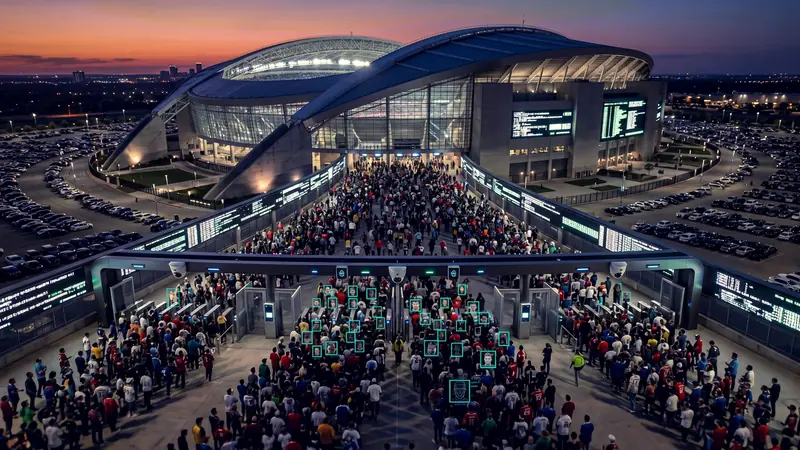
Italy is watching the tournament with a critical eye. This edition is structurally the largest in history — 104 matches in total compared to the 64 of the previous format — and costs are exploding proportionally. Tickets for the final stages have reached prohibitive prices, effectively excluding less affluent supporters. But the economic problem is only the surface. American stadiums have seen the large-scale installation of facial recognition systems (technology that identifies individuals through their physical features) and biometric sensors (devices that measure physical data such as heart rate), justified by the need to ensure security in a post-pandemic and geopolitically unstable context. The question many are asking is: who controls this data? And for how long is it retained?
France and the identity mirror: football as a nation's X-ray
The French perspective adds a dimension that neither algorithms nor balance sheets can capture. Les Bleus have for decades been the sharpest reflection of the Republic's contradictions: players with roots in sub-Saharan Africa, the Maghreb and the Antilles, all wearing the same shirt yet carrying profoundly different stories. At a time when the debate over French national identity is more heated than ever — amid migration tensions, constitutional reforms and a rising right wing — every match played by the national team becomes a test of social cohesion. Football, in this sense, is not an escape from politics: it is its continuation by other means.
The bigger picture: a tournament that is already a historical document
Bringing all these fragments together produces a coherent image. The 2026 World Cup is the first major global event in which artificial intelligence is not a supporting tool but a leading actor — in predictions, in tactical analysis, in surveillance. It is also the tournament in which the geopolitical competition between the United States and China finds an unexpected battleground: that of sporting predictive models. And while technology promises transparency and optimisation, the darker side — exclusionary costs, mass collection of biometric data, national identities under pressure — serves as a reminder that no innovation is neutral. The ball rolls on. But this time, the dots connect to form something far greater than a football match.