Key Points
- Sovereign investment in AI: Poland acquires a stake in ElevenLabs with an $11 million injection, aiming to become Europe's hub for voice artificial intelligence.
- Enhanced submarine infrastructure: Nokia and Symphony triple the MCT cable capacity to 30 Tbps, with Thailand consolidating its role as Southeast Asia's digital hub and convergence point for the China-ASEAN supply chain.
- Underwater data centers: China has commissioned the world's first underwater data center, powered by offshore wind energy, redefining global parameters for sustainable digital infrastructure.
Warsaw Buys a Piece of the Future: $11 Million on ElevenLabs
Some build artificial intelligence in a Silicon Valley garage; others choose to buy it with public money. Poland chose the second path, and it came fully prepared. Warsaw has formalized an investment of $11 million in ElevenLabs, the company that in just a few years has become one of the most significant names in the global landscape of voice synthesis and AI-based audio cloning. This is not a cosmetic move: it is a geopolitical declaration dressed up as a financial transaction.
ElevenLabs is no ordinary startup. Its voice AI technologies are already integrated into editorial pipelines, e-learning platforms, accessibility tools, and automated dubbing systems across dozens of languages. Acquiring a direct stake means sitting at the table where development trajectories are decided, rather than waiting for someone else to announce them. Poland, which in recent years has built a solid reputation as a tech ecosystem in Central and Eastern Europe, is openly aiming to transform itself into a continental hub for voice AI. The competition with Berlin, Paris, and Amsterdam is wide open, and Warsaw has just raised the stakes.

In a European context where governments oscillate between obsessive regulation and strategic timidity, Poland's move lands like a well-aimed slap to the rest of the continent. While Brussels argues over the AI Act, some are signing checks.
Data Flows Beneath the Sea: Nokia Rewrites Asian Connectivity
Thousands of kilometers away, on the floor of the South China Sea and the Indian Ocean, another story is unfolding. Nokia and Symphony have announced a massive upgrade to the MCT submarine cable system, bringing its transmission capacity to 30 Tbps — triple the previous configuration. Thirty years ago, the conversation was about kilobits. Today, it is about terabits. The scale of the change is difficult to absorb, but the meaning is crystal clear: Thailand is becoming an indispensable physical node for digital traffic across the entire region.

Bangkok is no longer just mass tourism and the automotive industry. The Thai Board of Investment is working in parallel to attract Chinese technology capital, positioning the country as a privileged convergence point for China-ASEAN supply chains. The logic is as simple as it is ruthless: if you want to sell advanced technology to Southeast Asia without navigating tariffs and geopolitical friction, Thailand is the right place to put down roots. Chinese capital knows this, and it is moving accordingly.
The MCT cable upgrade is not a technical footnote for industry insiders. It is the nervous system of a regional economy that processes orders, financial transactions, industrial communications, and real-time data flows. Tripling the capacity means tripling the economic potential that runs through it. Nokia has signed an infrastructure deal, but it has also signed a piece of Southeast Asia's commercial history.
China Takes Servers to the Ocean Floor. And It's for Real
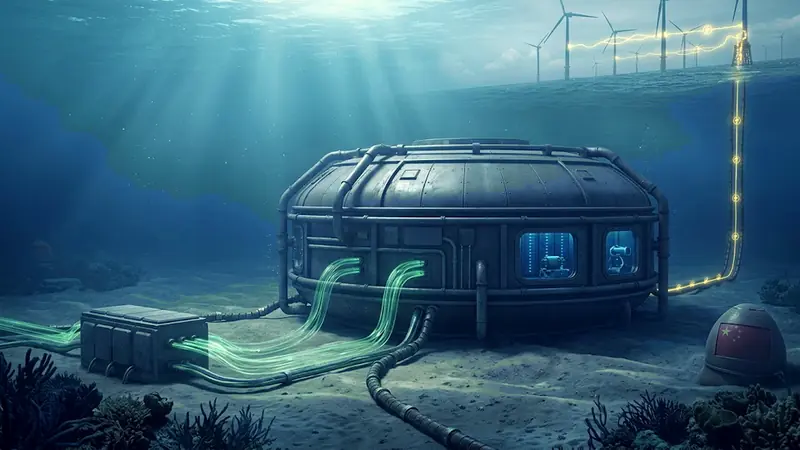
While Poland buys AI and Thailand upgrades its cables, China has done something that until just a few years ago seemed like industrial science fiction: it has commissioned the world's first underwater data center. Not a prototype. Not a tank experiment. A fully operational facility, on the seabed, powered by offshore wind energy.
The implications are multiple, and none of them are trivial. From a thermal standpoint, seawater solves one of the most costly and energy-intensive problems in the data center industry: cooling. On the surface, cooling servers consumes a significant share of a facility's total energy. Underwater, the problem nearly disappears. From a sustainability perspective, pairing the facility with offshore wind generation closes a loop that many had been trying to close for years without success.
Beijing did not announce this structure as an engineering curiosity. It presented it as a replicable model — a strategic direction for the country's digital infrastructure and, implicitly, for that of its Belt and Road Initiative partners. Whoever controls the physical nodes of information controls something far deeper than simple connectivity. China has known this for some time, and the underwater data center is the latest proof that it knows it better than anyone else.
2026 is proving to be the year in which global digital infrastructure stops being a backdrop and becomes the primary battlefield. According to industry estimates, by 2028 more than 40% of intercontinental data traffic will pass through upgraded or next-generation systems built within this two-year window.