Chinese Subsidies, Bacteria, and the Amazon: The Three Fronts of Sustainability in 2026
The future is not a single highway. It is a tangle of paths that intersect at unexpected points.
Key Points
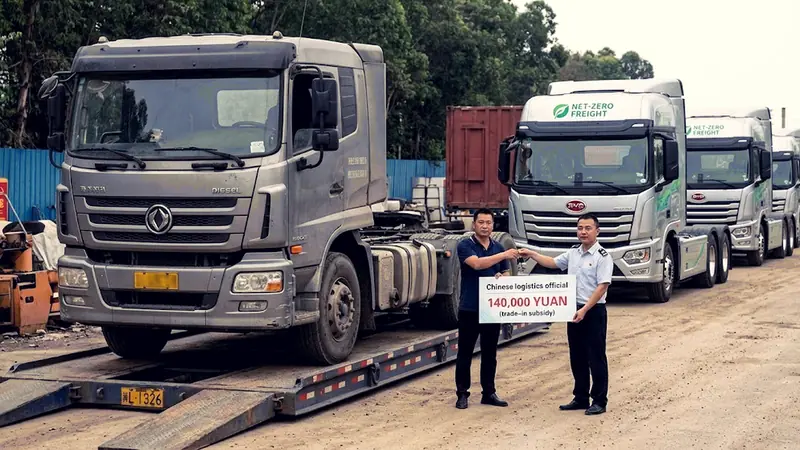
- Subsidies from Beijing: Up to 140,000 yuan (approximately 18,000 euros) for every diesel truck scrapped and replaced with a zero-emission electric vehicle.
- Microbial Biosynthesis (University of Tennessee – Knoxville): Thermal interface materials produced by living bacteria with thermal conductivity 5 to 10 times higher than traditional synthetic heat dissipators.
- Wired Amazon – Rainforest Expeditions: An average of one new animal or plant species discovered per month by tourist-researchers in the Tambopata National Reserve, Peru.
Enough with the institutional brochure narrative of the green transition as if it were a high-speed train running straight toward a climate paradise. The reality is far messier, more interesting, and in some ways more promising than any slide presented at Davos. In 2026, sustainability is being played out on three tables simultaneously: the dusty highways of Southeast Asia and Africa, the American university laboratories where bacteria build the future at room temperature, and the tree canopy of the Peruvian Amazon overflown by mini-drones piloted by tourists. Three worlds that do not communicate with each other but, observed together, tell us something essential about where this planet is heading.
China Has Understood That the Truck Is the Next Industrial War
Let's start with the elephant in the room — or rather, the truck. Heavy freight transport — the kind that moves containers, raw materials, cement, food — has always been the great unspoken subject of the green conversation. Too heavy for batteries, too expensive to electrify, too complicated to convince logistics operators who survive on razor-thin margins. Well, China has solved the problem in the most Chinese way possible: with state money and industrial scale.
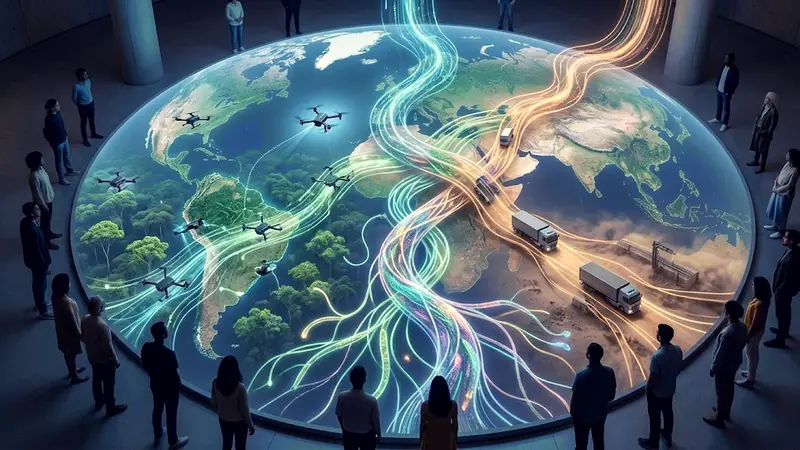
The mechanism is brutally effective. Beijing has put trade-in scrapping programs on the table that issue checks of up to 140,000 yuan, approximately 18,000 euros, for every old diesel truck handed over in exchange for a zero-emission electric vehicle. This is not environmentalism — it is industrial policy with blinders fixed firmly on the global market. The result? The Total Cost of Ownership (TCO) (the full lifetime cost of a vehicle) of Chinese electric commercial vehicles has collapsed, made possible by the mass adoption of LFP cells (Lithium Iron Phosphate) (a battery chemistry avoiding cobalt and nickel), which are chemically more stable, less expensive, and less dependent on cobalt and nickel than traditional lithium-ion cells. Companies that five years ago were buying diesel without even asking whether an alternative existed are now running the numbers and discovering that electric costs less. This is not ideology — it is arithmetic.
The expansion into ASEAN and Africa is not philanthropy. It is the construction of commercial and technological dependencies on a continental scale. Whoever supplies the trucks also supplies the spare parts, the fleet management software, and the chargers. The so-called "Net-Zero Freight" (decarbonizing global supply chains entirely) could carry a far more pronounced Mandarin accent than many are currently prepared to acknowledge.
Bacteria at Work: Biotechnology Enters the Battery Pack
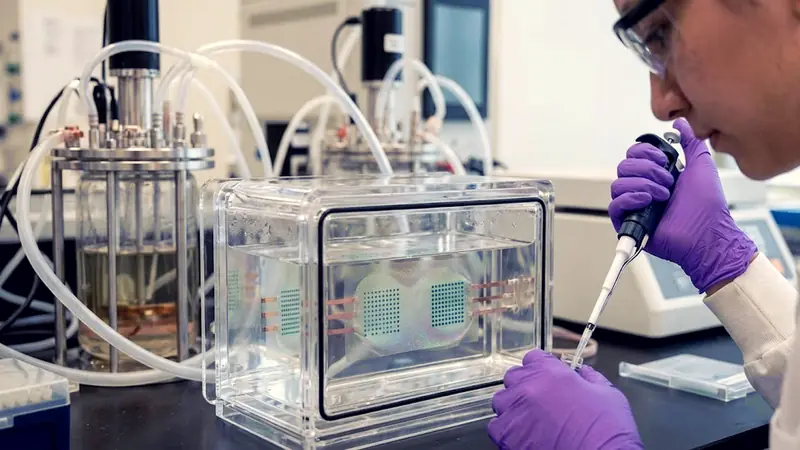
While China plays the industrial game, something quieter — and perhaps more revolutionary — is happening in a laboratory at the University of Tennessee in Knoxville. Professor Weinan Xu and his team have found a way to cool EV batteries using bacteria. This is not a metaphor. These are real bacteria, fed with simple sugars and metallic precursors (chemical building blocks for material synthesis), that biologically synthesize TIMs — Thermal Interface Materials (substances that transfer heat between components) — capable of dissipating the heat generated during ultra-fast charging or under prolonged stress.
The problem they are trying to solve is concrete and urgent. Thermal runaway (uncontrolled self-heating cascade in a battery) is one of the primary safety risks of lithium-ion battery packs. The faster you charge, the more the system heats up. The more it heats up, the more it degrades. Traditional synthetic thermal dissipators do their job, but with clear limitations. The material produced by Xu's bacteria records a thermal conductivity 5 to 10 times higher than synthetic competitors. Numbers that, in this sector, amount to a generational leap.
The additional advantage lies in the production process itself. Biosynthesis occurs in water, at room temperature. No industrial furnaces, no toxic solvents, no process emissions. In a sector — electronic manufacturing — historically dependent on energy-intensive and chemical-heavy processes, this paradigm shift carries implications that extend well beyond a single component. If the process scales industrially, it changes the very logic of how hardware for electric mobility is built.
The Amazon: Where the Tourist Stops Being a Consumer
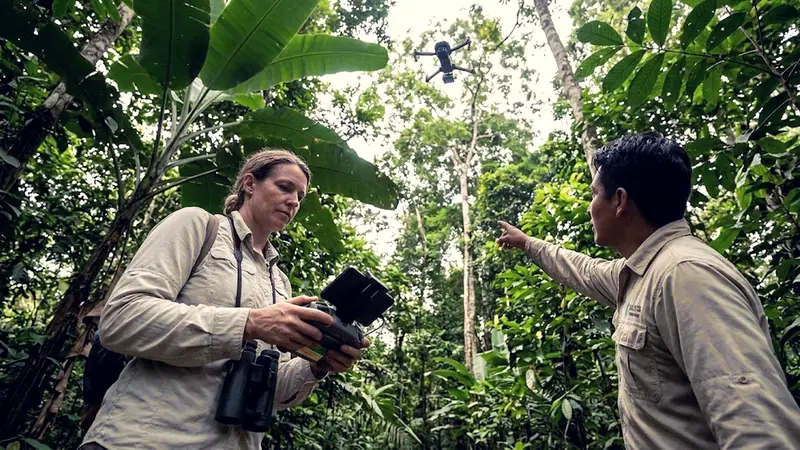
The third front is the most unlikely and, for that reason, the most interesting to report. In the Tambopata National Reserve, in the heart of the Peruvian Amazon, operator Rainforest Expeditions has launched Wired Amazon, a project that transforms tourists into field scientists. This is not a marketing gimmick. It is a structured citizen science (public participation in scientific data collection) system that produces real data, used by real researchers.
Visitors, working alongside professional biologists, operate on three fronts:
- Using nocturnal light traps, they catalog unknown insects whose samples are sent to the International Barcode of Life (a global DNA-based species identification database) for DNA analysis. The average is one new species discovered per month, with the tourist earning the right to choose its scientific name.
- With fleets of mini-drones, they fly over the ancient canopy (the uppermost layer of the forest) to monitor flowering cycles and vegetation health, detecting hidden deforestation events before they become irreversible.
- Through the AmazonCam Tambopata project, they install camera traps and thermal sensors to monitor jaguars, tapirs, and elusive fauna, uploading data to Zooniverse (a platform for collaborative human-AI research) for collaborative analysis between artificial intelligence and researchers distributed across the world.
The model also generates a direct economic return for local communities, building a concrete alternative to the extractive exploitation of the forest. According to current projections, if the Wired Amazon model were replicated across other protected areas of Latin America, the volume of biological data collected through citizen science could triple by 2030 relative to the current capacity of traditional academic research.