Key Points
- Record range: The new BYD plug-in hybrids with the DM-i 5.0 platform exceed 1,400 km of real combined range, with declared peaks of over 2,000 km for certain models in the Chinese market.
- Honda – QuantumScape deal: On June 18, 2026, the two giants signed a strategic agreement to integrate solid-state batteries into future Honda vehicles, while Japan allocated $660 million in subsidies for the supply chain.
- eVTOL and air logistics: Startup Acodyne closes a €2.5 million funding round for the E100 cargo drone (500 kg, 450 km/h); Valour Consultancy estimates nearly 7,000 commercial eVTOLs operational by 2050.
Welcome to 2026: green mobility stops putting on a show and starts getting serious
Forget the polished presentations, the renders on black backgrounds, and the turtleneck-wearing CEOs promising revolutions "in the coming years." June 2026 delivered something different: concrete numbers, signed agreements, real money changing hands. Sustainable mobility has officially stopped being a trade-show experiment and has started behaving like a mature industrial sector — with everything that entails, including contradictions, political calculations, and the occasional technological casualty along the way.
The geopolitical context is anything but neutral. From January 1, 2026, the UN Decade of Sustainable Transport officially came into force — the 2026–2035 UN decade that commits signatory governments to massive investment in low- and zero-emission transport systems. This is not rhetoric: it is institutional pressure with deadlines, reporting requirements, and above all, flows of public money in search of destinations. Those who position themselves well now will be feeding off it for a decade.
BYD raises the stakes: 1,400 kilometres and range anxiety gets filed away for good
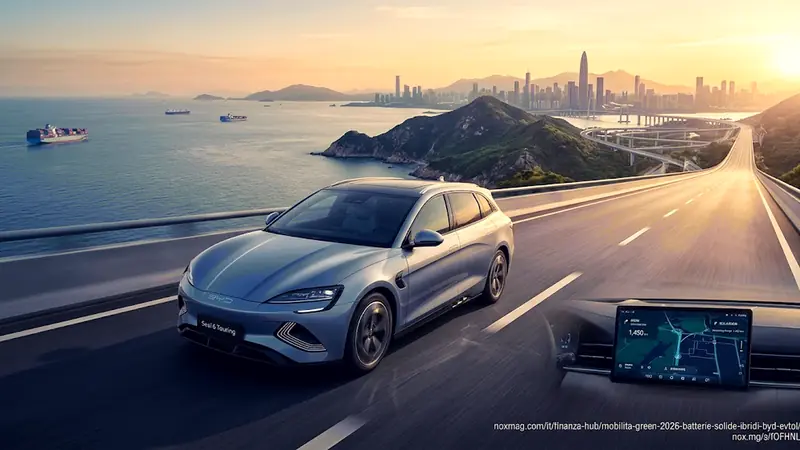
The loudest move of the month bears the stamp of BYD. The Chinese giant — at this point calling it "emerging" is almost an insult — unveiled its fifth-generation plug-in hybrid platform, the DM-i 5.0, and simultaneously launched two new models on the global market that make the company's strategy abundantly clear. The BYD Seal 6 Touring, a long-awaited estate car, and the Atto 8, a generously sized seven-seat SUV, are the vehicles carrying a technical proposition that undermines most of the arguments made by EV sceptics.
The point is not pure electric. The point is the combination: a hyper-optimised combustion engine paired with electric propulsion, in a system that allows drivers to exceed 1,400 km of real-world range on a single tank and one charge. Some models destined for the Chinese market declare peaks of over 2,000 kilometres. For anyone without a home charger — which is still the norm across much of Europe and the world — this radically changes the equation. Range anxiety, that psychological condition that has held back pure EV sales for years, no longer has much to stand on with numbers like these.

The European response to all of this is, let's be honest, still a work in progress. June saw an acceleration in plans for compact, no-frills vehicles, with the stated goal of bringing electric cars firmly below the €20,000 threshold within the next twelve to eighteen months. The Volkswagen ID.1 is the symbol of this catch-up effort. Good luck: in the meantime, Shenzhen is not waiting.
Solid-state batteries: the Holy Grail exists, but it's not on sale yet
On the technology that promises to change everything — solid-state batteries, with their ceramic or polymer electrolyte replacing the flammable liquid — June 2026 produced news stories that contradict one another, which is actually an excellent sign: it means the issue has become serious enough to generate diverging strategic positions.
On June 18, QuantumScape, the American company leading development of this technology, announced a landmark agreement with Honda to integrate its super-batteries into the Japanese manufacturer's future vehicles. Around the same time, the Japanese government unlocked $660 million in subsidies to build a dedicated domestic supply chain. Toyota and Honda are aiming to put the first commercial vehicles using this technology on the road between 2028 and 2030.
From the opposing camp, on June 23 at Summer Davos, Zeng Yuqun, chairman of CATL — the world's largest battery manufacturer, for anyone who missed it — cooled the enthusiasm with the bluntness of someone who truly knows the numbers. Solid-state, he said, sits at level 4 on a technology readiness scale that goes up to 9. Mass production is a long way off. In the meantime, LFP batteries — lithium iron phosphate, affordable and stable — will continue to do the heavy lifting for years to come.

The sky as infrastructure: cargo drones and flying taxis leave science fiction behind
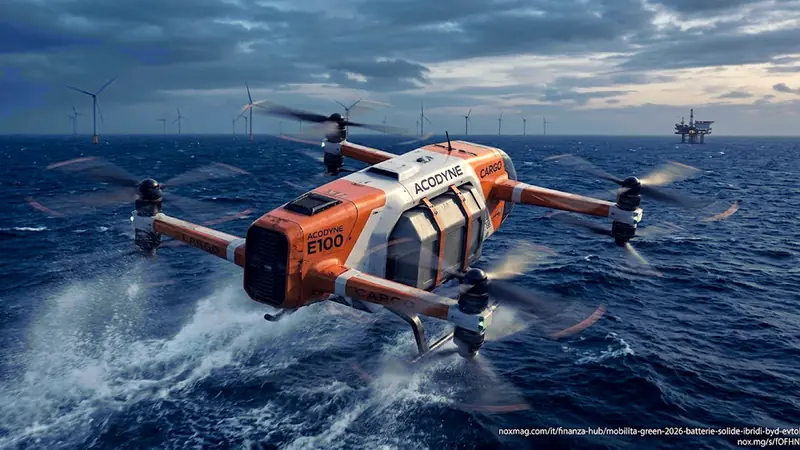
The most radical shift, however, is not happening on asphalt. It is happening at altitude. At the end of June, Northern European startup Acodyne closed a €2.5 million funding round to develop the E100 model, a fully autonomous — crewless — cargo eVTOL capable of carrying up to 500 kilograms of payload at a speed of 450 kilometres per hour. The target is not the end consumer: it is offshore platforms, maritime logistics routes, and urgent deliveries that today rely on kerosene-powered helicopters whose operating costs are simply unsustainable.
The long-term scenario was mapped out by Valour Consultancy in a study published on June 23: by 2050, nearly 7,000 commercial eVTOLs will be operational worldwide. They will not replace cars — a point worth emphasising — but they will create an entirely new segment. China is leading the race with the construction of genuine state-funded urban vertiports, while the rest of the world is still debating regulation.
The picture that emerges from this June 2026 is that of a sector that has stopped chasing a single utopian vision and has fragmented into parallel trajectories, each with its own industrial logic. High-range plug-in hybrids for mass everyday mobility, electric drones for extreme logistics, solid-state batteries as the horizon for the end of the decade. According to industry projections, by 2030 the global share of electrified vehicles — BEVs and PHEVs combined — will exceed 40% of new registrations in major markets.