Key Points
- Circular architecture at record speed: The Remise Rosa mixed-use complex, 2,500 square metres of CNC-prefabricated CLT, completed in just 5 months on a former freight rail yard in Zurich West.
- IFM Investors and Hostpoint AG: The global institutional fund acquires Green Group AG to dominate the Swiss hyperscale data centre market, while Hostpoint wins the inaugural LLB Business Award for 25 years of data sovereignty within national borders.
- Sygnum Bank, Crypto Valley unicorn: The world's first crypto-bank consolidates institutional leadership in the European blockchain market with a compliance model defined by the "constructive paranoia" of its co-founder Mathias Imbach.
Switzerland is no longer just banks and watches. It is Europe's construction site
There is a precise moment when a nation stops being a stereotype and becomes a system. For Switzerland, that moment is now — June 2026 — and it is measured in square metres of cross-laminated timber, petabytes of sovereign data, global pension capital, and a sentence spoken in German by a crypto banker that is worth more than any McKinsey report. Four seemingly unrelated pieces of news, four signals telling the same story: the Swiss Confederation is repositioning itself as the most advanced hybrid infrastructure ecosystem on the continent, brick by brick, server by server, blockchain block by blockchain block.
Zurich West burns the old and builds in pink
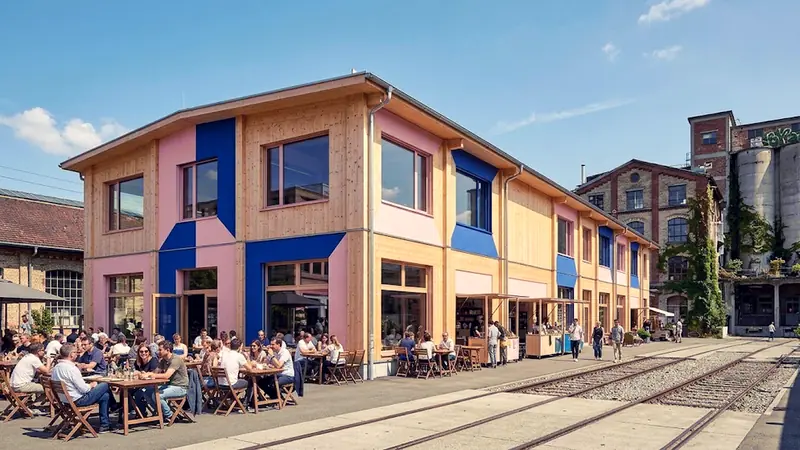
Let us start with concrete — or rather, with wood. In Zurich West, on a brownfield site that until a few years ago was an anonymous freight rail yard, architecture studio Hello Wood — founded in Budapest, operating across Europe — has just inaugurated Remise Rosa. A mixed-use complex spanning 2,500 square metres, dedicated to food and culture, whose very name betrays a precise aesthetic: lead architect Balázs Szelecsényi chose the visual contrast between natural woods and shades of pastel pink and cobalt blue — colours that, in a decommissioned industrial setting, read as a declaration of rupture.
But the real news is not aesthetic — it is engineering. The entire structure is built in CLT, Cross-Laminated Timber, cross-layered laminated wood prefabricated using CNC numerical control machinery. The components arrived on site ready for assembly, which allowed the works to be completed in just five months, eliminating material waste and drastically cutting emissions associated with the construction phase. Five months to regenerate a decommissioned industrial area into a fully functioning commercial and cultural space. It is practical proof that circular urban regeneration is not a conference concept: it is a business model that works, and it is already here.
The new brick is called a data centre
If Remise Rosa represents the visible physical infrastructure, the invisible one is growing beneath the surface with capital of an entirely different magnitude. IFM Investors, the institutional giant managing the portfolios of hundreds of global pension funds, has placed Switzerland at the centre of its European data strategy. Under the leadership of Anna Demarmels, Head of IFM Switzerland, the company confirmed the acquisition of Green Group AG, the undisputed leader in hyperscale data centres on Swiss soil.
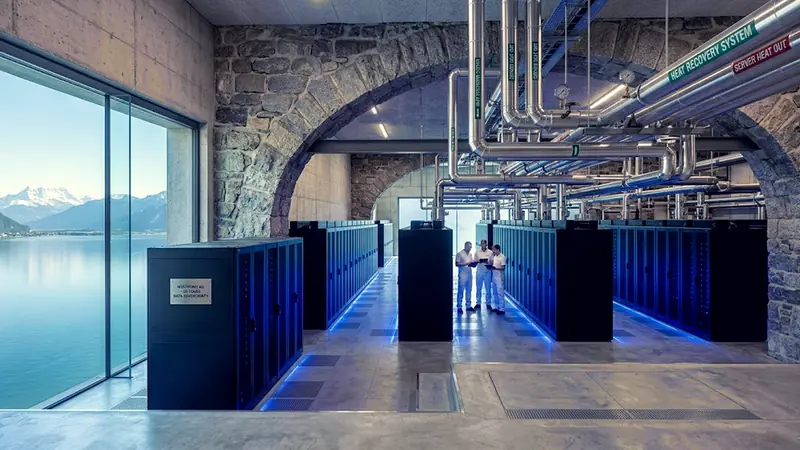
The logic is brutally simple: Switzerland has clean energy, political stability, and infrastructure that already recovers residual server heat to warm surrounding buildings. For large institutional investors, who must answer to increasingly stringent ESG criteria, this is not a technical detail but a decisive commercial argument. Digital infrastructure has become the new brick, and global pension capital understood this before European governments did.
Hostpoint wins, and traditional finance applauds
With the data centres built, the question of who controls them remains. And this is where a story enters the picture that, at the Wirtschaftsforum Obersee in Rapperswil in late June 2026, caused more of a stir than expected. The prestigious LLB, Liechtensteinische Landesbank Switzerland, presented its first-ever historic LLB Business Award. Not to an investment bank, not to a manufacturing giant. The prize — a sculpture entitled Green Gold Star, created by artist Hanna Roeckle — went to Hostpoint AG, the Swiss cloud and web hosting powerhouse co-founded by Markus Gebert.
Twenty-five years of operations, twenty-five years during which customer data never crossed a national border, never transited through American infrastructure, and was never exposed to the extraterritorial jurisdiction of the US Cloud Act. By honouring Hostpoint, LLB sent a message that the market received with clarity: data sovereignty is not an ideological value — it is the most critical infrastructure underpinning the operational continuity of European SMEs. And those who have guaranteed it for a quarter of a century deserve public recognition from the continent's most conservative financial institution.
Paranoia as method. Sygnum and the rigour worth billions
Ecological urban spaces, sovereign cloud servers, green-oriented institutional capital: the picture is still missing one element. It is missing the layer on which the financial value of the future is traded, held and transferred. It is missing the blockchain. And this is where Mathias Imbach enters — co-founder and CEO of Sygnum Bank, the world's first regulated crypto-bank, now firmly established as a financial unicorn headquartered in the heart of the Swiss Crypto Valley.

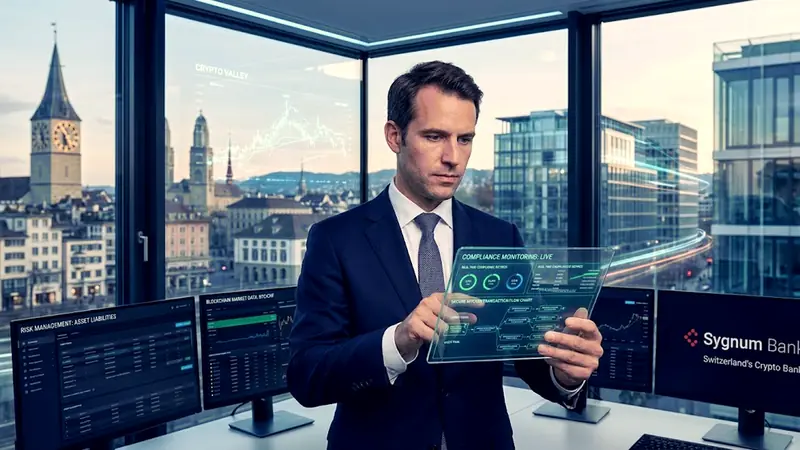
In a recent podcast interview released on the finews portal, Imbach distilled in a single sentence the philosophy that sets Sygnum apart from every other Web3 operator in Europe: "Als Unternehmer ist man immer ein bisschen paranoid. Every day I wake up and ask myself: what could go wrong?". This is not self-congratulation — it is method. While other nations and other operators approached the cryptocurrency and digital asset market with the speculative enthusiasm of those chasing the cycle, Sygnum built its growth on the risk management infrastructure typical of a traditional Swiss bank, applied at the speed of blockchain technology.
The result is an institution that today manages institutional portfolios in Bitcoin and tokenised assets with the same compliance rigour with which a Genevan private bank manages a generational fortune. Imbach's "constructive paranoia" is not a personality trait: it is the cultural product of an ecosystem — the Swiss one — that has always placed solidity above rapid growth.
A system, not four news stories
Remise Rosa, IFM Investors, Hostpoint, Sygnum. Four players, four sectors, one single direction. Switzerland in 2026 is not simply diversifying its economy: it is building, layer by layer, the most complete infrastructure ecosystem in Europe. Physical, digital, financial. Circular, sovereign, institutionally fortified. According to projections for the European data centre market, by 2028 Switzerland is set to overtake the Netherlands as the third continental hub for green processing capacity, with a volume of infrastructure investment estimated at over four billion euros over the next twenty-four months.