Key Takeaways
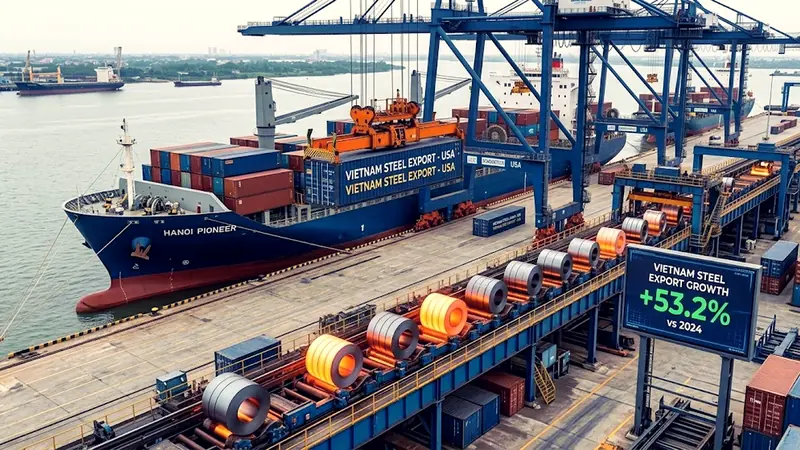
- Steel exports to the US: Growth exceeding 50% throughout 2024, signaling structural penetration into one of the world's most heavily protected, high-barrier markets.
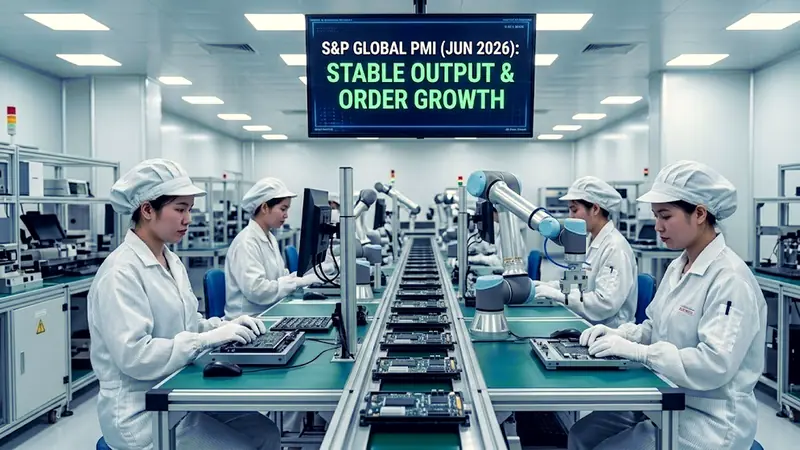
- S&P Global PMI Index (June): Vietnam's manufacturing sector records sustained expansion in both industrial output and new order intake, defying global demand volatility.
- Strategic positioning: Vietnam consolidates its role as Southeast Asia's primary manufacturing and technology hub, validated by the TMX report and S&P Global data.
Vietnam Is No Longer a Plan B
Forget the developing-nation narrative of a country waiting for the scraps of globalization. Vietnam has reinvented itself — loudly, and with hard numbers to back it up. In 2026, a cross-analysis of the latest macroeconomic indicators delivers an unambiguous picture: Hanoi is no longer a fallback destination. It has become a structural node in global supply chains (the interconnected networks linking production to end markets), a manufacturing and technology hub that major international corporations can no longer afford to overlook.
The global supply chain realignment — accelerated by years of geopolitical tension and the urgent need to reduce dependence on a single production hub — has turned Southeast Asia into a battleground for investment attractiveness. In that contest, Vietnam is winning. Not by accident, not by luck, but through a convergence of structural factors that the data certifies with a precision that is hard to dispute.
The TMX Report: Operational Efficiency as a Systemic Weapon
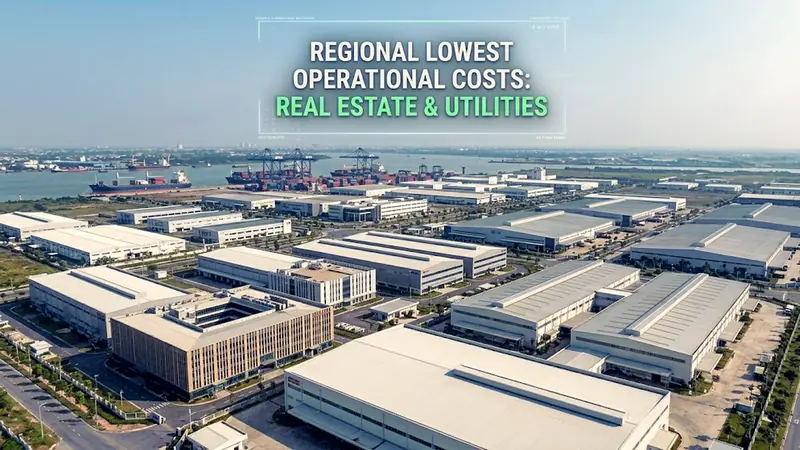
The recent TMX report places the first pillar of Vietnam's regional supremacy squarely on the table: radical optimization of operational costs. The country continues to post some of the lowest overhead burdens across the entire Asian region, maintaining a clear gap over direct competitors including Thailand, Malaysia, and Indonesia. But reducing this to a wages argument alone would be a mistake.
Vietnam's systemic competitiveness spans a far more complex ecosystem: contained industrial lease costs, accessible utilities, and a fiscal framework engineered with surgical precision to attract foreign capital. For multinationals operating in advanced electronics and Information Technology, this cost base is not an accounting footnote. It is the enabling factor that allows companies to scale production, compress go-to-market timelines (the time from product development to market launch), and grow operating margins in measurable terms. It is no surprise that Vietnam has become the destination of choice for China Plus One strategies (the corporate logic of diversifying production away from a single geography), adopted by major corporations to avoid being held hostage to a single manufacturing geography.
S&P Global Confirms the Resilience: The June PMI Does Not Lie
A cost advantage alone is worth nothing if the productive infrastructure is fragile. This is precisely where S&P Global data for June 2026 enters the picture — and it does so with authority. The PMI Index — the Purchasing Managers' Index (the most reliable real-time barometer of manufacturing health) — confirms that Vietnam's industrial sector is maintaining a solid growth trajectory. Both productive output and new order intake display a stability that, against a global backdrop marked by volatility and sudden demand contractions, carries all the hallmarks of a positive anomaly.
This continuity is not an abstract statistic. For global corporations that must guarantee uninterrupted production flows to their end clients, it means one concrete thing: Vietnam's subcontracting network (the ecosystem of local suppliers feeding larger manufacturers) is capable of absorbing high volumes without buckling. It means that supply chain disruption risk — one of the worst nightmares for any chief operating officer — is being mitigated at a structural level. The country's industrial system has reached an operational maturity that international markets recognize and price accordingly.

The Steel That Is Breaking Into the American Market
If a single data point were to encapsulate the maturation of Vietnamese industry, it would be this: steel exports to the United States grew by more than 50% over the course of 2024. A number that requires little commentary, but one that deserves to be read in its full depth.
Breaking into the North American steel market is not a trivial operation. It is one of the most protected and regulatory-demanding markets on the planet, with rigorous quality standards and a tariff system (import duties designed to shield domestic producers) that has historically functioned as a selective barrier. The fact that Vietnam's heavy industry breached that wall with double-digit growth exceeding 50% simultaneously certifies two things: the technical capacity to comply with stringent regulations, and the price competitiveness required to hold its own on an international scale.
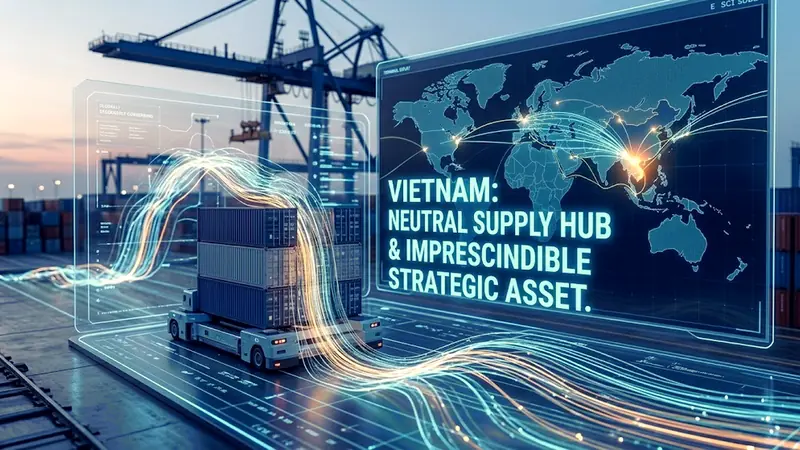
But there is a third reading — perhaps the most relevant from a geostrategic standpoint. This result demonstrates the effectiveness of Hanoi's economic diplomacy, which has successfully navigated the complexities of tariff barriers by positioning Vietnam as a reliable commercial partner perceived as neutral. A neutrality that, at this particular moment in history, is worth as much as any proprietary technology.
Not an Option. An Indispensable Asset
The intersection of minimized operational costs, manufacturing stability certified by robust PMI data, and record penetration into high-barrier markets produces a conclusion the market has already internalized: Vietnam is no longer a diversification option. It is an indispensable strategic asset for any organization seeking to guarantee profitability and security across its global value chains. Those who have not yet grasped this are already behind.