Key Points
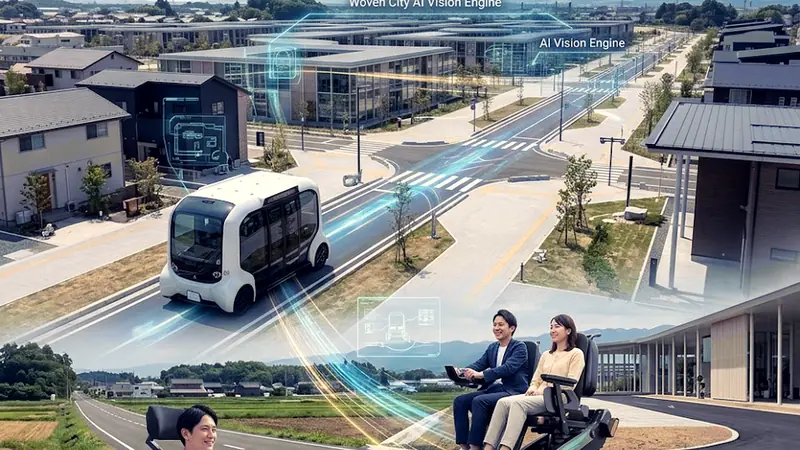
- Woven City operational: Toyota's urban laboratory "Phase 1" in Susono has welcomed its first human residents and research teams, with the Woven City AI Vision Engine digital nervous system unveiled at KAKEZAN 2026.
- Amble One and XSTO X12: A 450 kg, 15 kW electric buggy with 100 km of range at €20,000, and an all-terrain robot with a hybrid wheel-track chassis and self-levelling up to 40 degrees at $28,000.
- Three markets reshaped: Smart urban infrastructure, luxury slow mobility and advanced robotic accessibility converge in 2026 as the three pillars of the new contextual mobility industry.
The world moves differently. And it has no more excuses.
Forget the old playbook. For years the electric mobility sector played a single game: take a petrol car, strip out the combustion engine, pack it with batteries and call it the future. Game over. In 2026, anyone still thinking that way is watching the wrong film. The industry has made a qualitative leap that is no longer about propulsion but about something far deeper: the relationship between the vehicle, the environment and the human body. Three stories, three scales, one single direction.
Toyota is building a city. No, seriously.

Let's start at the top — the macro level, the most ambitious gesture any car manufacturer has ever made in recent history. Toyota didn't launch a new SUV. It built a city. Woven City, at the foot of Mount Fuji in Shizuoka Prefecture, on the site of the former Higashi-Fuji plant, has entered its operational Phase 1. The first residents — known as Weavers — are living there. Startups and research labs are working there. It is no longer an architectural rendering on a PowerPoint slide: it is asphalt, code and real people.
Woven City's urban planning overturns every conventional logic by separating flows into an interwoven grid: dedicated lanes for fast autonomous vehicles, mixed pathways for pedestrians and micro-mobility, and exclusively pedestrian trails. But the true exposed nerve is the software architecture. At the KAKEZAN 2026 event — "multiplication" of capabilities, for those unfamiliar with Japanese — Toyota unveiled the Woven City AI Vision Engine, a foundational model acting as a real-time urban nervous system: it collects visual and environmental data, anticipates movements, coordinates traffic and collaborates with the integrated Integrated ANZEN System to prevent accidents before they happen. Alongside this, the Woven City Infra Hub & Data Fabric enables autonomous vehicles such as the e-Palette pods, traffic lights, robots and energy grids to communicate securely within a single ecosystem.

The message is brutally clear: Toyota is no longer a car manufacturer. It is a mobility ecosystem provider. Woven City is the most radical proof of concept ever attempted at a real urban scale, where artificial intelligence is not tested in a laboratory but coexists with flesh-and-blood human beings, every single day. Anyone who thinks this will not change the way we design cities over the next twenty years is simply not paying attention.
Luxury means no doors. Welcome to slow mobility.
Let's step down a scale. Leave the infrastructure behind and step into the cabin — or rather, the absence of one. Adrien Roose, the entrepreneur who had already revolutionised urban mobility with Cowboy e-bikes before stepping away following the brand's acquisition by French group ReBirth, is back. And he has returned with a startup called Amble, launched in Lisbon alongside industrial designer Julian Hoenig — whose CV includes Apple and Audi — and hospitality entrepreneur José António Uva.
Their product is called the Amble One. It is road-legal. It weighs 450 kilograms. It has a 15 kW motor, a self-limited top speed of 65 km/h and an 11 kWh battery delivering 100 kilometres of range, rechargeable from a standard domestic socket. So far it might sound almost unremarkable. Then you actually look at the thing: no doors, no digital screens, none of that technological cacophony that has turned modern cabins into the waiting rooms of a hi-tech hospital. The materials — aluminium, canvas, leather, and even a cork steering wheel — are designed to age well, to develop a natural patina over time. A vehicle that wears the marks of use the way a quality object should.
The starting price is around €20,000. The first 2027 deliveries are already allocated to the luxury hospitality B2B sector: coastal resorts, rural estates, venues where slowness is the product being sold. Private consumers will have to wait until 2028. Roose has a name for what he is doing: Slow Mobility. Removing technological anxiety to physically reconnect the passenger with the environment. A segment that until yesterday did not exist on paper, and that today already has a waiting list.
The robot that climbs stairs and asks no one for help.
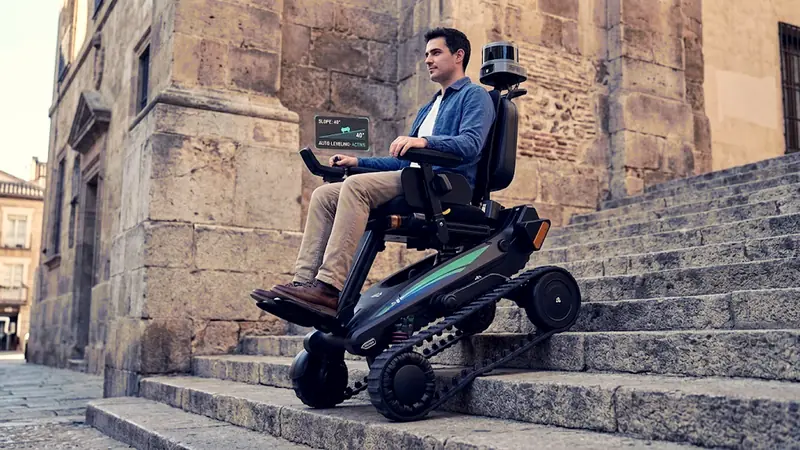
Third scale — the most personal and perhaps the most disruptive. XSTO Mobility has unveiled the X12, and calling it an electric wheelchair would be both a technical and a conceptual insult. The official definition is Embodied Mobile Robot. Positioned in a premium bracket at around $28,000, the X12 is equipped with LiDAR sensors and artificial intelligence that scan three-dimensional space in real time. When the system detects a flight of stairs or a significant obstacle, it automatically deploys a track system capable of climbing up to 30 steps per minute and crossing gaps and obstacles without the user having to touch a thing.
The real showstopper is called Mengchong, the 360-degree self-levelling system. On a 40-degree incline, the seat physically compensates for gravity in real time, keeping the passenger perfectly horizontal relative to the ground. The risk of tipping over — and above all the fear of tipping over — is eliminated at the root. For decades, accessibility has meant slowly adapting cities: ramps, lifts, architectural barriers removed brick by brick. XSTO has chosen the opposite direction: it is the vehicle that adapts to the world, not the world that adapts to the vehicle.
The global mobility aids market is worth over $6 billion and is growing steadily as populations age in developed countries. With the X12, XSTO aims to redefine the entire premium category by 2028, the year in which the first commercial-scale deliveries in Europe and North America are expected.