
Key Takeaways
- African electric mobility: Afreximbank committed $125 million to Spiro, which closed a record $215 million funding round to scale battery-swapping (rapid battery exchange at dedicated stations) operations across Kenya, Uganda, Nigeria and Rwanda.
- Digital sovereignty: South Africa launches BrainSAT Satellite Services, a state-controlled joint venture with UAE-based Space42, built on YahClick and Thuraya infrastructure, as a publicly governed alternative to foreign private operators.
- Space-based fire detection: Greece is the world's first country to operate a national anti-wildfire satellite constellation: four CubeSats (small standardized satellites, roughly briefcase-sized) developed by OroraTech with ESA support, capable of identifying hotspots as small as 4 meters in diameter in real time.
Africa stops being just a mine: Afreximbank and Spiro redraw the electric mobility map
For decades, the African continent has extracted critical minerals to fuel other nations' energy transitions. Lithium, cobalt, manganese: raw resources shipped out and returned, when returned at all, as finished products. The recent agreement between the Africa Export-Import Bank (Afreximbank) and Spiro marks an explicit and structural shift. The institution committed $125 million in direct investments and credit lines to the company, which simultaneously closed a record funding round of $215 million. The capital will be deployed to aggressively expand the battery-swapping (rapid battery exchange at dedicated stations) network across key markets: Kenya, Uganda, Nigeria and Rwanda.

Spiro's operational model is called Battery-as-a-Service: the battery is decoupled from the vehicle purchase price and converted into a subscription service. The customer buys the two-wheeled vehicle at a reduced upfront cost and accesses rapid-swap stations to replenish range within minutes. The result is a lower barrier to entry for electric mobility and a recurring revenue stream for the company. The logic mirrors software-as-a-service (subscription model applied to digital products), applied here to energy hardware.
But Afreximbank's vision extends well beyond distributing electric scooters. With African lithium reserves projected to represent 15% of global production by 2028, the stated objective is to build an integrated supply chain on the continent: from raw mineral processing to cell assembly, through to recycling and the management of distributed energy networks via the charging stations themselves. No longer raw material exporters, but technology manufacturers. The scale of the ambition is unprecedented for the sector.

BrainSAT: South Africa chooses the public route to satellite connectivity
On the telecommunications front, South Africa has made a move with few precedents on the continent. The government of Pretoria signed a strategic partnership with UAE-based company Space42, establishing BrainSAT Satellite Services, a new state-controlled entity dedicated to satellite connectivity. The system will leverage YahClick infrastructure for high-speed broadband and the Thuraya network for mobile communications.
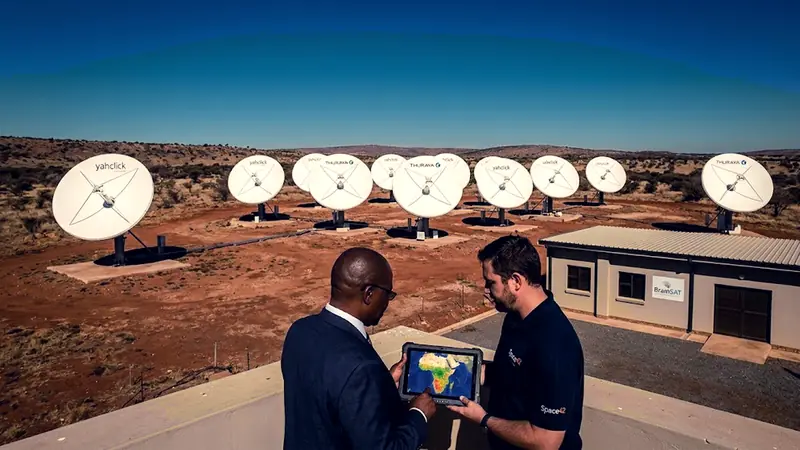
The choice of a public ownership model is deliberate. In a market where private operators like Starlink are advancing rapidly, bringing with them recurring regulatory tensions over operating licenses and user data management, South Africa opts for a model that keeps control of critical infrastructure within national borders. BrainSAT is the central pillar of the National Satellite Communication Strategy and goes beyond connecting rural and remote areas to the internet. The project's architecture aims to deliver resilient public services, stimulate local digital economies and train engineers and specialist technicians domestically, reducing long-term dependence on foreign expertise. National data sovereignty (state control over citizens' data flows) is explicitly listed among the program's objectives.
Hellenic Fire System: four CubeSats and an artificial intelligence against Greek wildfires
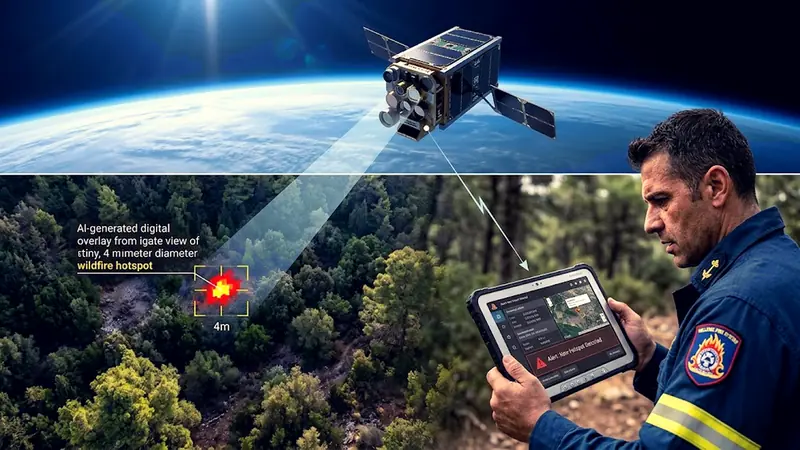
Greece is officially the first country in the world to deploy a national satellite constellation dedicated exclusively to wildfire detection. The system, designated the Hellenic Fire System, was developed by Munich-based startup OroraTech with technical support from the European Space Agency (ESA) and funded through the European Recovery and Resilience Facility (EU post-pandemic investment fund). The first four CubeSats of the program were launched into orbit in May 2026 aboard a SpaceX Falcon 9 rocket.
The satellites are the size of a carry-on suitcase. Their operational capabilities are in an entirely different category. Each unit is equipped with state-of-the-art infrared and thermal sensors, but the decisive component is the software. Through an edge computing (onboard data processing without ground relay) architecture and Artificial Intelligence models processed directly on board, the CubeSats can identify hotspots with a minimum diameter of four meters in real time. The system is also trained to distinguish anthropogenic heat sources, such as solar panels and industrial plants, from genuine fire ignitions, drastically reducing false positives. Alerts are transmitted to firefighting crews within minutes of detection.
For a territory like Greece, fragmented across hundreds of islands and characterized by highly flammable Mediterranean vegetation, response speed is a variable that directly determines the scale of damage. The operational model developed in Athens is already drawing interest from other countries exposed to comparable risks. The convergence of low Earth orbit (LEO), thermal sensors and predictive algorithms could become a standard architecture for environmental emergency management at global scale.
A shared matrix: technology as an instrument of strategic independence
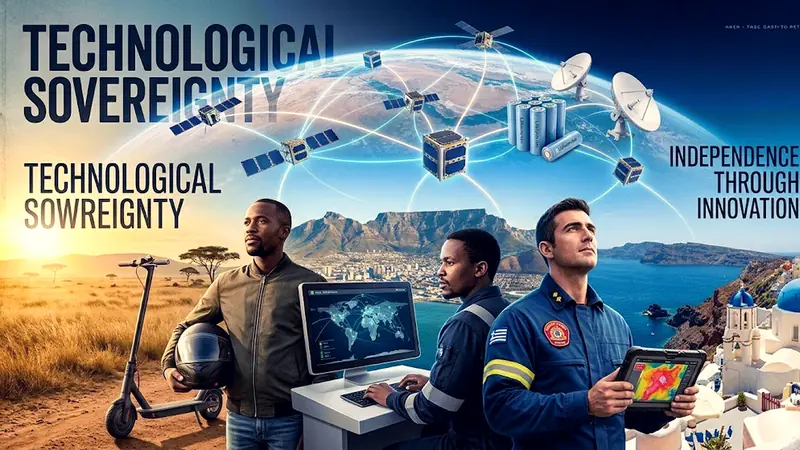
The three scenarios described — Africa's battery supply chain, South Africa's public satellite network, Greece's anti-wildfire constellation — share more than advanced technology. They share a precise political logic: the use of innovation not as a consumer product, but as sovereignty infrastructure. Electric mobility, satellite telecommunications and artificial intelligence applied to environmental monitoring are being treated by these actors as strategic levers to secure operational independence, systemic resilience and control over their own resources and data. 2026 registers this convergence as a structural fact, not as an emerging trend.