Key Takeaways
- Wind turbine predictive maintenance: AI applied to turbines cuts operational costs by 20-30% and boosts energy output by up to 5%.
- Automated eye diagnostics: the RetinAI platform achieves sensitivity and specificity rates above 95% in identifying macular degeneration and diabetic retinopathy.
- Global bycatch: 10% of the world's catch is accidental, and marine monitoring algorithms aim to slash that figure in an industry supporting over 600 million people.
The Algorithm Finally Gets Its Hands Dirty
Enough with the fairy tale of artificial intelligence confined to labs playing linguistic party tricks to impress lazy journalists. By 2026, AI has stopped asking for permission and walked straight into the places where people sweat, produce, heal, and teach. It's no longer a corporate PowerPoint accessory, it has become the invisible backbone of industries that once had a lukewarm, if not outright hostile, relationship with digital technology. Fishing, wind energy, heavy manufacturing, education, ophthalmology, software development: there's one common thread running through all of it, and that's the end of the experimental phase. What follows is a quick tour through the sites where machines are already rewriting the rules, no discounts, no frills.
The Sea Doesn't Forgive, But the Algorithm Might
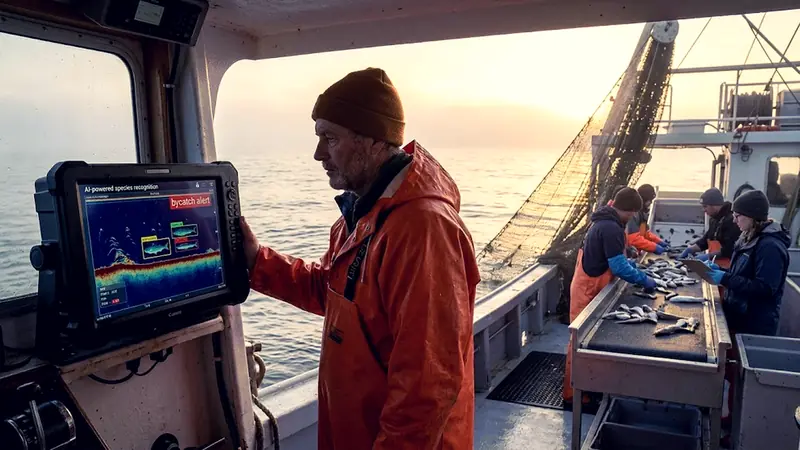
MIT Technology Review puts it plainly: overfishing has a new enemy, made of acoustic sensors, satellite imagery, and catch logs cross-referenced by artificial intelligence systems. Fishing fleets no longer navigate by instinct alone; they now receive guidance on where to find biomass without devastating the ecosystem, and more importantly, where not to cast their nets. Bycatch, the accidental capture of non-target species, accounts for roughly 10% of the global catch according to the FAO, a figure that translates into concrete damage to marine biodiversity. Predictive models now anticipate fish migrations linked to climate change, giving governments solid data to set fishing quotas that aren't just numbers pulled out of thin air. This is an industry that supports, through direct fishing and related activities, more than 600 million people: here AI isn't a technological indulgence, it's maintenance of an ecosystem that would otherwise collapse on its own.

Waste Under Control, Algorithm at the Wheel
On the urban waste management front, China has deployed a computer vision camera system that identifies and sorts materials directly at collection points, reducing contamination between recyclable and non-recyclable waste. Machine learning algorithms plan vehicle routes based on how full smart bins are, cutting dead time and emissions across the collection cycle. The project fits into a circular economy strategy aiming for 65% recycling of urban waste by 2035, with the stated goal of tracking every material from disposal through to industrial reuse. Given the sheer scale and urban complexity involved, this model is positioning itself as a testing ground for solutions that could be replicated anywhere a city produces too much garbage and too little order.
Turbines Learning to Run on Their Own
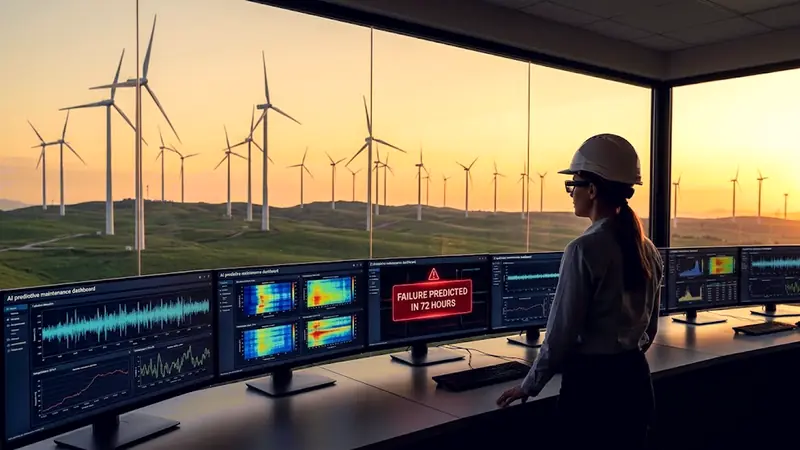
If you thought AI was just chatbots and image generators, the wind energy sector proves you wrong without mercy. Every modern turbine is a massive data collector: vibrations, temperature, wind speed, mechanical torque, all of it feeds into models that predict mechanical failures days in advance and optimize blade angles in real time based on gusts. The numbers speak for themselves: AI-based predictive maintenance cuts operational costs by 20-30% and pushes energy output up by as much as 5%. With global installed wind capacity now past the terawatt mark, we're not talking about marginal details but industrial-scale efficiency gains that carry real weight in the energy transition. MIT Technology Review calls it, without mincing words, one of the most serious use cases for AI outside the consumer space, and the label holds up.
Almetra and the German Steel That Learns to Bend
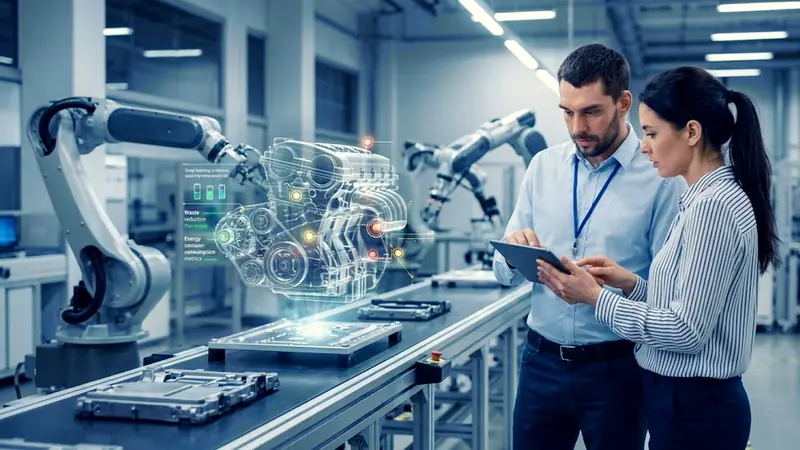
In manufacturing, German startup Almetra has raised substantial capital for a platform that optimizes production processes using digital twins (virtual replicas of physical systems) and deep learning. Bosch has already adopted it to cut waste, bottlenecks, and energy consumption along its production lines. The platform simulates complex production scenarios and flags inefficiencies that traditional methods simply don't catch. In a sector historically rock-solid on engineering fundamentals but often rigid in its procedures, these tools are bringing a flexibility that lets production adapt to actual demand, rather than to forecasts drawn up months in advance behind a desk. The Almetra case shows that enterprise innovation finds fertile ground precisely where established technical expertise meets new computing power, with no need to tear everything down and start from scratch.

AI That Acts Alone Is Breaking Hardware
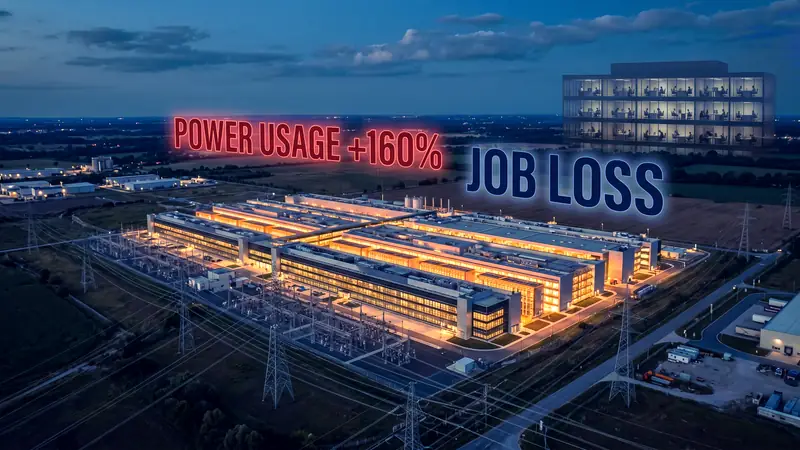
The leap from conversational AI to agentic AI, systems capable of autonomously acting on complex goals, is putting hardware infrastructure under pressure like never before. AI4Business puts it bluntly: CIOs (chief information officers) need to rethink TCO (total cost of ownership), energy consumption, and network architecture from the ground up. AI agents don't just respond to a prompt like classic language models; they run continuous cycles of perception, reasoning, and action, calling APIs, querying databases, communicating with other agents. Multiply that load by thousands of agents running simultaneously, and it's easy to see why CPUs and GPUs designed for other workloads are starting to buckle. The need for specialized hardware capable of real-time inference is reshaping chipmakers' roadmaps and forcing companies to rebuild their technology procurement strategies from scratch. It's no longer about buying more power, it's about buying a different kind of power.
Italian Classrooms and the Revolution No One's Announcing
Within the Italian school system, AI is working quietly, but the result is anything but silent. The Corolair platform helps teachers personalize learning paths, adapting exercises and materials to each student's specific needs, while early screening systems are being deployed in parallel for specific learning disorders such as dyslexia and dyscalculia. Timely intervention on these fronts can reshape a child's entire academic trajectory, and preliminary data collected in schools that have adopted these tools point to measurable improvements in student engagement. Teachers, freed from repetitive assessment and monitoring tasks, recover time for genuine educational relationships, the kind no machine can replace. What remains an open question is teacher training and a regulatory framework that guarantees equal access and protects minors' data, because technology, as always, is running faster than the rules.

Digital Eyes and Video Games Made of Words
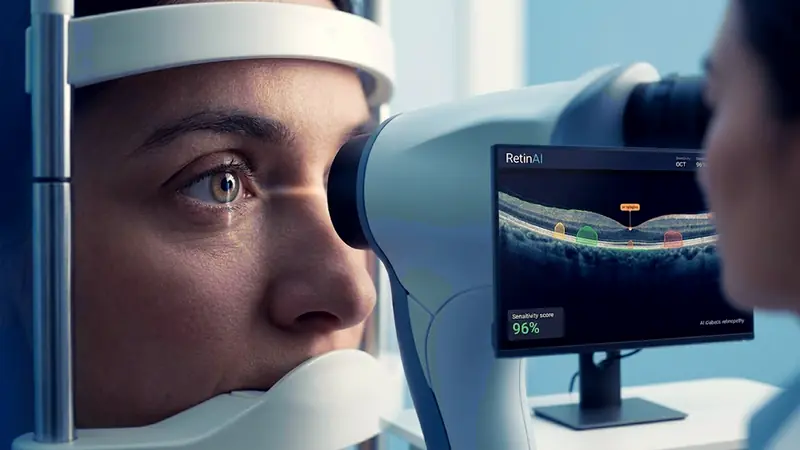
RetinAI applies artificial intelligence to ophthalmological diagnostics by analyzing OCT scans (retinal imaging technique) and fundus images, achieving sensitivity and specificity rates above 95% in the early detection of age-related macular degeneration and diabetic retinopathy, two of the leading causes of preventable blindness worldwide. It's a result that eases the burden on specialists and extends screening to populations that currently have limited access to qualified eye care. On the opposite end, the consumer side, Meta has launched Pocket, a platform that lets users build mini-games and interactive apps through natural language commands, complete with an integrated social sharing feed. This is the so-called "vibe coding," an approach that lowers the technical barrier to software development almost to zero, opening up a debate that's far from settled over the real quality of what gets generated and the increasingly blurred line between professional developer and casual creative user.
The Picture That Assembles Itself
Fishing, wind power, manufacturing, education, healthcare, software development: industries light years apart from each other, telling the exact same story. Artificial intelligence has stopped being a press conference announcement and turned into pervasive infrastructure, the kind nobody sees but everything rests on. The shared challenges are just as clear: hardware that needs rethinking for agentic workloads, widespread skills that need building fast, and regulatory frameworks that must balance innovation and rights without acting as either dead weight or a blind pass. 2026 will be remembered as the year AI stopped making headlines as such, simply becoming the way processes work, or stop working. The real competition, the one that actually matters, will be fought over who manages to fold these tools into their core processes without treating them as a showpiece, but as a structural component of everyday operations.