Key Points
- Geometry of Meaning: The Geneva Graduate Institute published a study in 2026 formalizing the shift from symbolic translation to "geometric translation" of animal vocalizations through multidimensional vector spaces.
- GrimACE (ETH Zurich) and EMANS 2028: An open-source infrared system for objectively detecting pain in mice, currently being trained on 11 additional species; the European Veterinary Big Data Strategy is an official pillar of the EMA framework by 2028.
- Veterinary diagnostics market: Commercial tools such as ScopioVet and Zoetis VETSCAN IMAGYST are already operational in clinics, signaling a commercial maturity of the AI-veterinary sector well beyond the experimental phase.
Machines Are Learning to Listen to Animals. And It's Not Science Fiction
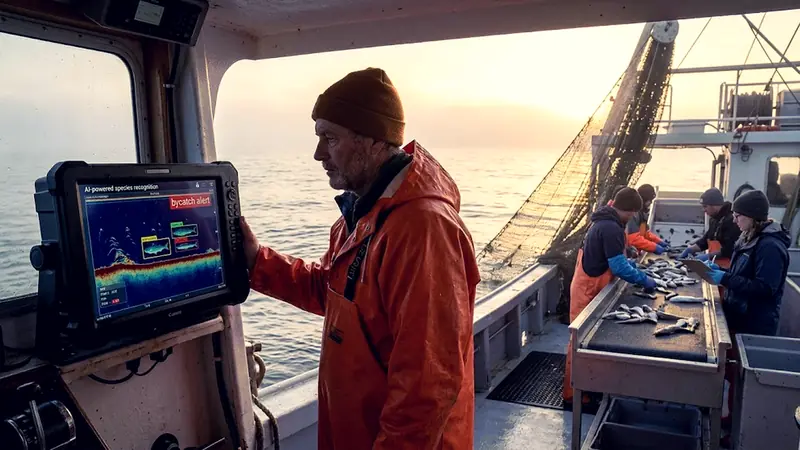
Welcome to 2026, where artificial intelligence has stopped looking exclusively at human beings and has begun turning its algorithms toward the rest of the animal kingdom. This is not a romantic twist from a nature documentary. It is a silent, methodical revolution, funded by elite academic institutions and technology giants, that is reshaping veterinary medicine, bioacoustics, and even the way we conceive of the concept of cross-species communication. And like every revolution worth its name, it arrives without much fanfare.
Let's start from the most philosophically unsettling angle of the matter. For decades, research into animal communication operated under an implicit and fundamentally arrogant assumption: to understand what an animal "says," you had to teach it to speak like us. Symbols, schemas, human codes implanted into non-human brains. The result? Partial, distorted, fundamentally useless data. In 2026, the Geneva Graduate Institute published a study that draws a line under this approach, formalizing what in academic circles is already being called the paradigm shift of the "Geometry of Meaning." The idea is as simple as it is brutally effective: instead of forcing a sperm whale or a crow to learn our grammar, their vocalizations are mapped onto multidimensional vector spaces and the recurring structures are sought out — the statistical patterns, the internal geometry of their communicative system. No human-animal dictionary. No anthropocentric projection. Just mathematics applied to sound.
Organizations such as the Earth Species Project and Project CETI are already operating on this frontier, training artificial intelligence models on enormous archives of vocalizations to find that hidden geometry. We do not yet know what those patterns "mean." But for the first time in history, we know they exist and that we can measure them. It is a beginning worth more than thirty years of chimpanzees trained in sign language.

Pain Doesn't Lie. Now Neither Does the Machine
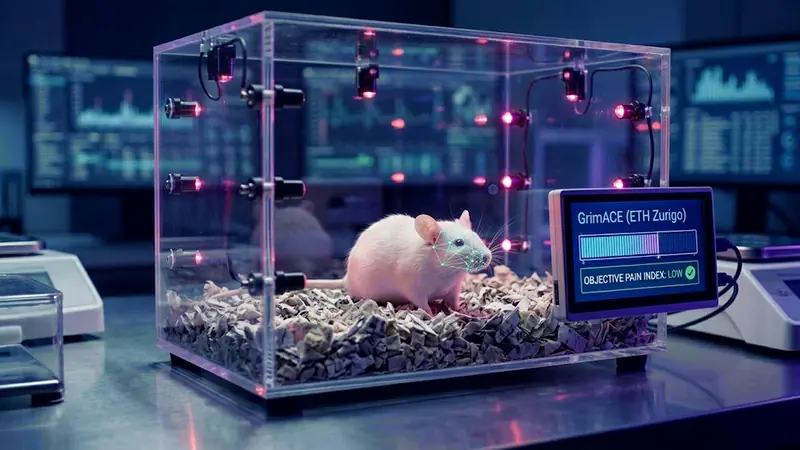
If bioacoustics represents the most speculative front, the automated assessment of animal pain is the most immediately concrete one — and, in some respects, the most urgent. In April 2026, the Swiss Federal Institute of Technology Zurich (ETH Zurich) made GrimACE public, an open-source system that deserves far more attention than it has received. Its operation is surgical: a booth equipped with infrared cameras records in real time the posture and facial micro-expressions of laboratory mice — eye narrowing, ear and whisker position — and a Computer Vision and Machine Learning algorithm analyzes every frame to objectively detect pain signals. Zero human interpretation, zero visual bias from an operator who may have slept four hours or who is simply distracted that day.
The Grimace Scale, the animal grimace scale on which GrimACE is built, has existed for years as a manual tool. The problem has always been the human element: two different researchers looking at the same image can give different assessments. GrimACE eliminates this variable. And it does not stop at mice: analogous models are currently being trained on at least 11 additional species, including cats, sheep, horses, and cattle. Within a few years, a farmer or a veterinarian will be able to know with objective certainty whether an animal is suffering before symptoms even become visible. This is not abstract progress. This changes protocols, changes ethics, changes laws.
In Clinics It's Already a Reality. The Market Doesn't Wait for Philosophers
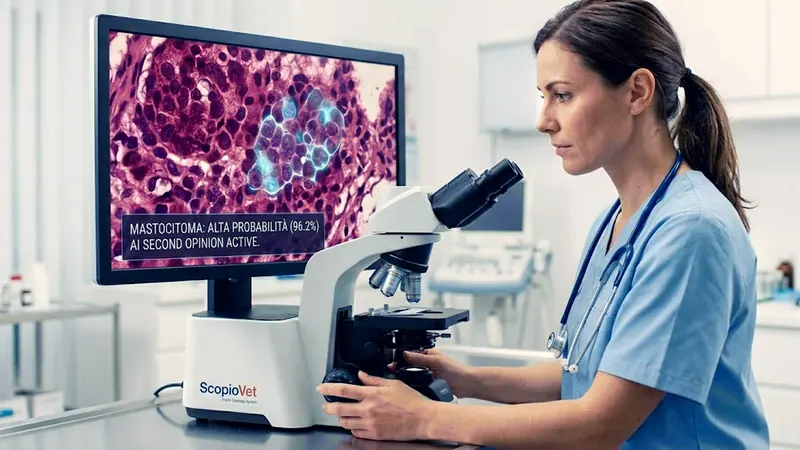
While academia deliberates over geometries and vector spaces, the commercial market has already made its moves. AI-based veterinary diagnostics is not a future promise: it is a shelf already fully stocked. Tools such as the ScopioVet Digital Cytology System and Zoetis VETSCAN IMAGYST are operational in veterinary clinics and leverage Deep Learning techniques — specifically Semantic Segmentation and Super-Resolution — to analyze cellular preparations under a microscope in a matter of minutes. Inflammations, mast cell tumors, tissue abnormalities: the algorithm highlights them instantly, acting as a second expert opinion that is always available, always objective, and never tired. The veterinarian makes the final call, but with a computational safety net that ten years ago was science fiction.
On the ecological monitoring front, Wildlife Insights — developed with the support of Google — uses convolutional neural networks trained on millions of photographs to identify species in camera traps with a precision that far surpasses human capability in terms of speed. For livestock and domestic animals, wearable and IoT devices continuously track data such as rumination and mobility, building an individual baseline for each animal: any minimal statistical deviation is intercepted by the algorithm before a symptom becomes clinically visible to the naked eye.
Brussels Has Already Signed Off. 2028 Is the Deadline, Not the Starting Point
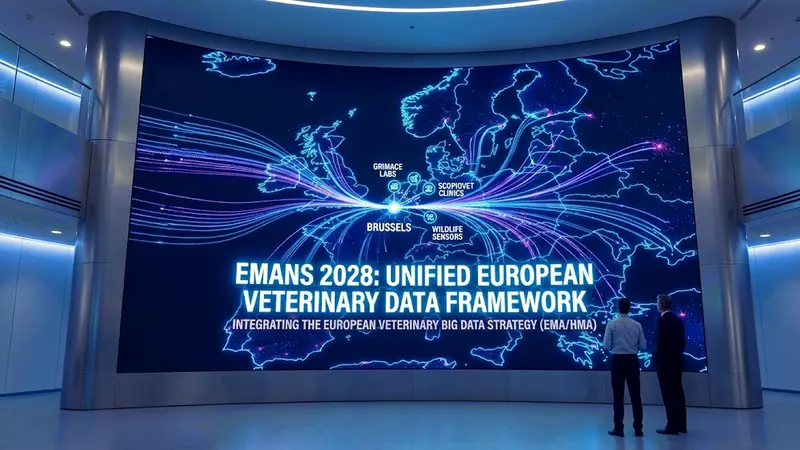
The European Union is not watching from the sidelines. The European Medicines Agency (EMA) and the HMA have adopted EMANS 2028, the strategic plan that explicitly integrates the European Veterinary Big Data Strategy. The stated objective is to standardize the management of veterinary data at a continental level, ensure interoperability between national systems, and establish binding ethical guidelines for the use of artificial intelligence in veterinary medicine by 2028. This is not a vague statement of intent: it is an institutional document with deadlines, operational pillars, and assigned responsibilities. The European market for AI-based animal diagnostics and monitoring will operate within that regulatory perimeter. Those who are not compliant by that date will be left out.
By 2028, according to the projections integrated into EMANS, all veterinary data collected in member states will be required to comply with common interoperability standards: a wealth of information that, once aggregated and made accessible to algorithms, will likely represent the largest animal biological dataset ever built in Europe.