Key Points
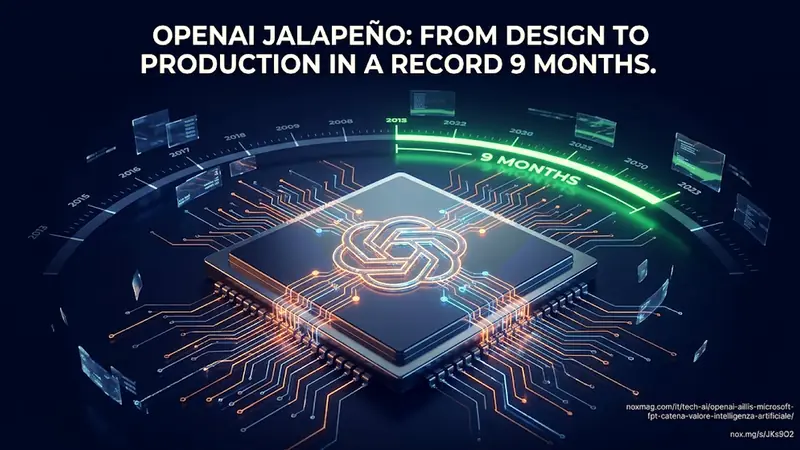
- Jalapeño in 9 months: OpenAI and Broadcom developed a custom ASIC chip for LLM inference in just 9 months from design to production, the fastest cycle in history for this hardware category.
- Aillis and pharyngeal diagnostics: Aillis's deep learning models identify infections by analyzing throat images exclusively, detecting visual biomarkers such as follicles on the posterior pharyngeal wall.
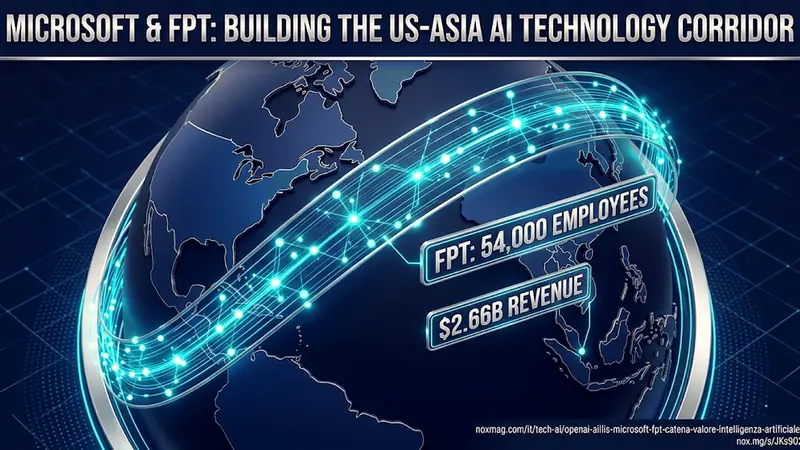
- Microsoft-FPT and Vietnam: FPT, with 54,000 employees and $2.66 billion in revenue, consolidates the US-Asia axis; Vietnam is certified by Microsoft as having the highest concentration of AI talent in Southeast Asia.
The Value Chain Nobody Has Told You About in Full
There is a wrong way to read this week's tech news: treating each story as a separate event, sealed in its own compartment. The OpenAI chip, the Japanese medical startup, the deal between an American giant and a Vietnamese powerhouse. Different stories, different directions, different markets. Wrong. What is happening is one single thing, and if you cannot see it in its entirety, you are missing the most important point of the year on artificial intelligence.
Let's start from the foundations, from the raw concrete on which everything else is built. OpenAI has stopped being a software company dependent on Nvidia. It did so quietly, through a project developed together with Broadcom and Celestica that goes by the codename Jalapeño. This is not an update. It is not an optimization. It is a blank-slate architecture, designed from scratch, engineered exclusively for Large Language Model inference — including the specific workloads of models such as GPT-5.3-Codex-Spark. What makes competitors' stomachs tighten is the timeline: nine months. From initial design to production. Nine months for an ASIC — an Application-Specific Integrated Circuit — that normally requires multi-year development cycles. It is the absolute record for this hardware category, and it is not a symbolic milestone.
The implications are brutal and concrete. Focusing on inference means maximizing throughput, slashing latency, cutting energy consumption. Translated into business terms: TCO, Total Cost of Ownership, collapses. OpenAI stops paying the toll to Nvidia and begins building gigawatt-scale data centers — by 2026 — with a level of computational autonomy that until yesterday was science fiction. The operational model mirrors that of Google with its TPUs and Amazon with Trainium. The difference is that OpenAI did it in nine months where others took thirty. This reshapes the cost structure of AI for everyone who uses it, not just for those who produce it.
When AI Looks Down Your Throat and Sees What the Doctor Cannot

Lowering computational cost is not an academic exercise. It serves a precise purpose: enabling applications that until yesterday were economically unsustainable. And this is where Aillis enters the picture — the startup founded by physician Sho Okiyama — and the story becomes as concrete as a hospital emergency waiting room.
Aillis has trained deep learning models capable of diagnosing infections — including influenza — by analyzing throat images exclusively. The algorithm identifies specific visual biomarkers: follicles on the posterior pharyngeal wall, structures that an untrained human eye simply does not see, or sees poorly, or interprets with clinically unacceptable margins of error. The machine processes them with a predictive accuracy that justifies the strategic investment from partners such as Tauns.
The point is not to replace doctors — that is the lazy narrative that generalist journalists use to generate headlines. The point is to transform the clinical role: from diagnostic executor to consultant. The doctor stops being the one who looks and interprets, and becomes the one who decides and acts on a superior quality information base. The ROI of AI in healthcare, in this model, runs through advanced visual sensors coupled with predictive models. Not chatbots. Not automated clinical record summaries. Diagnoses.
FPT, Microsoft and the US-Asia Technology Corridor Moving Billions
Sovereign hardware, precision vertical applications: all of this must reach businesses. And to do so, integrators are needed that operate at industrial scale, with the capacity to simultaneously speak the language of Western enterprises and that of Asian markets. Microsoft has known this for some time, which is why the consolidation of its partnership with FPT — the Vietnamese IT giant with over 54,000 employees and revenues exceeding $2.66 billion — is not an ordinary commercial agreement. It is the construction of a stable technology corridor between the United States and Asia, with FPT deeply integrating Microsoft's generative AI and cloud solutions into its own services for enterprises and governments.
The capillary penetration of the Asian market that Microsoft achieves through FPT would be impossible to replicate with its own structures within the timelines and at the costs the market imposes today. It is the logic of the network: you do not build everything yourself, you rely on those who know the territory better than you do.
Vietnam Is No Longer Where You Send Low-Cost Work
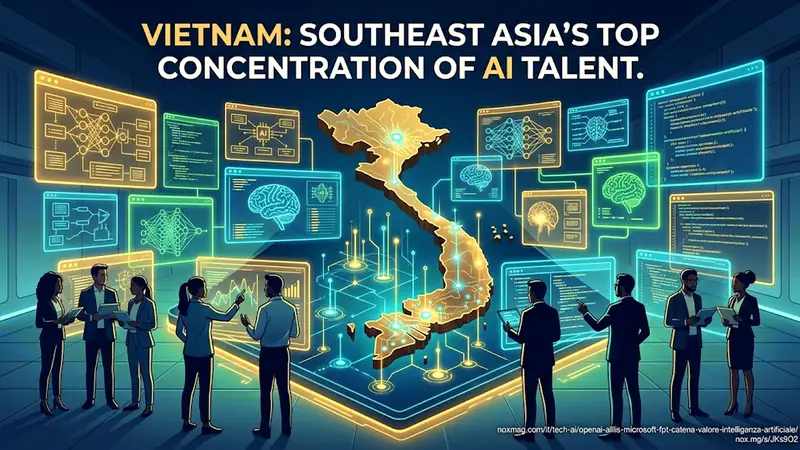
And the territory, in this case, is extraordinarily fertile. Analyses certified by Microsoft identify Vietnam as the country with the highest concentration of AI talent in the entire Southeast Asian region. This is not an impression. It is the result of massive skilling programs — including Ready4AI&Security — designed to train millions of ASEAN citizens, with a specific focus on AI literacy in Vietnam. The country has definitively moved beyond the low-cost outsourcing hub role that was stitched onto it for twenty years. Today it is a center of excellence in research and development, with a pool of engineers specialized in machine learning and cybersecurity that Western companies are already courting with growing aggressiveness.
The chain is complete: Jalapeño's custom chips drive down inference costs and make complex models like those of Aillis sustainable; Microsoft and FPT build the global distribution infrastructure; Vietnam supplies the human capital to run the whole system at full capacity. By 2028, according to industry projections, the AI market in Southeast Asia will exceed $45 billion. The value chain taking shape today will determine who captures that figure.