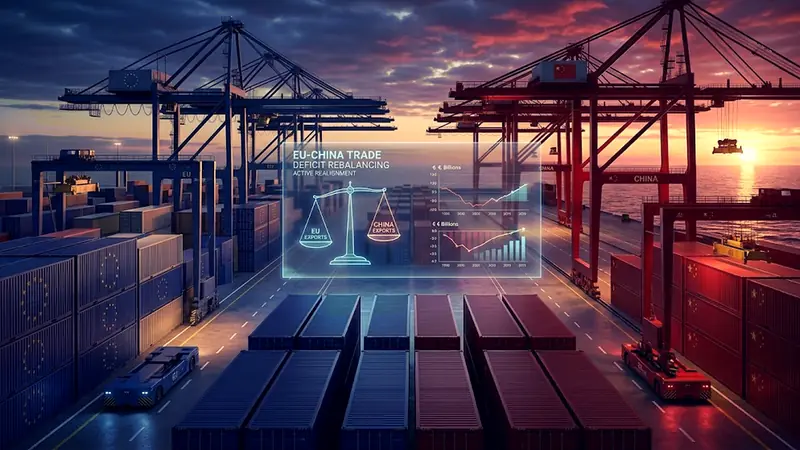
Key Takeaways
- Record growth: Global humanoid robot shipments reached 19,100 units in the first half of 2026, up 272% year-over-year.
- Chinese dominance: AGIBOT overtook Unitree as the world's top manufacturer, holding a 44% share against Unitree's 31%; together they control 75% of the market.
- Falling costs: Production cost (BOM) dropped from 500,000 yuan to 140,000-200,000 yuan, with Unitree selling its R1 model at $5,900.
Shipments on an exponential curve
Global humanoid robot shipments hit roughly 19,100 units in the first half of 2026, compared with 5,100 in the same period of 2025. If the current pace holds, the market would close the year at 60,000 units, with estimated revenue of $1.6 billion. 2025 had already posted a 508% year-over-year jump according to IDC, with 18,000 units shipped and $440 million in revenue. The research firm forecasts that annual shipments will surpass 510,000 units by 2030, with a compound growth rate near 95%.
AGIBOT overtakes Unitree as demand concentrates
Manufacturers based in one region accounted for over 97% of global shipments in the first half of 2026, while that same region absorbed more than 85% of global demand. In the manufacturer rankings, AGIBOT overtook Unitree to become the world's top producer with 8,400 units shipped, equal to 44% of the market, compared with Unitree's 5,900 units and 31% share. Together the two companies control 75% of the global market.
Production costs in freefall
The BOM cost of these humanoid robots dropped from 500,000 yuan in early production stages to a range of 140,000-200,000 yuan, driven by core component localization exceeding 90%. Unitree sells its G1 model for $13,500 and its R1 model for $5,900 — a price point considered unreachable before 2029 back in 2024. Unitree's research-grade H1 model costs around $90,000, while the competing Agility Digit model tops $100,000.
Factories and warehouses, not homes
Over 70% of first-half 2026 shipments went to industrial and commercial applications — manufacturing, logistics, warehousing, inspection — compared with 50% a year earlier. Figure AI robots work shifts at the BMW plant in Spartanburg. Agility Digit is deployed in Amazon fulfillment centers. Apptronik Apollo units are deployed at Mercedes-Benz. Tesla's Optimus units, however, remain — by Elon Musk's own admission — "mainly for learning, not production tasks."
The gap between claimed numbers and real production
Tesla has never published an official production figure for Optimus, and Figure AI counts only a few hundred verified units. Unitree's G1 model surpassed 11,000 cumulative units produced by mid-2026. AGIBOT, with a lineup ranging from full-size bipeds to wheeled versions, has already begun active deployments in the United Kingdom and Germany.
Foundation models and technical limits
The NVIDIA Isaac GR00T platform, launched in 2025, is changing the programming approach: instead of coding every single movement, operators now give natural-language instructions that the AI translates into action. Vision-Language-Action models and world models are progressing rapidly, though they remain in relatively early stages. Reliability, manipulation accuracy, and safety remain the main technical barriers, while restrictions on foreign-made robots could limit the overseas expansion of certain vendors.
Projections toward 2035
According to Omdia, the market could reach 2.6 million units annually by 2035; Interact Analysis instead estimates revenue up to $15 billion. Real demand will remain concentrated, holding over 65% of the share by that date, backed by government investment, subsidies, and state-enterprise procurement. 2026 marks the shift of humanoid robots from prototype to mass-produced industrial machine, at costs considered out of reach just two years ago.