Key Takeaways
- Record debut: the Northstar prototype was unveiled after just nine months of development, during the Machina Summit in Paris.
- Proprietary technology: the robot runs on Real-Time Learning, an observation-based learning system that replaces action-by-action programming.
- $40 million funding round: the startup UMA, founded by former Tesla engineer Rémi Cadène, is targeting pilot programs in logistics, manufacturing, and healthcare by the end of 2026.
A Former Optimus Engineer Founds UMA in Paris
UMA (Universal Mechanical Assistant), a humanoid robotics startup, has launched in Paris under the leadership of Rémi Cadène, who spent five years as a Tesla engineer and served as the first research engineer on the Optimus program. Cadène left Tesla to become lead developer of LeRobot, the open-source library on Hugging Face that surpassed 12,000 stars on GitHub in a single year.

The Founding Team
A group of founders with standout technical backgrounds has formed around Cadène: Pierre Sermanet, a former Google DeepMind researcher, takes on the role of Chief Science Officer; Simon Alibert, formerly of Hugging Face and a co-developer of LeRobot, serves as CTO; Robert Knight, a designer specializing in robotic hands, holds the title of Chief Robot Officer. Investors and advisors include Yann LeCun, Thomas Wolf, Xavier Niel, and Nico Rosberg.

Northstar: Design and Technology
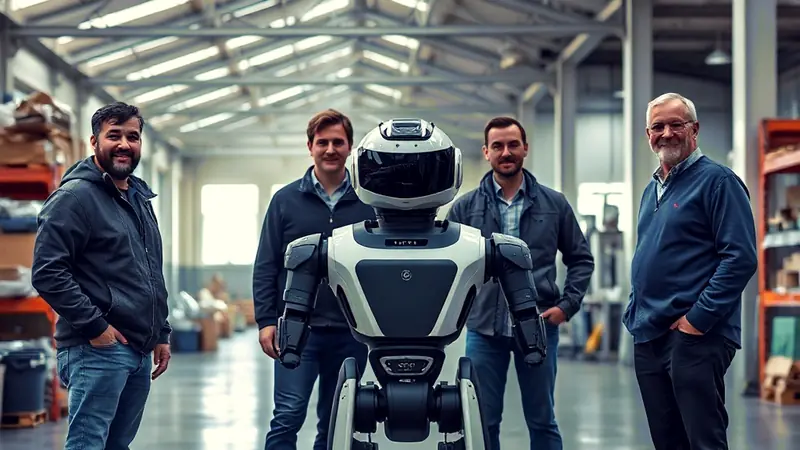
The Northstar prototype weighs roughly 40 kg, is built for repairability, and features a deliberately non-anthropomorphic design: a neutral visor in place of a face, a soft outer shell, and exposed mechanical joints. Its control system relies on Real-Time Learning: an end-to-end neural network connected directly to onboard cameras determines actions and movements without relying on pre-programmed sequences. In one demonstration video, the robot corrects its posture and regains balance after an external push; in another, two robotic arms sort deformable cables, slippery bottles, and fragile boxes, adapting in real time to manual interference.
A Europe-First Strategy
UMA is steering its commercial development toward the European market, setting itself apart from competitors such as Tesla, Figure, and Unitree. The company points to labor shortages driven by the continent's aging population as its core rationale. It has already opened discussions with roughly 50 potential clients and plans to launch pilot programs in logistics, manufacturing, and healthcare throughout 2026.
Funding and Structure
Having emerged from stealth in December 2025, UMA is currently negotiating a seed round of approximately $40 million, backed by Greycroft, Relentless, and Red River West. The company employs around 30 people across Paris, London, and Switzerland. Its stated goal is to deliver a working proof of concept by the end of 2026.